

Healthcare Funnel Optimization: Your 2026 Guide

Healthcare funnel optimization is the process of improving every stage of a patient’s journey, from first awareness through booking and long-term retention, to increase the number of leads who become paying, returning patients. In the industry, you’ll also hear this called patient journey optimization or healthcare conversion rate optimization (CRO). Whatever you call it, the concept is the same: stop letting potential patients fall through the cracks. This guide covers what is healthcare funnel optimization, the key stages and metrics that matter, proven tactics like A/B testing and friction reduction, and the practical first steps you can take right now to improve patient acquisition at your practice.
What is healthcare funnel optimization and why does it matter?
Healthcare funnel optimization is defined as the systematic improvement of each stage in the patient acquisition funnel to reduce drop-off and increase the rate at which prospects become booked, engaged patients. The “funnel” metaphor captures the reality that many people enter at the top with general health questions, but far fewer make it to a scheduled appointment. Your job is to widen that funnel at every stage.
This matters because most practices bleed patients silently. A prospective patient searches for a cardiologist, lands on your website, gets confused by a clunky booking form, and books with someone else. That’s revenue that never walked in. Funnel stage analysis identifies exactly where prospects stop progressing, so you can fix the right problem instead of guessing.

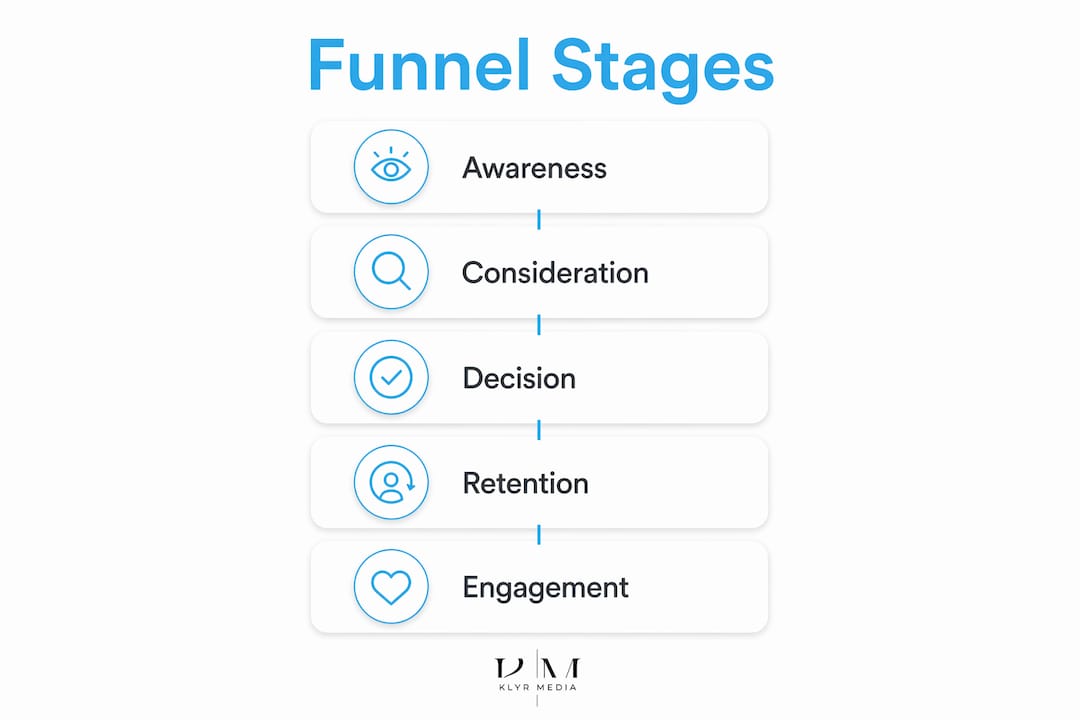
The standard framework for the healthcare marketing funnel runs through four stages: awareness, consideration, decision, and retention. Each stage has its own drop-off risks and its own set of fixes. Treating them as one undifferentiated mass is one of the most common and costly mistakes in healthcare marketing.
What are the key stages of the healthcare marketing funnel?
Each stage of the funnel represents a different mindset your prospective patient is in. Match your strategy to that mindset, and conversion rates climb. Miss the match, and you lose them to a competitor who got it right.
Here is how each stage works in practice:
- Awareness: The patient realizes they have a health need and starts searching. This is where Google Business Profile rankings, local SEO, and educational blog content do the heavy lifting. If you are not visible here, you do not exist to that patient.
- Consideration: The patient is comparing options. They are reading reviews on Healthgrades, checking your website, and looking at your service pages. Trust signals, clear messaging, and fast load times determine whether they stay or bounce.
- Decision: The patient is ready to book. This is where your booking flow, form design, and call-to-action placement either close the deal or kill it. Friction here is fatal.
- Retention: The patient has visited once. Now the goal is to keep them coming back and referring others. Automated follow-up systems, appointment reminders, and post-visit communication all live in this stage.
Improving the entire patient experience from early awareness through decision and ongoing engagement keeps patients progressing when they are ready to act. Focusing only on the bottom of the funnel, where patients are already close to booking, leaves a massive amount of potential growth untouched.
Pro Tip: Map your current patient journey on paper before touching any technology. Walk through every touchpoint from a Google search to a confirmed appointment. You will find leaks you never knew existed.
Which metrics and kpis should you track to optimize your funnel?
Metrics are where most healthcare practices get lost. They track website traffic and call volume, then wonder why growth stalls. The metrics that actually drive decisions are the ones tied to conversion and profitability.
| Metric | What It Measures | Why It Matters |
|---|---|---|
| Patient Acquisition Cost (PAC) | Total marketing and sales spend divided by new patients acquired | Shows the true cost of each new patient |
| Cost per Lead (CPL) | Ad or channel spend divided by leads generated | Identifies which channels are efficient |
| Lead-to-Patient Conversion Rate | Percentage of leads who become booked patients | Reveals funnel health at the decision stage |
| PAC-to-Lifetime Value (LTV) Ratio | Patient acquisition cost compared to long-term revenue per patient | Determines whether acquisition spend is profitable |
| Channel-Specific Attribution | Revenue or bookings traced back to a specific source | Prevents misleading blended averages |
Patient acquisition cost is calculated as total marketing and sales spend divided by new patients acquired, with lead-to-patient conversion and PAC-to-LTV ratios serving as the primary decision metrics. A low PAC means nothing if those patients only visit once. The ratio to lifetime value is what tells you whether your acquisition strategy is actually building a sustainable practice.
Calculating true lead-to-patient conversion requires tracking downstream outcomes beyond initial contact, classifying leads by outcomes like booked visits, no-shows, or insurance mismatches. Most practices stop at the form fill. That is a vanity metric. The real number is how many of those form fills turned into a chair in your exam room.
PAC-to-LTV and service line attribution require granular, channel-specific data collection to avoid misleading blended averages. If you blend your Google Ads cost with your organic referral cost, you will never know which channel is actually profitable.
Pro Tip: Set up separate tracking for each acquisition channel in Google Analytics 4 or a healthcare CRM like Salesforce Health Cloud. Blended averages hide your best and worst performers.
What are the most effective funnel optimization tactics for healthcare?
Once you know where patients are dropping off, you have a target. Here are the tactics that move the needle most in healthcare settings.
-
Run A/B tests on your highest-traffic pages. CTA optimization and landing page improvements yield high win rates in healthcare. Test your button text (“Book Now” vs. “Request an Appointment”), your hero headline, and your form length. Multi-step forms often outperform single-step forms because they feel less overwhelming.
-
Fix your booking flow before anything else. Reducing friction across scheduling, referrals, and communications increases the share of patients who complete bookings. A patient who hits a broken calendar widget or a five-minute intake form at 10 PM will not come back tomorrow.
-
Optimize the page just before conversion. The final service page before conversion is often the highest return-on-investment target for healthcare CRO because it reduces variables and improves test accuracy. This is the page where the patient is one click away from booking. Make it count.
-
Personalize by patient segment. A 65-year-old Medicare patient and a 28-year-old looking for urgent care have completely different concerns. Segment your landing pages, email follow-ups, and ad copy accordingly. Generic messaging converts at generic rates.
-
Prioritize post-click experience over ad spend. Conversion rate improvements at post-click funnel steps reduce cost per acquisition even with stable click volumes. Spending more on ads while your landing page leaks is like filling a bucket with a hole in it.
For a deeper look at how website design affects conversion, the layout of your forms and CTA placement are often the fastest wins available.
How does healthcare funnel optimization differ from standard marketing funnels?
Healthcare funnels are not just B2C funnels with a medical logo slapped on. The differences are structural and they change how you optimize.
| Standard Marketing Funnel | Healthcare Marketing Funnel |
|---|---|
| Single decision-maker in most cases | Often involves family members, insurance, and referrals |
| Purchase decision is low-stakes | Health decisions carry high emotional and financial weight |
| Trust built through reviews and price | Trust built through credentials, compliance, and bedside manner |
| Conversion is a transaction | Conversion is a relationship with ongoing care episodes |
| Vanity metrics like traffic are common KPIs | Profitability metrics like PAC-to-LTV are the real KPIs |
Sustainable patient growth requires tracking conversion rates and profitability, not just lead volume or traffic. A practice that generates 500 leads a month but converts only 3% is in worse shape than one generating 100 leads at 25% conversion. Volume without conversion is just noise.
The multi-stakeholder nature of healthcare decisions also means your funnel needs to address trust at every stage, not just at the point of sale. A patient researching a specialist may spend weeks in the consideration stage before acting. If your content and follow-up systems go quiet after the first touchpoint, you lose them.
Optimizing across the full funnel yields better patient growth because healthcare decisions involve trust and multiple stakeholders. This is why an end-to-end healthcare marketing approach consistently outperforms narrow, bottom-funnel-only campaigns.
What practical steps can you take to start optimizing your patient funnel?
You do not need a massive budget or a full marketing team to start. You need a clear sequence and the discipline to follow it.
- Audit your existing funnel first. Pull data from Google Analytics 4, your CRM, and your scheduling software. Find the step where the largest percentage of prospects drop off. That is your first fix, not your last.
- Build reliable attribution before scaling anything. If you cannot trace a booked patient back to the channel that brought them in, you are flying blind. Set up UTM parameters, call tracking with tools like CallRail, and CRM tagging before you spend another dollar on ads.
- Fix operational bottlenecks before running experiments. Operational delays like scheduling friction and slow lead response times must be resolved before scaling marketing experiments. A CRO test on a landing page means nothing if the booking system behind it takes 48 hours to confirm an appointment.
- Invest in referral and organic channels first. Google Business Profile optimization, referrals, and insurance directories often offer the best patient acquisition cost to lifetime value ratio compared to paid media. These channels cost less and convert at higher rates because trust is already partially established.
- Run one controlled A/B test at a time. Test your highest-traffic service page first. Change one variable, run it for at least two weeks, and measure conversion rate change. Then move to the next test. Stacking multiple changes at once makes it impossible to know what worked.
For practices looking to reduce drop-off at the scheduling stage specifically, website optimization strategies focused on booking flow are a strong starting point.
Key takeaways
Healthcare funnel optimization works when you measure conversion and profitability at every stage, fix operational friction before scaling ads, and treat patient acquisition as a long-term system rather than a one-time campaign.
| Point | Details |
|---|---|
| Define your funnel stages | Map awareness, consideration, decision, and retention before making any changes. |
| Track the right metrics | Use PAC, CPL, lead-to-patient conversion rate, and PAC-to-LTV as your core KPIs. |
| Fix friction before scaling | Resolve booking flow and intake delays before running A/B tests or increasing ad spend. |
| Optimize the pre-conversion page | The service page just before booking is your highest-impact CRO target. |
| Invest in organic and referral channels | Google Business Profile and referrals typically deliver better PAC-to-LTV than paid media alone. |
The measurement discipline most practices skip
Here is what I have seen consistently: practices invest in ads, get leads, and then declare the campaign a failure because appointments did not spike. The real problem was never the ad. It was the booking flow, the 48-hour callback time, or the intake form that asked for insurance information before the patient even knew if they liked the practice.
Healthcare funnel optimization is not a marketing project. It is an operational and marketing project running in parallel. The practices that grow fastest are the ones that treat every patient touchpoint as a conversion variable, not just the ad click. They measure what happens after the click with the same intensity they apply to the click itself.
The other thing I would push back on is the obsession with lead volume. More leads into a broken funnel just means more wasted spend. Fix the funnel first. Then scale. That sequence sounds obvious, but most practices do it backwards because scaling feels like action and fixing feels like admitting something is broken.
Healthcare marketing succeeds as a revenue function when organizations invest in compliant data infrastructure and measure revenue incrementally, not just impressions. That is not a technology problem. It is a discipline problem. And discipline is free.
— Opinly
How Klyrmedia helps you build a funnel that actually converts
If your practice is generating interest but not filling your schedule, the problem is almost always somewhere in the funnel, not in the market. Klyrmedia works exclusively with healthcare providers, independent pharmacies, and medical clinics to identify exactly where patients are dropping off and fix it.
From HIPAA-compliant website design that removes friction at the booking stage to healthcare SEO services that put you in front of patients at the awareness stage, Klyrmedia builds the full system. No generic marketing hacks. No guesswork. Just a structured approach to patient acquisition that compounds over time. If you are ready to stop losing patients to a leaky funnel, Klyrmedia is the team to call.
FAQ
What is healthcare funnel optimization in simple terms?
Healthcare funnel optimization is the process of improving each step a patient takes from first discovering your practice to booking and returning for care. The goal is to reduce the number of people who drop off before becoming a patient.
What metrics matter most for funnel optimization in healthcare?
Patient acquisition cost (PAC), lead-to-patient conversion rate, and PAC-to-lifetime value ratio are the three most important metrics. Traffic and lead volume alone do not indicate whether your funnel is profitable.
How is a/b testing used in healthcare funnel optimization?
A/B testing compares two versions of a landing page, CTA, or form to see which converts more patients. Common tests include button text, form length, and hero messaging on service pages.
Why do healthcare funnels need a different approach than standard marketing funnels?
Healthcare decisions involve multiple stakeholders, high emotional stakes, and trust factors that standard consumer funnels do not account for. Optimization must address trust and compliance at every stage, not just at the point of conversion.
Where should a healthcare practice start with funnel optimization?
Start by auditing your current funnel data to find the highest drop-off point, then fix operational friction like slow booking confirmation before running any paid media or CRO experiments.

