

What Is End-to-End Healthcare Marketing?

Most healthcare marketers are running campaigns, not systems. They launch a Google Ads push here, send a patient newsletter there, and call it a marketing strategy. That fragmented approach is exactly what keeps patient acquisition costs high and retention rates low. Understanding what is end-to-end healthcare marketing means recognizing that every touchpoint, from the first search query to the post-visit follow-up text, needs to work as a connected, measurable whole. This guide breaks down the framework, the data requirements, the compliance realities, and the practical steps to actually build it.
Table of Contents
- Key takeaways
- What end-to-end healthcare marketing actually means
- The patient journey is your marketing map
- Data infrastructure and HIPAA compliance
- Attribution models for complex patient journeys
- How to implement healthcare marketing end-to-end
- My honest take on where most teams go wrong
- How Klyrmedia can build this for your practice
- FAQ
Key takeaways
| Point | Details |
|---|---|
| Definition matters | End-to-end healthcare marketing connects every patient touchpoint into one measurable system, not just a collection of channels. |
| Compliance is foundational | HIPAA compliance must be built into your data architecture from the start, not added as an afterthought. |
| Attribution is the hard part | Only 1% of healthcare organizations have advanced attribution models that tie marketing spend to actual patient revenue. |
| Data infrastructure first | The biggest barrier to effective healthcare marketing is not creativity. It is compliant, connected data infrastructure. |
| AI accelerates everything | AI-driven marketing systems can reduce planning and execution timelines from 18 months down to 6 months with measurable ROI gains. |
What end-to-end healthcare marketing actually means
So what is end-to-end marketing in healthcare, really? It is not a technology platform or a campaign type. It is a philosophy and an operating model that covers the entire patient lifecycle, from the moment someone searches “urgent care near me” to the automated recall message that brings them back six months later.
Traditional B2B or B2C marketing cycles are mostly linear. A prospect sees an ad, clicks, buys, done. Healthcare is nowhere near that simple. You are dealing with multi-stakeholder decisions, where a patient, their primary care physician, their insurer, and sometimes a family member all influence the path to care. You are managing longer decision cycles, offline touchpoints like physician referrals and front-desk calls, and strict privacy regulations that do not apply to most other industries.
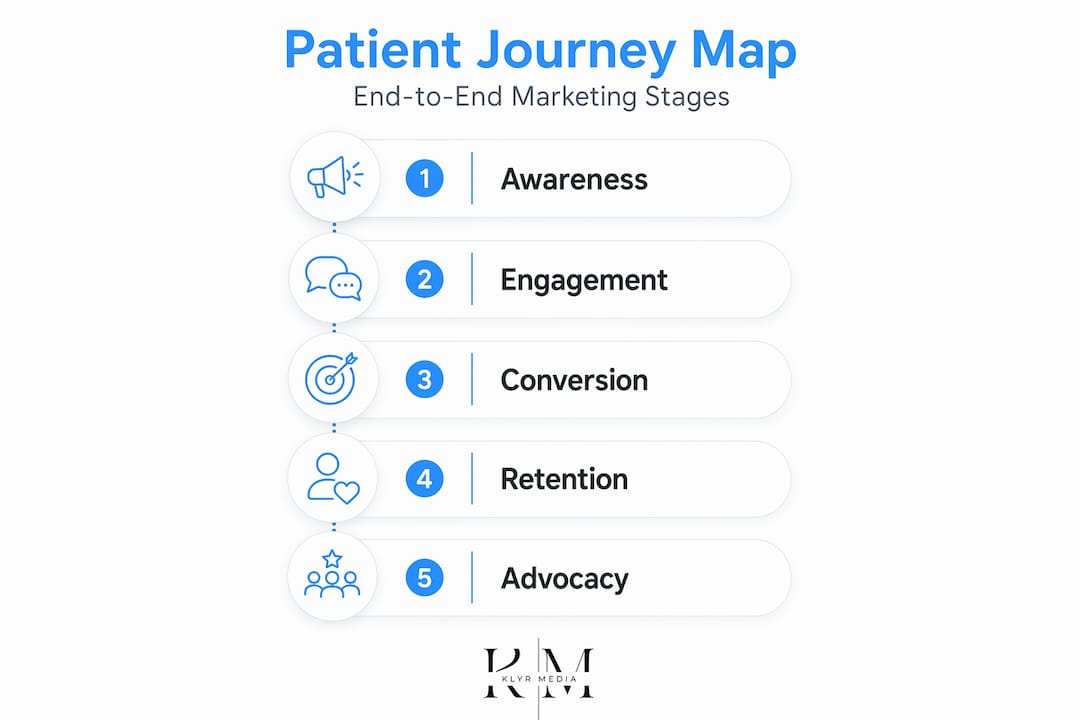
End-to-end marketing in healthcare integrates five core functions: initial awareness and research, multi-channel engagement across digital and offline touchpoints, campaign execution with compliant data handling, continuous measurement and attribution, and post-visit retention and lifetime value optimization. Miss any one of those, and you have a gap that leaks patients.
| Factor | Healthcare marketing | General B2B/B2C marketing |
|---|---|---|
| Decision timeline | Weeks to months; influenced by clinical urgency | Days to weeks; driven by budget cycles |
| Buying committee | Patient, physician, insurer, caregiver | Individual buyer or small procurement team |
| Attribution complexity | Offline clinical data must merge with digital signals | Primarily digital, easier to track |
| Regulatory environment | HIPAA, state privacy laws, FDA (pharma) | GDPR, CCPA for some sectors |
| Channel mix | Search, referral networks, EHR data, in-office | Search, social, email, events |
Pro Tip: If you are still measuring success by click-through rates alone, you are measuring the wrong thing. Start tying every channel back to booked appointments and patient lifetime value.
The patient journey is your marketing map
Here is something most marketing teams get wrong. They build campaigns around channels instead of around patient behavior. The patient journey is not a funnel. It is a web of touchpoints, and patient journeys span 6 to 12 touchpoints online and offline before a care decision is made.

Think about what that actually looks like. A patient notices a symptom, searches online, reads reviews, visits your website, sees a retargeted ad, calls the front desk, books an appointment, receives a reminder, completes a visit, and ideally gets a follow-up message that keeps them connected. Each of those steps is a marketing moment. Each one can either build trust or lose the patient entirely.
The five core stages of a well-mapped patient journey are:
- Awareness: The patient recognizes a health need and starts researching. SEO, paid search, and social proof matter most here.
- Consideration: They are comparing providers. Reviews, website content, and trust signals drive this stage.
- Access: Scheduling, insurance verification, wait times. Friction here is a direct cause of abandoned patient acquisition.
- Care delivery: In-office experience, communication quality, and staff interactions shape whether a patient returns.
- Post-visit: Follow-up messages, recall campaigns, satisfaction surveys, and referral asks. This is where retention is won or lost.
Patient journey stages each carry unique touchpoints that affect both acquisition and long-term retention. What separates integrated marketing from omnichannel buzzwords is connected data. You need to know when a patient moves from one stage to the next, and your messaging needs to shift with them in real time.
Data infrastructure and HIPAA compliance
Here is the uncomfortable truth. The primary barrier to end-to-end healthcare marketing is not creative quality or budget size. It is data infrastructure. Specifically, the challenge of connecting protected health information sitting in your EHR system with the marketing platforms that need behavioral data to target and personalize.
HIPAA compliance must be designed into your marketing data architecture from day one. Not bolted on after the fact. The moment you use a non-compliant analytics tool that captures patient data or run retargeting without properly scrubbing PHI, you are exposed to serious legal and financial penalties.
The technical requirements for a compliant marketing tech stack include:
- HIPAA-ready CRM or CDP: Standard advertising platforms simply cannot receive PHI. Customer Data Platforms scrub and de-identify data before anything reaches ad networks, protecting both you and your patients.
- Encryption and audit trails: Every data transfer involving patient information needs encryption in transit and at rest, with audit logs showing who accessed what and when.
- Business Associate Agreements (BAAs): Any vendor touching patient data needs a signed BAA. This includes your email platform, analytics tools, and CRM.
- Role-based access controls: Not everyone on your team needs access to patient-level data. Restrict it by function.
- Governance documentation: Written policies for data handling, breach response, and vendor management are not optional.
Compliance-first marketing stacks use encryption, role-based access, audit trails, and BAAs to manage PHI securely throughout digital campaigns. Automation helps here too. Manual data transfers between systems are where compliance errors sneak in. The more you can automate data flows through compliant pipelines, the lower your risk exposure.
Pro Tip: Use de-identified or aggregated data for audience building and campaign targeting wherever possible. You can still personalize messaging based on care stage or service line without ever moving raw PHI into an ad platform.
Attribution models for complex patient journeys
Attribution is where most healthcare marketing programs quietly fall apart. You know patients are converting. You just cannot prove which marketing efforts drove them there, which makes it nearly impossible to allocate budget intelligently.
The core problem is that healthcare buying committees and extended decision timelines break the assumptions behind simple last-click or first-touch models. A patient who booked an appointment after seeing a Facebook ad probably also read three blog posts, called your front desk, and got a referral from their PCP. Crediting only the Facebook ad misrepresents the entire system.
Only 1% of healthcare organizations have advanced attribution models that integrate EMR data with digital marketing platforms. That is a staggering gap. The good news is that even moving from last-click to a time-decay or U-shaped model gives you significantly better signal.
| Attribution model | Best use case in healthcare | Key limitation |
|---|---|---|
| Last-click | Short-cycle, single-channel campaigns | Ignores all prior touchpoints |
| First-touch | Brand awareness measurement | Ignores conversion-driving channels |
| Time-decay | Long patient decision journeys | Undervalues early awareness stages |
| U-shaped (position-based) | Practices tracking acquisition and conversion | Misses middle-journey clinical signals |
| W-shaped | Multi-provider or multi-service journeys | Requires mature data infrastructure |
Starting EMR integration with appointment data is the practical first step. It carries lower PHI sensitivity than revenue data and immediately gives you closed-loop visibility between marketing touchpoints and actual booked visits. Full EMR integration can cost $50,000 to $150,000 and take six or more months. Start small and build from there.
Healthcare multi-touch attribution should account for committee-level dynamics too. A referring physician is a stakeholder in that attribution story. Ignoring non-patient decision influencers leads to systematic budget misallocation toward consumer channels at the expense of physician outreach that may be driving far more volume.
How to implement healthcare marketing end-to-end
Most healthcare marketing teams operate at Stage 2 or Stage 3 of maturity, meaning they are capable of channel execution but have not yet achieved journey-level integration or true ROI accountability. Getting to the next stage is a phased effort, not a single project.
The strategic progression looks like this. Channel-focused organizations learn to execute individual channels well. Journey-integrated organizations connect those channels with shared data and consistent messaging across the patient lifecycle. Retention-optimized organizations build programs that systematically grow patient lifetime value. Revenue-accountable organizations tie every marketing dollar to clinical and financial outcomes.
AI-driven marketing systems can compress the journey from channel-focused to revenue-accountable. What used to take 18 months can now take 6. The same AI-enabled systems have delivered a 3x script lift in pharma contexts with 20 to 30% budget savings. Healthcare practices can apply the same principles to patient acquisition and retention.
Leading healthcare marketers replace static media plans with dynamic, signal-driven operating models that respond to clinical intent in real time. Think about a patient who downloads your asthma management guide and then searches for pulmonologists in your area. A signal-driven system picks that up and delivers a timely, relevant message. A static media plan sends everyone the same monthly email blast.
Here is a quick list of do’s and don’ts for executing this well:
- Do build your patient personas before selecting channels or writing copy.
- Do invest in a HIPAA-compliant CDP before scaling any paid media.
- Do match attribution models to your data maturity, not to industry trends.
- Do treat patient engagement tactics as part of the care experience, not separate from it.
- Don’t send PHI to ad platforms directly, even through tracking pixels.
- Don’t measure marketing success only on traffic or leads without tying back to appointments.
- Don’t skip the compliance groundwork because it feels slow. One breach will cost more than years of gradual progress.
My honest take on where most teams go wrong
I have seen this play out repeatedly. A healthcare organization invests in a new website, launches paid search, hires a social media manager, and wonders why patient volume is not moving. The channels are running. The results are not there. And the team cannot explain why because the data is not connected.
The real problem is that marketing gets treated as a creative function instead of a revenue function. The moment I helped a medical practice tie their Google Ads spend to actual booked appointments through a compliant CDP integration, the entire conversation changed. Suddenly, the budget discussion was about ROI per service line, not about how many impressions the campaign generated.
HIPAA-compliant data integration feels intimidating. But what I have learned is that compliance is actually a framework for doing things right, not a wall blocking progress. When privacy controls are built in from the start, you move faster and with more confidence. The teams that treat compliance as an obstacle spend more time cleaning up problems than building momentum.
The other mindset shift that matters: stop planning campaigns and start mapping patient journeys. Your creative, your channels, your budget, your measurement. All of it should flow from a clear understanding of where patients are in their decision process and what they need at each step. That is what end-to-end healthcare marketing looks like in practice.
— Opinly
How Klyrmedia can build this for your practice
If you have read this far and recognized your own marketing gaps, you are already ahead of most. The harder part is knowing where to start when the data infrastructure, compliance requirements, and attribution complexity all feel like they need to happen at once.
Klyrmedia specializes in exactly this kind of work for independent pharmacies, medical clinics, and healthcare practices across the United States. From HIPAA-compliant website design that secures patient data from the first click, to automated patient follow-up systems that keep your retention rates climbing, every service is built around the reality of healthcare marketing, not generic digital strategy. The team also covers local SEO, compliant paid advertising, and AI-powered engagement tools tailored for the specific compliance and workflow needs of healthcare providers. If you are ready to move from channel-focused execution to a full healthcare marketing system, Klyrmedia is the partner worth talking to.
FAQ
What is end-to-end healthcare marketing?
End-to-end healthcare marketing is an integrated system that connects every patient touchpoint, from initial awareness through post-visit retention, into a single measurable and compliant marketing operation.
How is healthcare marketing different from regular marketing?
Healthcare marketing involves longer decision cycles, multi-stakeholder buying committees, strict HIPAA compliance requirements, and the need to integrate offline clinical data with digital marketing platforms.
What is the biggest challenge in implementing healthcare marketing?
The biggest barrier is data infrastructure. Specifically, bridging protected health information in EHR systems with marketing platforms in a HIPAA-compliant way requires purpose-built tools and governance.
Which attribution model works best in healthcare?
Time-decay and U-shaped models generally work best for patient journeys because they account for multiple touchpoints over extended decision periods rather than crediting a single channel.
How can AI help with end-to-end marketing in healthcare?
AI-driven systems can reduce marketing planning and execution from 18 months down to 6 months and support signal-driven personalization that responds to clinical intent in real time.

