

Healthcare Lead Generation Process: Your 2026 Guide

The lead generation process in healthcare is where good intentions go to die. You know your solution works. You have the case studies. But HIPAA constraints, 13-month sales cycles, and five-person buying committees keep turning promising pipelines into slow-draining holding tanks. What is healthcare lead generation in this environment? It is not just filling a form. It is patient lead acquisition that respects privacy law, reaches every decision-maker, and survives a process that looks nothing like generic B2B. This guide gives you the actual playbook.
Table of Contents
- Key Takeaways
- The lead generation process in healthcare: compliance first
- Mapping the healthcare buying committee
- Executing a hybrid lead generation approach
- Lead nurturing over long healthcare sales cycles
- Measuring and optimizing your pipeline
- My honest take on healthcare lead gen in 2026
- How Klyrmedia helps healthcare organizations build better pipelines
- FAQ
Key Takeaways
| Point | Details |
|---|---|
| Compliance comes first | Every vendor, tracking pixel, and CRM must meet HIPAA requirements before outreach begins. |
| Map all stakeholders | Healthcare deals involve clinical, financial, IT, and compliance roles. Reach all of them. |
| Hybrid strategy wins | Combine inbound SEO and content with outbound account-based outreach for best pipeline results. |
| Expect long cycles | 70% of healthcare organizations report 13-plus month purchase cycles. Build nurture sequences accordingly. |
| Measure pipeline health, not just leads | Track account engagement, pipeline velocity, and appointment conversion, not just form fills. |
The lead generation process in healthcare: compliance first
Before you run a single ad or publish a landing page, you need your compliance infrastructure locked down. Skip this step and every lead you generate becomes a liability.
HIPAA’s Privacy Rule defines marketing as any communication that encourages the use or purchase of a product or service. That definition is broader than most marketers assume. If you are using protected health information (PHI) in any part of your outreach, you need explicit patient authorization. Period.
Here is what your compliance infrastructure should cover before you touch a single lead:
- Business Associate Agreements (BAAs). Every vendor that touches PHI, including your CRM, marketing automation platform, and ad network, must sign a BAA and support granular consent management. This is not optional.
- Third-party pixel hygiene. Do not drop standard Google or Meta tracking pixels on sensitive pages like appointment request forms or symptom checkers. Use server-side conversion tracking instead. This keeps PHI off third-party servers.
- Consent workflows. Build progressive disclosure into your web forms. Show users exactly what data you are collecting and why, before they click submit.
- Data security controls. Role-based access, audit logging, and encryption at rest are not IT concerns alone. Marketing owns these conversations when patient data flows through your stack.
For a deeper look at how compliance shapes your entire channel strategy, the patient engagement compliance guide from Klyrmedia lays out the practical implementation.
Pro Tip: Run a vendor audit before your next campaign launch. List every tool in your marketing stack and confirm each one has a signed BAA. If you find one that cannot provide a BAA, replace it before it costs you a six-figure penalty.
Mapping the healthcare buying committee
One of the biggest mistakes healthcare marketers make is treating a hospital system or physician group as a single buyer. It is not. It is a committee. And if you are only reaching one person, you are not in the deal.
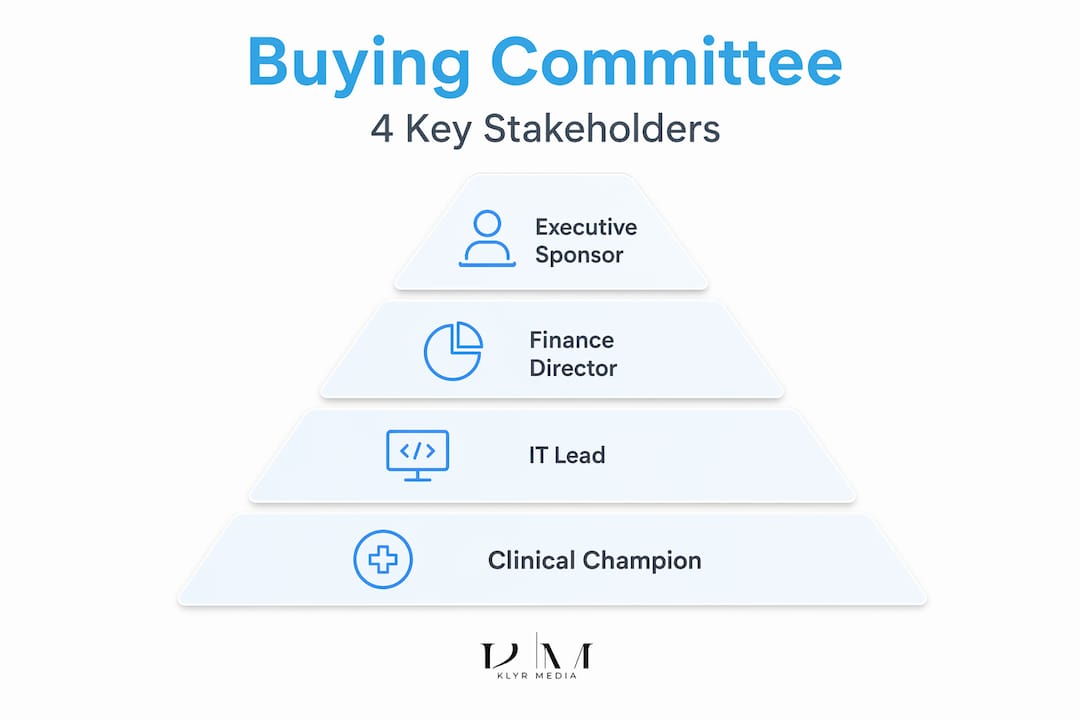
A typical healthcare transaction involves at least four distinct stakeholder types, each with different concerns and different timelines.
| Stakeholder Role | Primary Concern | Engagement Angle |
|---|---|---|
| Clinical champion (physician, CNO) | Outcomes and care quality | Evidence-based results, peer case studies |
| Financial sponsor (CFO, revenue cycle) | ROI and cost justification | Cost per outcome, payback period |
| IT and security lead | Integration and compliance | Architecture fit, HIPAA controls |
| Operations/compliance officer | Workflow and risk | Implementation timeline, audit readiness |
Your target account list should run between 250 and 1,500 accounts depending on your segment. For IDNs and large health systems, go narrower and deeper. For physician groups and ASCs, you can cast a wider net. The key is using real buying signals to prioritize, not just firmographic data.
The two most underused signals in healthcare lead acquisition? CMS rule publication timing and executive hire tracking. When the CMS IPPS final rule drops in August, it opens a 60 to 90-day window where health system leaders are actively reassessing vendor contracts. A new CIO or CMO hire means fresh budget authority and a clean slate for vendor relationships. These are not cold outreach situations. They are warm entry points.
Pro Tip: Set up Google Alerts and LinkedIn notifications for new executive hires at your top 100 target accounts. Trigger a personalized outreach sequence within 72 hours. You will reach them before competitors even know about the change.
Executing a hybrid lead generation approach
The smartest healthcare marketing teams do not choose between inbound and outbound. They run both in parallel and let each one feed the other. Here is how to build that system.
-
Build your inbound foundation with high-intent SEO. 77% of patients use search before booking an appointment. That same search behavior applies to healthcare buyers researching vendors. Create pages targeting specific, high-intent queries like “revenue cycle management for rural hospitals” or “pharmacy automation for independent pharmacies.” These pages capture existing demand without a single cold call.
-
Use first-party intent capture only. Avoid third-party intent data tools that drop client-side cookies on clinical pages. Build gated content like whitepapers, benchmark reports, and webinars to capture intent data directly from your audience, with proper consent built in from the start.
-
Launch targeted outbound using account signals. Once your account list is built and your intent signals are tracked, execute account-based outreach with personalized messaging for each committee role. Do not send the CFO a clinical outcomes whitepaper. Send them a cost-per-patient-day analysis.
-
Coordinate across channels. Multi-channel sequences combining email, phone, and LinkedIn outperform single-channel outreach by three to five times in healthcare. Phone is especially underused. A well-timed call, personalized to the prospect’s role and the signal that triggered your outreach, connects at rates that email cannot match.
-
Time everything to buying cycles. Build your campaign calendar around the CMS fiscal year, Q4 budget approvals, and your top accounts’ contract renewal windows. Random outreach in a compliance-heavy sector reads as spam. Timed outreach reads as relevance.
Pro Tip: Run a pre-conference LinkedIn ad campaign targeting attendees of a major healthcare event like HIMSS or HFMA one week before the event. Then follow up with direct outreach during the event. You go from cold to warm before the first handshake.
Lead nurturing over long healthcare sales cycles
Most leads you generate today will not close for 12 to 24 months. That is not a failure. That is the market. The question is whether your nurture system is built for that reality or whether you are letting those leads go cold after 30 days.
Here is what a mature healthcare nurture system looks like in practice:
- Automated routing by service line and location. Leads contacted within five minutes convert at 10x the rate of leads contacted after 24 hours. Route every inbound lead automatically to the right intake coordinator, based on specialty and geography, the moment they come in.
- Multi-touch sequences with 12 to 20 contacts. Use a mix of emails, calls, and LinkedIn touches. Not every touch needs to sell. Educational content, new case studies, and relevant industry news all count as meaningful contacts.
- Behavioral lead scoring. Weight scores by role and action. A CFO downloading a ROI calculator is worth more than a junior analyst opening an email. Configure your CRM to reflect those differences.
- Dead lead revival protocols. Set calendar reminders tied to CMS rule publications and fiscal year start dates. A lead that went cold in March may be ready to re-engage in September when new budgets open.
The data foundation for all of this is a centralized, HIPAA-compliant CRM with role-based access and audit logging. Not just for compliance. For visibility. You need to see every stakeholder touchpoint across a 14-month cycle in one place.
| Nurture Stage | Timeline | Key Tactics |
|---|---|---|
| Awareness | Months 1 to 3 | SEO content, webinars, initial outreach |
| Consideration | Months 4 to 9 | Case studies, ROI tools, multi-role personalization |
| Evaluation | Months 10 to 16 | Demos, pilot programs, procurement support |
| Decision | Months 17 to 24 | Contract support, compliance documentation, exec alignment |

Measuring and optimizing your pipeline
You cannot manage what you cannot see. And in healthcare, most marketing teams are flying blind because their measurement setup was built for e-commerce conversions, not 18-month enterprise cycles.
Here is what you actually need to track:
- Pipeline velocity. How fast are accounts moving through each stage? A slowdown in the evaluation phase tells you something different than a slowdown at awareness.
- Cost per qualified lead, not cost per lead. A $50 lead that never talks to sales is not cheaper than a $300 lead that becomes a $200,000 contract.
- Appointment conversion rate. Especially relevant for patient lead generation. Track form fills that turn into scheduled appointments and appointments that show up.
- Account engagement score. Leading indicators like account engagement tell you what is heating up in your pipeline before revenue materializes.
The infrastructure behind these metrics requires unified data pipelines that connect campaign spend, lead data, appointment records, and revenue. That data must live behind HIPAA-compliant access controls with full audit logging. This is where most independent practices fall behind hospital systems. It does not have to be that way.
Pro Tip: Build a weekly “pipeline health” dashboard that shows account engagement scores by stage and compares them to the same period last quarter. Review it with your sales team every Monday. This single habit catches stalled deals before they die.
Klyrmedia’s resources on HIPAA-compliant Google Ads show how to connect paid acquisition data to patient appointment outcomes without violating privacy rules.
My honest take on healthcare lead gen in 2026
I have seen healthcare organizations spend $50,000 on a demand gen campaign with a generic B2B agency and walk away with nothing but a list of unqualified contacts and a HIPAA headache. Generic playbooks fail here for a reason. Healthcare buying is slower, more political, and more regulated than almost any other sector. What works in SaaS will burn you here.
What I have learned is that the teams winning in healthcare lead acquisition share three traits. They treat compliance as a feature, not a friction point. They build for the long cycle from day one, not as an afterthought when deals stall. And they invest in connecting every stakeholder in the buying committee, not just the one who fills out the form.
The hardest part is patience combined with discipline. You need automated systems running consistently in the background while your team stays focused on the 20 accounts most likely to close this quarter. Both things at once. That balance is where the results live.
— Opinly
How Klyrmedia helps healthcare organizations build better pipelines
Healthcare marketers need infrastructure that is built for this industry, not adapted from it. Klyrmedia specializes in exactly that.
From HIPAA-compliant website design that enables secure patient data capture without third-party pixel exposure, to marketing automation that routes leads instantly, scores by behavior, and sequences nurture across 12-plus months. Klyrmedia builds the full stack for independent pharmacies, medical clinics, and healthcare practices competing against large chains with fraction of the budget. If your current setup is leaking leads at intake or losing pipeline to slow follow-up, the healthcare digital transformation solutions Klyrmedia offers are worth a closer look. Real systems. Real compliance. Results you can measure.
FAQ
What is the lead generation process in healthcare?
The lead generation process in healthcare refers to the systematic approach of attracting, capturing, and qualifying potential patients or B2B buyers while maintaining HIPAA compliance throughout. It involves inbound content, targeted outbound outreach, multi-stakeholder engagement, and structured lead nurturing over extended sales cycles.
How long does healthcare lead generation take to show results?
Most healthcare B2B sales cycles run 12 to 24 months, with 70% of organizations reporting 13-plus month cycles. Patient lead generation for practices can move faster, but still requires consistent nurturing through at least 12 to 20 touchpoints.
Do I need a BAA for every marketing tool I use?
Yes. Any vendor that handles PHI as part of your marketing operations must sign a Business Associate Agreement. This includes your CRM, email platform, ad network, and analytics tools that receive patient or prospect data.
What KPIs should healthcare marketers track?
Beyond form fills, track pipeline velocity, cost per qualified lead, appointment conversion rate, and account engagement scores. These metrics reveal whether your pipeline is healthy, not just active.
How do I time outreach for healthcare decision-makers?
Align outreach with CMS rule publication windows in August, new executive hires at target accounts, fiscal year budget cycles, and contract expiration timelines. Timed outreach converts significantly better than volume-based cold campaigns.

