

The Role of Digital Marketing in Healthcare in 2026

Most healthcare administrators think digital marketing means running a few Google ads or posting on social media. That’s like thinking a stethoscope is just for show. The real role of digital marketing in healthcare goes far deeper. It shapes how patients find you, decide whether to trust you, book an appointment, and stay with your practice long-term. The healthcare digital marketing market is valued at $6.4 billion in 2026 with 18% annual growth, and digital channels now account for 62% of total marketing spend. If you’re not treating digital as a core business function, you’re already behind.
Table of Contents
- Key takeaways
- The core roles digital marketing plays in healthcare
- How data and AI are changing the game
- Channels compared: what actually works in healthcare
- Practical steps to implement what you’ve learned
- My honest take on where healthcare marketing goes wrong
- How Klyrmedia helps you put this into practice
- FAQ
Key takeaways
| Point | Details |
|---|---|
| Digital marketing drives patient acquisition | SEO, paid search, and content marketing directly connect patients to your practice at critical decision points. |
| Content must be clinically reviewed | AI tools speed up content production, but physician oversight is non-negotiable for accuracy and trust. |
| Compliance shapes every channel | HIPAA requirements affect how you advertise, track, and follow up with patients across all digital platforms. |
| Measure beyond traffic | Link digital engagement to booked appointments and patient lifetime value, not just clicks or page views. |
| Video accelerates local trust | Short-form provider videos reduce patient acquisition costs and build the personal connection patients need before booking. |
The core roles digital marketing plays in healthcare
Here’s something most people get wrong. Digital marketing is not a department. It’s the connective tissue between your practice and the patients who need you. The role of content marketing in healthcare is best understood as an operating system, not a promotional tool. It supports every step of the patient decision journey, from first Google search to scheduled appointment to post-visit follow-up.
Let’s break down where digital marketing actually shows up in healthcare:
- Search visibility. When a patient types “urgent care near me” or “endocrinologist in Dallas,” SEO determines whether they find your practice or your competitor’s. Paid search captures the same intent for patients ready to book right now.
- Trust building through content. Patients are drowning in health misinformation. Effective healthcare content that balances clinical accuracy, patient storytelling, and transparent author credentials positions your organization as the credible voice in the room.
- Patient engagement at every touchpoint. Email campaigns for appointment reminders, social media to humanize your providers, personalized follow-up messaging after visits. These are not marketing gimmicks. They’re relationship infrastructure.
- Data analytics and precision targeting. Understanding which demographics are searching for specific services, which content converts browsers into callers, and which channels produce actual appointments. That’s the difference between guessing and growing.
- The post-care experience. Digital marketing does not stop at the front door. Review management, patient satisfaction surveys distributed by email, re-engagement campaigns for lapsed patients. All of it shapes whether a patient comes back or quietly goes somewhere else.
Pro Tip: Before you invest in any paid channel, audit your Google Business Profile completely. It’s the single highest-ROI, lowest-cost digital asset most clinics are underutilizing. Missing hours, no photos, zero reviews. That’s revenue walking past your door.
The role of digital marketing for physicians specifically is often underappreciated. Patients increasingly research the individual provider before booking, not just the practice. A physician with no online presence, no patient reviews, and no authored content is essentially invisible to 70% of the people deciding where to go.
How data and AI are changing the game
The word “AI” gets thrown around so carelessly that it’s almost lost meaning. So let’s be specific about what it actually does in healthcare marketing, and where the hard limits are.
Here is how data-driven strategies and AI tools are reshaping digital marketing healthcare strategies right now:
- First-party data collection. Your patient portal, appointment system, and email list are gold mines. Building direct relationships with patients through owned channels reduces your dependence on expensive third-party platforms and gives you behavioral data you can actually act on.
- AI-assisted content planning. Tools that analyze search trends, social conversations, and news cycles help teams like Cleveland Clinic identify what patients are actually asking about. Then editors and physicians shape the final content. The AI finds the signal. Humans write the answer.
- Multi-touch attribution modeling. Linking digital engagement to appointments requires tracking micro-conversions. A patient reads your blog, watches a provider video, then books online three days later. Without attribution, that booking looks like it came from nowhere. With it, you know exactly which content earned the appointment.
- Automated patient communication. Recall reminders, post-visit check-ins, preventive care outreach. AI handles the timing and personalization. Your staff handles the actual care. Done right, this reduces no-shows without adding headcount.
- Compliance-aware ad targeting. AI-powered platforms enable intent-based marketing and budget optimization but require strict HIPAA governance structures to avoid exposing protected health information in retargeting workflows.
“AI must be deployed with discipline in healthcare marketing, balancing efficiency with ethics, transparency, compliance, and HIPAA governance to maintain patient trust.” — AI in Healthcare Marketing
The uncomfortable reality is that AI governance is still immature at most healthcare organizations. Cleveland Clinic established a cross-departmental AI council with formal policies specifically to prevent the risks that come from well-intentioned but ungoverned AI use. If you’re a smaller clinic or independent practice, that kind of structure may feel out of reach. But even a simple written policy about what AI tools your team can use for content and what requires physician sign-off goes a long way.
Channels compared: what actually works in healthcare

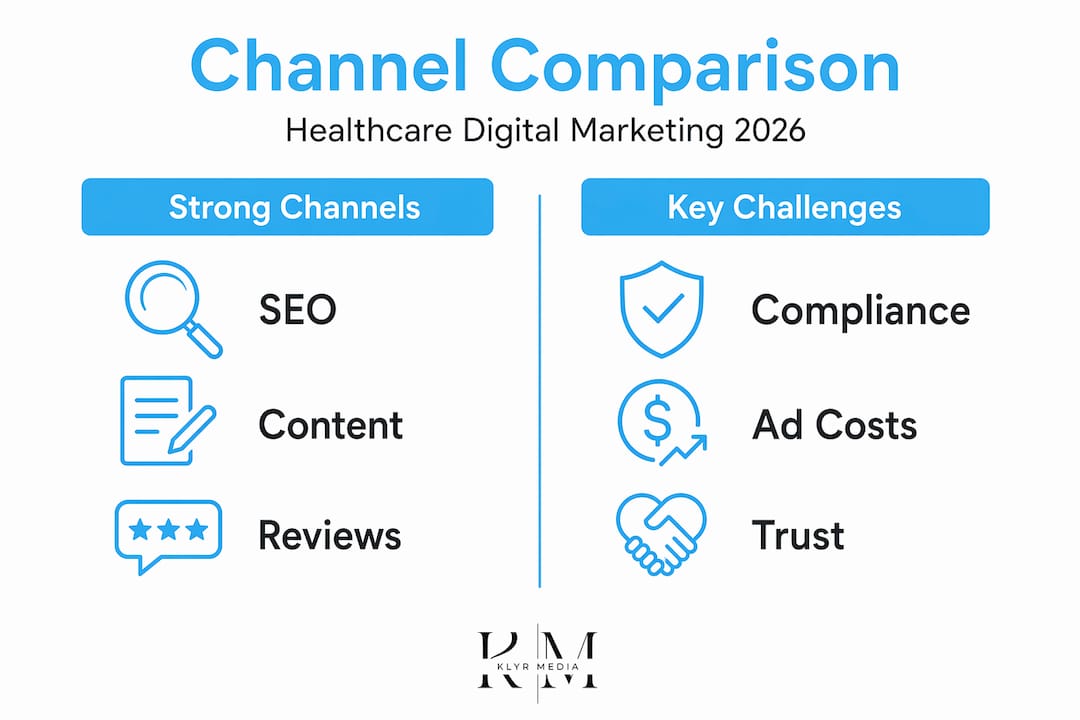
Not all digital channels are equal, and healthcare has unique constraints that change the math compared to other industries. Here is how the major channels stack up:
| Channel | Strengths | Key challenges |
|---|---|---|
| SEO and content marketing | Meets patient intent; builds long-term organic authority | Requires consistent effort, clinical review, and E-E-A-T compliance |
| Paid search (PPC) | Captures high-intent searches immediately | Costly, especially in competitive specialties; strict ad policy rules |
| Social media | Humanizes providers; builds community | Misinformation risk; privacy pitfalls; algorithm dependency |
| Endemic advertising | High contextual relevance; better qualified impressions for HCP targeting | Limited reach outside professional audiences |
| Email marketing | Owned channel; high ROI for patient retention | Requires proper consent and HIPAA-compliant platforms |
The digital marketing healthcare strategies that consistently win are built on SEO and content as the foundation, with paid search layered on top to capture immediate demand. Social media fills the trust gap. Email retains the patients you already have.
Endemic advertising deserves more attention than it gets in clinic settings. When you’re advertising to other healthcare professionals, reaching them on the platforms and publications they actually use for professional development produces far better engagement than generic programmatic display. It’s contextual relevance doing the heavy lifting.
Pro Tip: Healthcare paid search can cost $15 to $80 per click in competitive markets. Before scaling spend, make sure your landing pages convert. A page that loads in 5 seconds and has no clear call to action is burning your budget before the patient ever calls.
Social media is where things get complicated. The benefits of digital marketing for hospitals and clinics on social are real, including provider visibility, patient education, and community connection. But the downside is just as real. Patient privacy violations on social media are rarely intentional. They happen when staff post photos that include identifiable patients without explicit consent, or when comments on health posts draw out sensitive disclosures that then become visible. You need written policies before you post, not after.
Check out the types of healthcare marketing that are working for practices similar to yours if you want a fuller breakdown by specialty and setting.
Practical steps to implement what you’ve learned
Knowing the theory is one thing. Actually building a digital marketing system in a busy clinic or hospital department is another challenge entirely. Here’s what moves the needle:
- Map your patient decision journey. Before you publish anything, understand what questions a patient asks at each stage. Awareness (“what is Type 2 diabetes?”), consideration (“is Metformin the right treatment for me?”), and decision (“find an endocrinologist near me”). Your content should exist at all three stages, not just the last one.
- Publish based on data, not a calendar. The mistake most clinics make is planning content months in advance based on health awareness months, then ignoring what patients are actually searching for in real time. Check your search console data weekly. Publish based on demand.
- Invest in clinical content review. Every piece of health content your practice publishes should have a physician or clinical expert listed as the author or reviewer. Google’s E-E-A-T standards reward this, patients trust it, and it protects your organization from the liability of publishing inaccurate health information.
- Track micro-conversions. Phone call clicks, “book now” button taps, contact form submissions, and online scheduling completions. These are the signals that connect your content to actual patient acquisition. If you’re only looking at traffic, you’re missing the story.
- Use video consistently. 72% of patients prefer short-form video for health information in 2026, and practices posting at least four short videos per month reduce patient acquisition costs by 29%. A 60-second video of your provider explaining what to expect during a first visit is worth more than ten blog posts to a patient deciding between two clinics.
Digital branding in healthcare comes down to one thing: does a patient who finds you online feel like they already know and trust your provider before they walk through the door? That is the outcome you’re building toward. It’s not impressions or followers. It’s that feeling. See the healthcare digital marketing checklist for a structured framework you can work through with your team.
My honest take on where healthcare marketing goes wrong
I’ve spent a long time watching healthcare organizations chase tactics instead of building systems. They run a paid search campaign, get some calls, then pull the budget when the ROI isn’t instant. Or they hire a content writer with no clinical background and publish articles full of technically incorrect information. Then they wonder why Google traffic drops or why patients leave negative reviews citing misinformation.
Here’s what I’ve actually learned: the importance of digital marketing in healthcare is undeniable, but it only compounds when you treat it as infrastructure, not a project. The practices that win are the ones that commit to a consistent content cadence, maintain physician review on everything patient-facing, and measure outcomes all the way to booked appointments.
AI is exciting. Genuinely. But I’ve seen what happens when teams let AI generate patient-facing content without any clinical oversight. One factually shaky article can undo years of trust-building. The physician review and governance that Cleveland Clinic has built is not bureaucracy. It’s self-preservation. Small practices need a version of that too, even if it’s just a monthly content sign-off from one trusted clinician.
My other strong opinion: stop deprioritizing the patient experience between digital touchpoints. You can have a perfect SEO strategy and a beautiful website, but if a patient can’t reach you by phone after hours, or never gets a follow-up after their visit, your digital marketing is filling a leaky bucket. Fix the bucket first.
— Opinly
How Klyrmedia helps you put this into practice
Understanding how digital marketing impacts healthcare is the first step. Actually building it, maintaining compliance, and connecting it to real patient growth is where most practices get stuck. That’s exactly what Klyrmedia was built for.
Klyrmedia specializes in healthcare digital marketing for independent clinics, pharmacies, and medical practices across the United States. From HIPAA-compliant website design that protects patient data to local SEO strategies that make you visible when nearby patients are searching, Klyrmedia delivers the full system, not just individual tactics. If your practice serves a specific facility type, the medical facilities solutions page is a good starting point to see what a tailored approach looks like. The goal is simple: more patients finding you, trusting you, and staying with you.
FAQ
What is the role of digital marketing in healthcare?
Digital marketing in healthcare connects patients to providers through search, content, and targeted communication at every stage of the patient decision journey. It drives patient acquisition, builds trust, and supports long-term retention.
How does digital marketing help clinics compete with large hospital systems?
The role of digital marketing in clinics is to level the playing field through local SEO, patient reviews, and personalized content that large systems struggle to replicate at the community level.
What digital marketing channels work best for physicians?
SEO, content marketing, and short-form video consistently outperform other channels for physician visibility and patient trust, especially when content includes verified physician authorship.
Is social media safe for healthcare marketing?
Social media can be effective but carries real compliance risks. Written privacy policies, staff training, and strict content approval processes are required before your practice posts anything patient-facing.
How do you measure ROI from healthcare digital marketing?
Real ROI measurement requires tracking micro-conversions like phone call clicks and online bookings, then connecting those to appointment completions and patient lifetime value through CRM integration.

