

Digital Marketing Workflow Healthcare: 2026 Guide

Running a compliant, effective digital marketing workflow in healthcare is genuinely hard. You are not just selling a service. You are operating in a regulated environment where one misstep with patient data can trigger a HIPAA violation, and where patients go through 6 to 12 touchpoints across digital and offline channels before they ever book an appointment. Generic marketing advice does not cut it here. This guide walks you through building a digital marketing workflow for healthcare that is structured, compliant, and designed to actually move patients from awareness to scheduled visit without leaking revenue at every handoff.
Table of Contents
- Key takeaways
- Building your digital marketing workflow foundation
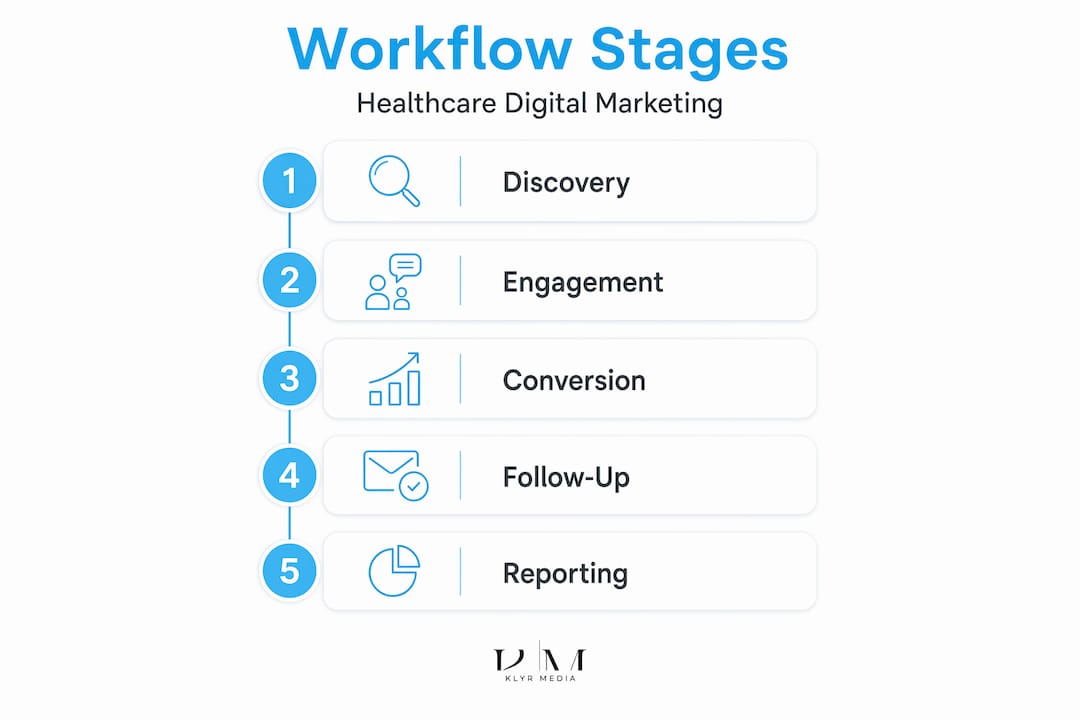
- Step-by-step workflow execution for healthcare
- Verifying and improving your workflow
- HIPAA compliance inside your marketing workflows
- My honest take on healthcare marketing workflows
- How Klyrmedia builds workflows that work
- FAQ
Key takeaways
| Point | Details |
|---|---|
| Map the full patient journey | Patients cross multiple digital and offline channels before converting, so your workflow must connect all of them. |
| Build compliance into the structure | HIPAA requirements belong in your workflow architecture, not applied as an afterthought before you hit send. |
| Use multi-touch attribution | Last-click reporting misrepresents which channels drive appointments. Multi-touch models reveal the real picture. |
| Segment on non-sensitive data | Personalize communications using engagement history and demographics, not PHI, to stay compliant and still stay relevant. |
| Close the lead-routing gap | Inconsistent routing of digital leads to schedulers is where most healthcare marketing revenue quietly disappears. |
Building your digital marketing workflow foundation
Before you write a single email or run a single ad, you need a clear picture of what your workflow is actually supposed to do. That means understanding the patient journey and the tools required to support it.
Understanding the patient journey
A prospective patient might find you through a Google search, read two of your blog posts, see a social media post, and then call your front desk three weeks later. That call is where most practices think the journey started. It did not. Patients cross search, social, email, referrals, and offline touchpoints before they convert, and your workflow needs to account for every one of those moments.
The practical implication is this: your marketing system must be able to capture, track, and connect activity across all those channels. That requires more than a website and a Facebook page. Here is what the technology stack needs to cover:
- HIPAA-compliant CRM (like Salesforce Health Cloud or a BAA-covered HubSpot setup) to store patient and prospect data securely
- Marketing automation platform covered by a signed Business Associate Agreement (BAA) for email, SMS, and workflow triggers
- Call tracking software that integrates with your CRM and records which campaigns drove inbound calls
- Attribution platform connecting GA4, your CRM, and ad platforms to measure true multi-channel impact
- Secure lead capture forms with SSL encryption and HIPAA-compliant data handling on the back end
Pro Tip: Before signing any marketing software contract, ask the vendor directly for a signed BAA. If they cannot provide one, they cannot handle PHI. Full stop. No workaround exists.
The table below shows how different channels map to workflow stages and the tools required at each point:
| Channel | Workflow stage | Required tool |
|---|---|---|
| Google Search / SEO | Awareness and discovery | Analytics, call tracking |
| Social media | Awareness and education | Social scheduling, pixel tracking |
| Email and SMS | Consideration and nurture | BAA-covered automation platform |
| Referrals and events | Intent and trust-building | CRM with referral source tracking |
| Phone and scheduling | Conversion | Call tracking, EMR integration |
Data integration across these platforms is where most practices stumble. Siloed tools produce siloed data, and siloed data produces budget decisions based on incomplete information.

Step-by-step workflow execution for healthcare
Now you know what you need. Here is how you actually build and run it.
-
Design compliant lead capture forms. Your forms should collect only what is necessary: name, contact information, reason for interest (without clinical detail), and consent language. Do not ask for diagnosis or medication history in an intake form. That creates PHI you are then responsible for protecting in every downstream system.
-
Build your multi-touch email nurture sequence. A typical healthcare nurture sequence runs three to five emails over two to three weeks. The first email confirms the opt-in and delivers value (a helpful resource, a service overview). Subsequent emails address common patient questions and objections. The final email offers a direct call to action: book an appointment, call the office, or use your online scheduler. Multi-step reminder sequences with confirm and reschedule options reduce no-shows and keep patients engaged between touchpoints.
-
Segment based on non-sensitive attributes. Conditional content and segmentation let you personalize emails based on engagement history, location, or service interest without ever touching PHI. Someone who clicked your “Flu Vaccine” blog post gets different content than someone who came in through your “Chronic Care Management” page. Same platform, same workflow, zero PHI in the message body.
-
Integrate offline touchpoints into your tracking. Referral sources need to be logged in your CRM at intake. Phone calls need UTM-level attribution through your call tracking tool so you know which ad or search term drove that call. Appointment outcomes should feed back into the CRM to mark a lead as converted. Without this loop, your digital reporting will always undercount your results.
-
Implement attribution before you scale spend. Do not increase your ad budget until you know which channels are actually producing appointments. Set up GA4, CRM integration, and call tracking as your attribution infrastructure. Link confirmed bookings back to the campaign that started the conversation.
Pro Tip: Set up a “conversion verification” step in your CRM workflow that requires a staff member to confirm a booking before it counts as a converted lead. This keeps your attribution data clean and your ROI calculations honest.
Verifying and improving your workflow
Building the workflow is the start. Proving it works and finding where it breaks is the ongoing job.
Attribution models that actually make sense
Last-click attribution is the default in most healthcare marketing setups, and it is misleading. It gives 100% of the credit to whichever touchpoint came directly before the booking, typically a branded search or a direct call. Multi-touch attribution distributes credit across all the touchpoints that contributed to the conversion. That means your SEO content, your social posts, and your email sequence all get recognized for the role they played.
Online-to-offline attribution connects digital exposure to actual scheduled appointments and facility visits. Health systems that reallocated spend based on this data have seen roughly 30 to 40% efficiency gains. That is not a minor improvement. That is budget reallocation that makes every dollar do more work.
KPIs worth tracking
Focus on outcomes, not activity. Here are the metrics that actually tell you if the workflow is working:
- Appointment conversion rate from digital leads (form submissions and calls)
- No-show rate by channel to see where patient commitment is weakest
- Referral source tracking to measure offline and word-of-mouth contribution
- Cost per booked appointment by channel, not cost per click
- Patient retention rate at 3 and 12 months post first visit
Common workflow failures
Most workflow problems in healthcare marketing are not strategy problems. They are configuration problems. Leads fall through because nobody defined the routing logic. Emails go out without PHI checks because compliance was assumed, not built in. Attribution looks wrong because CRM and ad platforms were never properly connected.
The fix is almost always the same: document the workflow, assign ownership to every handoff point, and audit the data flow quarterly.
HIPAA compliance inside your marketing workflows
Compliance is not a checklist you complete once. It is architecture you build into every trigger, every segment, and every vendor relationship.
What HIPAA actually requires for marketing
HIPAA permits marketing communications only when PHI is not disclosed, or when valid written authorization has been obtained and documented. That means your pre-send workflow must include a compliance gate: a check that confirms no PHI is being exposed in the subject line, body, or any dynamic content field before the message goes out.
Here is what a privacy-by-design workflow looks like in practice:
- Role-based access controls on your marketing platform so only authorized staff can view or modify patient segments
- Audit logging that records who accessed what data and when, which is required under the HIPAA Security Rule
- BAA-covered vendors only for any tool that processes, stores, or transmits data related to patients
- Exclusion zones on your website analytics to prevent tracking pixels from firing on sensitive pages like patient portals, appointment confirmation pages, or prescription management pages
- Documented authorization records for any campaign that references a patient’s health status or treatment history
Pro Tip: Use a “PHI-free zone” policy for all outbound marketing content. Your automation platform should be configured to pull only from fields explicitly designated as non-PHI. If a field is ambiguous, it stays out of marketing communications until legal review clears it.
Compliance-by-design workflows use trigger and segmentation logic on non-sensitive data and generate PHI-based content only after verifying stored authorization. That is the standard to build toward.
It is also worth noting that nearly 30% of inbound healthcare calls go unanswered. That is revenue that never walked in. Call tracking with automatic SMS callbacks is both a compliance and a revenue tool, because it creates a documented touchpoint and recovers leads that would otherwise be lost.
My honest take on healthcare marketing workflows
I have seen a lot of healthcare marketing programs that look polished on the surface and fall apart in execution. The strategy decks are thorough. The creative is solid. But somewhere between the campaign launch and the monthly reporting call, patients are disappearing. The leads are not converting. The numbers do not add up.
Almost every time, the issue is not the message. It is the handoff. Lead-routing gaps happen when a form submission goes to a generic inbox nobody checks on Fridays, or when a call comes in from a campaign but the scheduler never knows which ad drove it. That data disappears. That patient often goes elsewhere.
What I have found is that most teams need to treat marketing as a revenue function with defined accountability, not a creative support function. That shift changes how you build workflows. You stop asking “did we send the emails?” and start asking “did the emails produce appointments, and who owns the conversion step?”
The other thing I keep coming back to is the value of multi-touch attribution in budget conversations. When you can show leadership that the blog post someone read six weeks ago was part of the conversion path for 40% of your new patients this month, the conversation about content investment changes completely. Attribution frameworks prevent decisions based on vanity metrics by measuring what actually happened.
Compliance and personalization are not opposites, either. With the right segmentation logic, you can send content that feels genuinely relevant to a patient without ever putting their health information at risk. That balance is achievable. It just requires intentional architecture, not shortcuts.
— Opinly
How Klyrmedia builds workflows that work
If reading this made you realize your current setup has gaps, you are not alone. Most independent practices and clinics are running marketing programs that have never had the infrastructure underneath them to fully work.
Klyrmedia builds HIPAA-compliant websites designed from the ground up for patient acquisition and privacy. The agency’s healthcare SEO services help your practice show up when local patients are actively searching, and the marketing automation solutions are configured with BAA compliance, proper segmentation, and attribution tracking built in. This is not a generic agency applying generic tactics to a specialized industry. Klyrmedia works exclusively in healthcare, which means the workflows they build already account for the compliance requirements, the patient journey complexity, and the operational realities that generic marketers miss.
FAQ
What is a digital marketing workflow in healthcare?
A digital marketing workflow in healthcare is a documented, automated sequence of marketing activities, from lead capture through patient conversion, that coordinates digital channels like search, email, and social with offline touchpoints like calls and referrals, all while maintaining HIPAA compliance.
How do you keep email marketing HIPAA-compliant?
HIPAA requires that marketing emails do not expose PHI unless a valid written authorization is documented. Use segmentation based on non-sensitive attributes, work only with BAA-covered platforms, and build a pre-send compliance check into every automated sequence.
What KPIs should healthcare marketers track?
Focus on appointment conversion rate, cost per booked appointment, no-show rate by channel, referral source volume, and patient retention at 3 and 12 months. These metrics connect marketing activity to actual clinical and revenue outcomes.
Why is last-click attribution a problem for healthcare?
Last-click models give all credit to the final touchpoint before booking, which obscures the role that content, social, and email played earlier in the journey. Multi-touch attribution distributes credit accurately and leads to smarter budget decisions.
How do you close the lead-routing gap?
Define routing logic for every lead source before campaigns launch, assign ownership to each handoff point, integrate your call tracking and CRM so no lead enters a dead inbox, and audit your routing quarterly to catch breakdowns before they compound.

