
Digital Marketing Trends 2026 Healthcare Providers Must Know
Discover the digital marketing trends 2026 healthcare providers must know to enhance patient engagement and boost acquisition. Stay ahead!

Digital Marketing Trends 2026 Healthcare Providers Must Know

Healthcare digital ad spend is projected to hit $26.2 billion in 2026, with 82% of budgets shifting away from TV and print. If you manage marketing for a clinic, pharmacy, or medical practice, the digital marketing trends 2026 healthcare world is throwing at you are not optional upgrades. They are table stakes. AI is rewriting how patients find you, how they book appointments, and how aggressively regulators are watching what happens to their data along the way. This article walks through the trends that will actually move the needle on patient acquisition and retention in 2026, and gives you the framework to prioritize them intelligently.
Table of Contents
- Key Takeaways
- 1. How to evaluate which digital marketing trends are worth your budget
- 2. Agentic AI for appointment conversion and patient engagement
- 3. SEO bifurcation: two tracks for two very different search intents
- 4. AI-powered personalization and predictive analytics
- 5. Voice AI, telehealth funneling, and social media’s growing role
- 6. Compliance and data privacy: the risks you cannot afford to ignore
- My honest take on innovation vs. compliance in healthcare marketing
- How Klyrmedia helps you execute on every one of these trends
- FAQ
Key Takeaways
| Point | Details |
|---|---|
| AI drives appointment conversion | Agentic AI systems boost appointment conversion by up to 27% while keeping PHI fully segregated from marketing tools. |
| SEO requires two separate tracks | Local provider queries and informational health queries need distinct optimization strategies to win in 2026 search. |
| Compliance is non-negotiable | OCR’s 2024 tracking guidance makes architectural data segregation a legal requirement, not a best practice. |
| Telehealth is an acquisition funnel | Practices using telehealth marketing see 30 to 45% lower patient acquisition costs compared to traditional channels. |
| Measure AI answer presence | Zero-click search is rising fast, so tracking AI citation appearances matters as much as tracking landing page visits. |
1. How to evaluate which digital marketing trends are worth your budget
Not every shiny trend deserves a line item in your budget. Before chasing the next platform or tool, run each opportunity through these four filters.
- Patient acquisition cost impact. Does this tactic lower your cost per new patient? With click costs reaching $8 to $15+ in competitive healthcare categories, precision matters more than volume.
- Appointment conversion uplift. A trend that drives traffic but does not close appointments is just brand spending with a digital wrapper.
- HIPAA and OCR compliance risk. Any tactic involving tracking pixels, retargeting, or behavioral data touches regulatory territory. If the architecture is wrong, you are not just wasting money. You are building liability.
- Measurability and attribution. Can you tie this channel directly to confirmed appointments or patient lifetime value? If attribution is murky, budget allocation will always be guesswork.
Pro Tip: Start every channel evaluation by asking: “Can we measure a direct line from this spend to a booked appointment?” If the answer requires more than two steps of inference, the channel needs more scrutiny before scaling.
2. Agentic AI for appointment conversion and patient engagement
Agentic AI is not a chatbot that answers FAQs. It is a system that takes initiative. It identifies a patient’s intent, personalizes the response, and moves them toward a confirmed appointment without a human in the loop at every step.

The results are hard to ignore. Agentic AI deployments in healthcare marketing are showing a 27% lift in appointment conversion and a 19% reduction in patient acquisition cost, with zero PHI exposures in properly architected systems. The key word there is properly architected.
The highest conversion gains do not come from better click-through rates. They come from closing the gap between a website visit and a confirmed appointment, specifically through compliant intake and scheduling agents that keep patients moving through the funnel without friction.
“AI’s marketing power depends on sequencing compliance controls ahead of velocity, or risk costly OCR enforcement.” — Digital Applied
- Build your agentic AI layer on top of a clean, PHI-free marketing data environment
- Deploy scheduling agents that connect directly to your practice management system without routing through marketing inference tools
- Test conversion rates at each funnel stage before scaling AI-driven messaging
Pro Tip: Do not deploy agentic AI on your website before confirming that your intake forms and scheduling flows are architecturally isolated from EHR and any PHI-containing systems. The speed gains are real, but one data architecture mistake erases them entirely.
3. SEO bifurcation: two tracks for two very different search intents
If you are running one SEO strategy for your entire site, you are leaving patient acquisition on the table. The 2026 SEO trends for healthcare providers demand two separate tracks because the search environment is fundamentally split.
Local provider queries (“urgent care near me,” “pharmacist in Austin”) receive little AI Overview interference, making them the highest-opportunity acquisition channel in search right now. Google’s AI Overviews largely step aside for these queries because the intent is transactional and location-specific.
Informational queries (“what causes high blood pressure,” “is metformin safe”) are now dominated by AI-generated answers. AI Overviews answer roughly 40% of health queries without producing a click, so the goal shifts from ranking in position one to earning citation inside the AI answer.
| Query Type | AI Overview Impact | Primary Tactic | Goal |
|---|---|---|---|
| Local provider (“dentist near me”) | Low interference | Google Business Profile optimization | Direct appointment bookings |
| Informational (“symptoms of diabetes”) | High interference | Clinician-backed content hubs | AI citation presence |
For local SEO, your Google Business Profile is the front line. Keep hours accurate, respond to every review within 48 hours, and post updated clinical photos monthly. Local healthcare search increasingly resolves on the SERP without a website click, so your GBP listing needs to carry full weight on its own.
For informational content, winning AI answer presence requires clinician-authored content organized into topical hubs, strong E-E-A-T signals, and a citation strategy that earns links from authoritative health publishers. You can explore healthcare SEO fundamentals for a structured approach to both tracks.
4. AI-powered personalization and predictive analytics
Generic email blasts to your entire patient list are not marketing. They are noise. The best healthcare marketing platforms 2026 has to offer are built around dynamic, condition-aware personalization that speaks to where a patient actually is in their care journey.
Here is what that looks like in practice. A patient who visited your site looking at diabetes management services gets a different follow-up sequence than someone browsing pediatric care. Messages adapt based on condition stage, insurance type, and behavioral signals. No single patient sees a one-size-fits-all campaign.
Predictive analytics takes this further by forecasting churn risk, appointment likelihood, and service demand before you spend a dollar on outreach. Instead of marketing to everyone, you spend on patients who are statistically likely to book and who are at risk of switching to a competitor.
- Use behavioral segmentation to group patients by care stage and intent signals
- Build predictive models that flag high-value patients 30 to 60 days before their likely next appointment
- Track ROI by patient cohort, not just campaign-level aggregate numbers
- Establish governance rules that define which data inputs are permissible under HIPAA before building any personalization model
Pro Tip: Before deploying any AI personalization layer, map every data input to its source. If any field could be derived from or associated with PHI, that input needs either explicit patient authorization or architectural removal from your marketing system.
5. Voice AI, telehealth funneling, and social media’s growing role
The channels your patients use to find, evaluate, and contact you are multiplying. Here is where the real growth is in 2026.
-
AI voice agents. These are not IVR phone trees. Modern AI voice agents handle scheduling, answer clinical FAQ questions, and route complex calls to staff, all outside business hours. For independent clinics and pharmacies fielding dozens of calls a day, this is always-on infrastructure that pays for itself in staff hours and missed-call recovery.
-
Telehealth as acquisition funnel. Telehealth drives 30 to 45% lower patient acquisition costs compared to traditional channels. The reason is reach. A patient in a neighboring county who would never drive to your location will book a virtual visit. Once they are in your system, conversion to in-person care follows naturally. Market telehealth as an entry point, not just a convenience feature.
-
Social media video. Platforms like TikTok and Facebook Reels are generating real patient conversion for practices willing to put clinicians on camera. Educational short-form content builds the kind of credibility that no Google Ad can replicate. A 60-second video from your physician explaining a common concern converts browsers to booked patients more effectively than a keyword-targeted landing page alone.
-
Connected TV. CTV and streaming ads are the dominant digital ad channel for reaching healthcare consumers at home. Yes, attribution is harder than search. But 84.1% of healthcare consumers use search engines after consuming content, which means CTV drives the search behavior you then capture with SEO.
6. Compliance and data privacy: the risks you cannot afford to ignore
This is the section most healthcare marketers skim. Do not skim this one.
OCR’s 2024 guidance on online tracking made something very clear: placing marketing pixels, analytics tags, or retargeting scripts on any page where patients enter, access, or view health-related information is a potential HIPAA violation unless you have a signed Business Associate Agreement with every vendor receiving that data. Most practices do not.
“Architectural segregation is necessary to align marketing automation with HIPAA enforcement; marketing inference systems must never touch EHR or patient-identifying data.” — Digital Applied
What compliant architecture actually looks like in practice:
- Marketing analytics run on anonymized, aggregated data only, fully isolated from EHR systems
- Identity and access management controls prevent PHI from entering marketing platforms
- All retargeting and behavioral advertising uses only non-PHI contextual signals
- Patient communications requiring health context use HIPAA-authorized messaging channels with proper consent
The FTC and state-level consumer protection agencies are also increasing enforcement around health data. If you use location data, app tracking, or third-party health data for targeting, get your legal team involved now. For a deeper look at building compliant patient communications, the compliance marketing best practices guide from Klyrmedia is a solid starting point.
My honest take on innovation vs. compliance in healthcare marketing
I have watched healthcare organizations get so cautious about compliance that they do nothing for years. Then they watch competitors who figured out the right architecture outpace them completely. I have also watched teams rush AI deployments without checking their data flows, then face the cleanup when OCR comes calling.
Here is what I have actually learned. Compliance is not a constraint on innovation. It is the foundation that makes sustainable innovation possible. The agentic AI systems I have seen perform best in healthcare are the ones where the compliance architecture was built first and the velocity came second. Not the other way around.
The single biggest underinvestment I see among independent practices right now is local SEO. Your Google Business Profile is working while you sleep or while it is neglected. There is no middle ground. If your hours are wrong, your photos are outdated, or you have unanswered reviews sitting there, you are losing patients to whoever bothered to keep their profile current.
Telehealth marketing is the other blind spot. Practices that frame telehealth as a convenience feature rather than a top-of-funnel acquisition strategy are missing the most cost-efficient patient acquisition channel available to them right now.
AI is worth pursuing. But pursue it the same way you would a new clinical protocol: define the parameters, build in safeguards, test before scaling, and measure against real outcomes.
— Opinly
How Klyrmedia helps you execute on every one of these trends
If reading through these trends left you energized but unsure where to start, that is exactly the position Klyrmedia is built for. The team specializes in healthcare digital marketing for independent pharmacies, clinics, and medical practices across the United States.
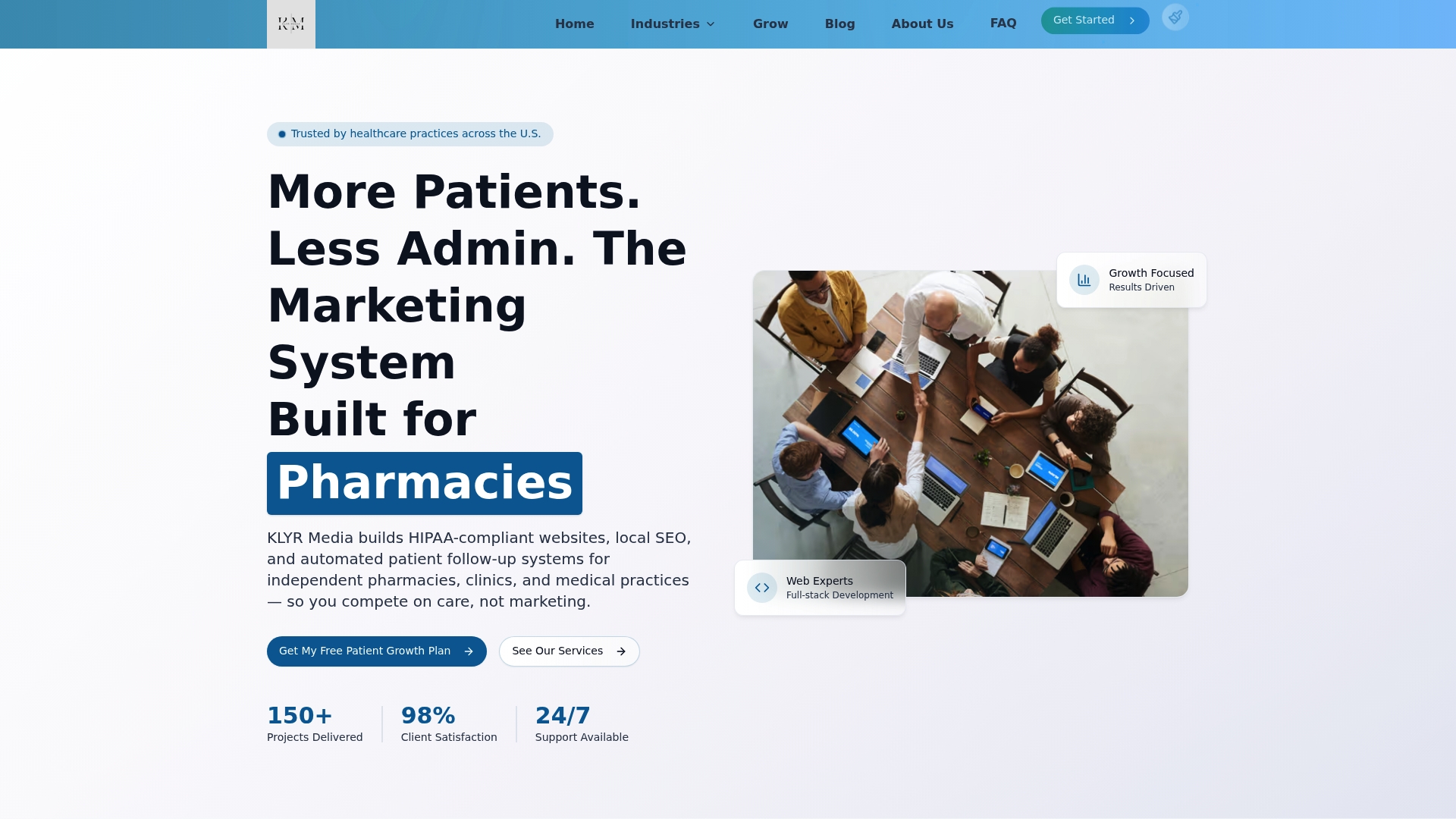
Klyrmedia builds HIPAA-compliant websites that meet OCR’s tracking guidance from the ground up, so your marketing infrastructure does not become a liability as you scale. Their healthcare SEO services handle both the local provider track and the informational content track separately, because that bifurcated strategy is what actually drives patient acquisition in 2026 search. And their marketing automation platform brings AI-driven personalization and scheduling integration into a single compliant system. If you want a strategic plan tailored to your practice, reach out to Klyrmedia for a consultation.
FAQ
What is the biggest digital marketing trend in healthcare for 2026?
Agentic AI for appointment conversion is generating the most measurable results, with deployment data showing a 27% lift in confirmed appointments and a 19% reduction in acquisition cost across compliant implementations.
How does SEO work differently for healthcare providers in 2026?
Healthcare SEO in 2026 requires two separate strategies. Local provider queries are low-interference and ideal for direct acquisition, while informational queries are dominated by AI Overviews and require a content and citation strategy to earn AI answer presence.
Are marketing pixels on healthcare websites still allowed?
Only under strict conditions. OCR’s 2024 guidance flags pixels on PHI-adjacent pages as a potential HIPAA violation unless every receiving vendor has a signed Business Associate Agreement and no patient-identifying data is transmitted.
Why is telehealth considered an acquisition channel now?
Because telehealth removes the geographic barrier to first contact. Patients who would never drive to your clinic will book a virtual visit, and acquisition costs drop 30 to 45% compared to traditional channels when telehealth is marketed as an entry point.
How do you measure SEO success when AI Overviews reduce clicks?
Track AI citation appearances alongside traditional rankings. Since AI Overviews answer roughly 40% of health queries without a click, citation presence inside AI answers is now a primary performance metric for healthcare informational content.

