

Search Intent in Healthcare: A Guide for Providers

Search intent in healthcare is defined as the underlying motivation driving why a person conducts an online search related to health, medical care, or a specific provider. Understanding this motivation, formally called “query intent” in information retrieval research, is the foundation of any content or communication strategy that actually reaches patients. When you know what a patient wants before they arrive on your page, you can give them exactly that. Miss it, and you lose them to a competitor who got it right.
Healthcare professionals and administrators who grasp the four primary intent categories, informational, navigational, commercial investigation, and transactional, gain a real edge in patient engagement. This is not a marketing abstraction. It is the difference between a patient booking an appointment and a patient bouncing off your site in under ten seconds.
What is search intent in healthcare, and why does it matter?
Search intent in healthcare is categorized into four primary types: informational, navigational, commercial investigation, and transactional. Each type reflects a distinct patient need and demands a different content response.
-
Informational intent: The patient wants to learn. Queries like “what causes high blood pressure” or “symptoms of type 2 diabetes” fall here. Informational intent dominates healthcare search globally. These patients are not ready to book. They need empathetic, authoritative content that builds trust over time.
-
Navigational intent: The patient already knows where they want to go. They search “Dr. Kim at Riverside Family Clinic” or “CVS pharmacy near me.” They are looking for a specific place or person. Getting in their way with irrelevant content is a fast way to lose them.
-
Commercial investigation: The patient is comparing options. “Best cardiologist in Austin” or “urgent care vs. emergency room” signals this intent. They are close to a decision but not there yet. Content that helps them evaluate, without pushing too hard, wins this group.
-
Transactional intent: The patient is ready to act. Queries include action language like “book,” “schedule,” or “appointment,” often paired with a location or specialty. Transactional queries signal provider selection intent. Your content here must remove friction, not add it.
Pro Tip: Map your top 20 website pages to one of these four intent types. If a page does not clearly serve one intent, it probably serves none well.
Why identifying healthcare search intent is harder than it looks

Healthcare queries carry a level of ambiguity that most other industries do not face. A search for “chest pain” could mean a patient in a medical emergency, a medical student studying cardiology, or a caregiver researching a parent’s symptoms. The words are identical. The need is completely different.
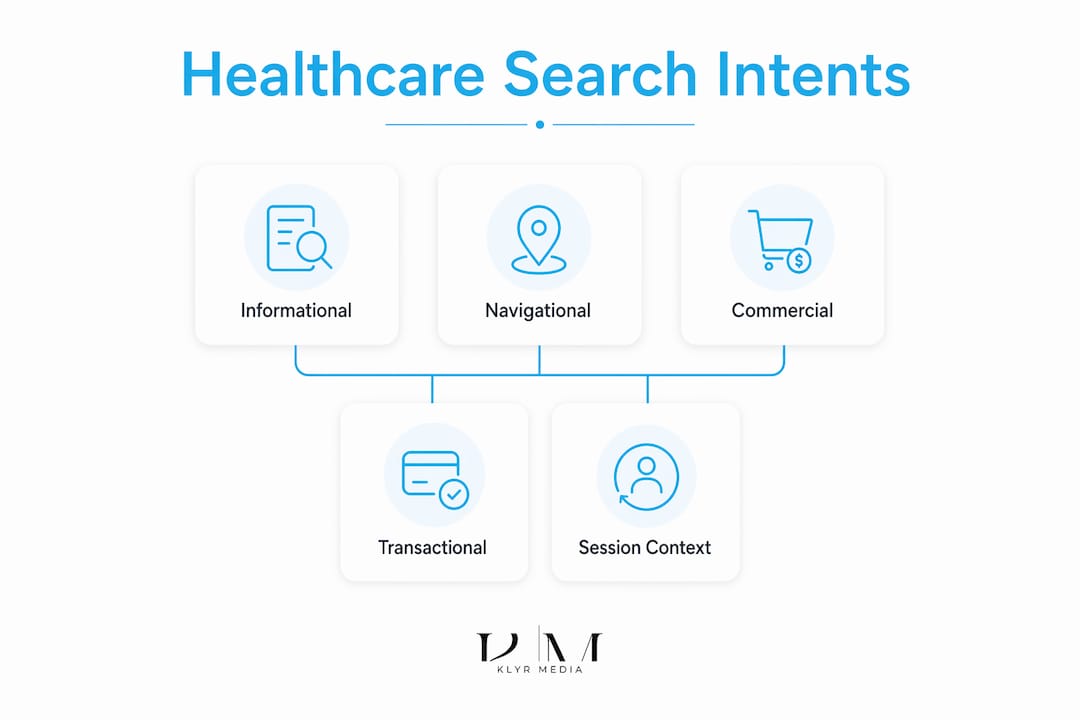
Session-based context improves intent recognition accuracy far more than aggregate keyword data alone. What a user searched before, how long they spent on a page, and what they clicked next all reveal intent more clearly than the query itself. This is why a single keyword report cannot tell you the full story.
The stakes of getting it wrong are high in healthcare specifically:
- Showing a “schedule an appointment” page to someone in a medical crisis creates distrust and may delay care.
- Serving a long educational article to someone ready to book wastes their time and yours.
- Confusing symptom-driven urgency with educational intent causes high bounce rates, which directly damages your search rankings.
“A single search term may represent multiple intents depending on user behavior history. Differentiating symptom-driven urgency from informational curiosity is vital. Content misalignment negatively impacts user trust and SEO ranking.”
The practical implication is this: healthcare providers cannot rely on keyword lists alone. You need to look at the full picture of how patients move through your site and what they do after they search.
How does search intent improve healthcare content and patient communication?
Aligning your content to patient intent is not just good SEO practice. It is good patient care. Here is how each intent type translates into a concrete content or communication action:
-
Build trust with informational content. Patients searching for health education need compliance-first content that is accurate, empathetic, and written at a reading level they can follow. Blog posts, condition explainers, and FAQ pages serve this group. When you answer their questions well, they remember your practice when they are ready to act.
-
Reduce friction for transactional intent. A patient searching “schedule a dermatologist appointment in Phoenix” wants one thing: a booking button. Website optimization focused on search intent places that button front and center, with doctor profiles and trust signals nearby. Improved intent alignment leads to better patient journeys and higher conversion rates.
-
Support decision-making for commercial investigation. Patients comparing providers or treatments need balanced, specific content. Provider bios, before-and-after treatment timelines, and clear explanations of what makes your practice different all serve this intent. Do not hide this information behind a contact form.
-
Optimize local visibility for navigational intent. When a patient searches for your clinic by name, your Google Business Profile, website metadata, and local SEO structure must make you easy to find. Navigational intent optimization improves local SEO and enhances patient usability by making specific clinics and doctors easy to find online. This is especially critical for independent practices competing with large health systems.
Practical strategies for healthcare professionals to apply search intent
Knowing the theory is one thing. Putting it to work in your practice’s digital presence is another. These are the moves that actually produce results:
-
Audit your current content by intent type. Pull your top 30 pages by traffic and label each one: informational, navigational, commercial, or transactional. You will almost certainly find gaps. Most independent practices are heavy on informational content and thin on transactional pages.
-
Add conversion mechanisms to high-intent pages. Urgent symptom searches produce the richest transactional intent. A click-to-call button, a live chat option, or a same-day appointment link on those pages converts patients who are ready to act right now.
-
Use search query data to spot intent patterns. Google Search Console shows you the exact queries driving traffic to each page. Sort by click-through rate. Low CTR on a high-impression query usually means your page title and meta description do not match the intent behind the search.
-
Monitor on-site behavior for context signals. Time on page, scroll depth, and exit pages tell you whether your content matched what the patient actually needed. A patient who reads 80% of a condition explainer and then bounces is different from one who reads 10% and leaves. Treat them differently.
-
Avoid the most common pitfall: one-size-fits-all landing pages. A single “Services” page cannot serve informational, commercial, and transactional intent at once. Healthcare keyword strategies work best when each page targets one specific intent with one specific audience in mind.
Pro Tip: Create a separate landing page for each high-value service, optimized for transactional intent. Include the provider’s name, credentials, a patient review, and a booking link above the fold.
Key Takeaways
Search intent in healthcare is the single most important factor in determining whether your digital content reaches patients at the right moment or misses them entirely.
| Point | Details |
|---|---|
| Four intent types exist | Informational, navigational, commercial investigation, and transactional each require a distinct content approach. |
| Context beats keywords | Session-based behavior reveals true intent more accurately than keyword data alone. |
| Mismatched content hurts rankings | Confusing urgency-driven searches with educational intent raises bounce rates and damages SEO performance. |
| Transactional pages need conversion tools | Click-to-call buttons, booking links, and trust signals belong on every high-intent page. |
| Local SEO serves navigational intent | Optimizing metadata and your Google Business Profile makes your practice easy to find by name. |
The uncomfortable truth about search intent in healthcare
I have reviewed dozens of healthcare websites where the team worked hard on content but still saw flat traffic and low appointment conversions. The problem was almost never the writing quality. It was intent mismatch. A beautifully written blog post about managing chronic back pain does nothing for a patient who searched “orthopedic surgeon near me accepting new patients.” That patient had transactional intent. The blog post served informational intent. The gap cost a real appointment.
The part that frustrates me most is how fixable this is. You do not need a massive budget or a complete website rebuild. You need to look at your top pages, ask what the patient actually wanted when they arrived, and then give them that. A booking button in the right place. A phone number that is actually clickable on mobile. A provider bio that answers “why should I trust this person with my health?”
AI-powered intent recognition is getting better fast, and session-based context analysis will soon make real-time intent matching possible at scale. But right now, in 2026, the practices winning online are the ones doing the basics right. They match content to intent. They put conversion tools where patients with urgent needs can find them. They enhance their online presence with the patient’s journey in mind, not the provider’s org chart.
The practices that ignore search intent are not just leaving traffic on the table. They are leaving patients without the right information at the right time. That is the real cost.
— Opinly
How Klyrmedia helps healthcare providers act on search intent
Knowing what patients want when they search is only half the equation. The other half is having a website and marketing system built to respond to that intent in real time.
Klyrmedia builds HIPAA-compliant websites designed specifically around the four healthcare intent types, so every page serves a clear patient need without compromising security or compliance. For practices ready to go further, Klyrmedia’s AI-powered marketing automation personalizes follow-up communication based on where patients are in their decision process. Whether a patient is researching a condition or ready to book, the right message reaches them at the right time. Independent pharmacies, medical clinics, and healthcare practices across the United States use these systems to compete with larger chains on a fraction of the budget.
FAQ
What is search intent in healthcare?
Search intent in healthcare is the underlying motivation behind a patient’s or provider’s online search query. It is categorized as informational, navigational, commercial investigation, or transactional, each requiring a different content response.
Why does search intent matter for healthcare marketing?
Search intent determines whether your content matches what a patient actually needs at that moment. Mismatched content raises bounce rates, damages search rankings, and costs you real patient appointments.
What are the four types of search intent for healthcare?
The four types are informational (seeking knowledge), navigational (finding a specific provider or facility), commercial investigation (comparing options), and transactional (ready to book or take action).
How does session context improve healthcare search intent recognition?
Session-based context, including prior searches, time on page, and click behavior, helps distinguish between a patient in a medical emergency and one doing general research, even when the query words are identical.
How can healthcare providers optimize for transactional search intent?
Transactional intent pages should include click-to-call buttons, online booking links, provider credentials, and patient reviews placed above the fold, removing every barrier between the patient and the appointment.

