

Local Search Optimization for Healthcare: 2026 Guide

Local search optimization is the practice of improving your healthcare business’s visibility in location-based search results so nearby patients find you first. The industry term for this is local SEO, and it covers everything from your Google Business Profile to the consistency of your name, address, and phone number across the web. 46% of all Google searches are local, and “near me” queries have grown 500% over the last five years. That number tells you one thing clearly: patients are already searching for what you offer. The question is whether your clinic or pharmacy shows up when they do.
What is local search optimization and why does it matter for healthcare?
Local search optimization is defined as the process of making your business appear prominently in Google Search, Google Maps, and the Local Pack when someone nearby searches for your services. For healthcare providers, this is not a nice-to-have. It is how independent pharmacies and medical clinics compete with large chains that have national ad budgets.
Local SEO targets existing demand, capturing patients who are already looking for a provider right now. That is fundamentally different from running a brand awareness campaign. A patient searching “urgent care near me” or “pharmacy open Sunday in Austin” has already made the decision to seek care. Your job is simply to be visible at that moment.

The benefits of local search optimization compound over time. A well-optimized Google Business Profile, a clean citation footprint, and a steady stream of reviews build authority that keeps paying off for months and years. That is the kind of return that a paid ad stops delivering the moment you cut the budget.
What are the primary local search ranking factors for healthcare providers?
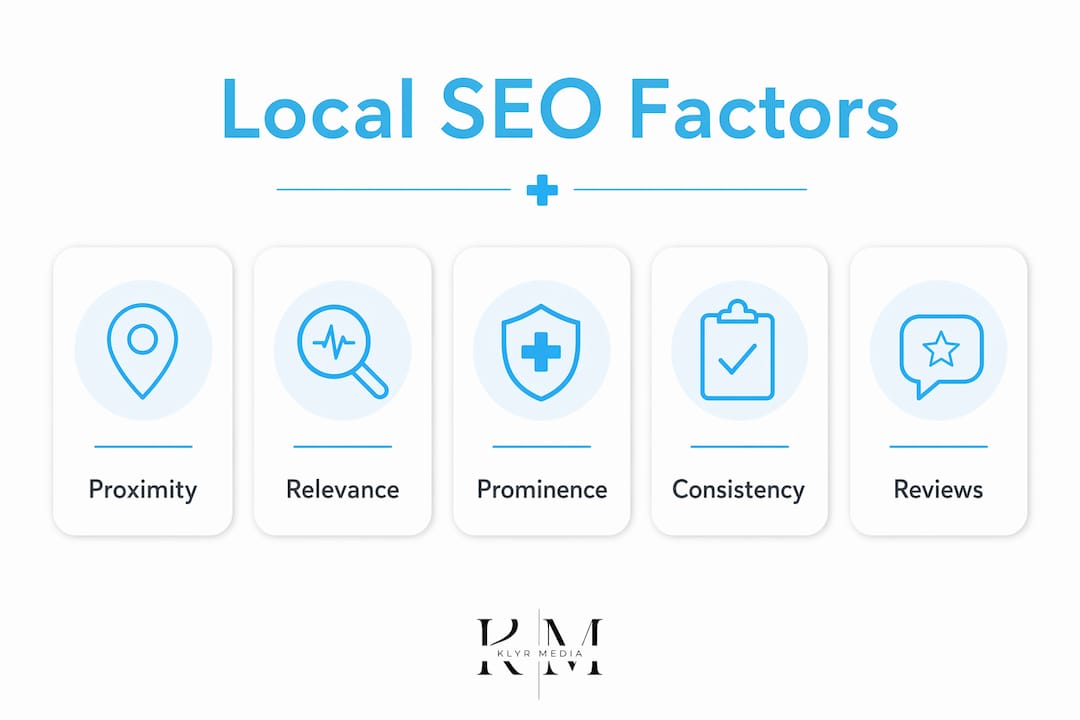
Google’s local algorithm operates on three core pillars: proximity, relevance, and prominence. Understanding each one tells you exactly where to focus your effort.
- Proximity is how close your practice is to the person searching. You cannot move your building, but you can make sure Google knows precisely where you are by keeping your address accurate and consistent everywhere it appears online.
- Relevance is how well your profile and website match what the patient is searching for. A clinic that lists “family medicine,” “pediatric care,” and “same-day appointments” in its Google Business Profile categories and services will rank for more queries than one with a bare-bones listing.
- Prominence is your reputation in Google’s eyes. It includes your review count, your average star rating, your citation volume, and how often authoritative sites mention your practice.
Google Business Profile photos matter more than most providers realize. Profiles with photos receive 42% more direction requests. That is patients literally navigating to your door because your listing looked credible and complete.
NAP consistency is one of the most common failure points. Inconsistent business hours across directories confuse patients and trigger Google penalties. If your address is listed as “Suite 200” on your website but “Ste. 200” on Yelp and something else on Healthgrades, Google treats those as different businesses. That inconsistency costs you rankings.
Pro Tip: Run a free audit on BrightLocal or Moz Local to find every place your NAP data appears online. Fix the mismatches before you build any new citations.
How does local SEO differ from traditional SEO for healthcare marketers?
Traditional SEO and local SEO solve different problems. Here is how they compare directly:
| Factor | Traditional SEO | Local SEO |
|---|---|---|
| Target audience | National or global searchers | Patients within a geographic area |
| Primary goal | Build broad keyword rankings | Appear in Google Local Pack and Maps |
| Key signals | Backlinks, content depth, domain authority | GBP optimization, reviews, NAP consistency |
| Search intent | Informational or broad commercial | High-intent, ready-to-act local queries |
| Timeline to results | 6–18 months | 3–6 months for local visibility gains |
| Content focus | Topic authority across a subject | Location-specific service pages |
Traditional SEO builds demand over time by educating a broad audience. Local SEO captures demand that already exists. For a healthcare provider, that distinction is significant. Someone searching “what is compounding pharmacy” is curious. Someone searching “compounding pharmacy in Denver” is ready to call.
The Local Pack, those three business listings that appear above organic results on Google, gets a disproportionate share of clicks. Ranking in that box is the primary goal of local SEO. Organic rankings matter too, but the Local Pack is where the phone calls come from.
For a deeper look at how healthcare SEO compares to general digital marketing approaches, the distinction becomes even clearer when you factor in HIPAA compliance requirements and patient privacy considerations that generic SEO agencies often overlook.
How to optimize for local search as a healthcare small business
This is where most providers either win or fall behind. The steps are not complicated, but they require consistency and follow-through.
-
Claim and fully complete your Google Business Profile. Choose the most specific primary category available, such as “Medical Clinic” or “Pharmacy.” Add all secondary categories that apply. Fill in every field: services, hours, attributes, description, and photos. An incomplete profile is a missed opportunity every single day.
-
Build 40–60 high-quality citations. Forty to sixty citations in reputable directories is the target for most local businesses. For healthcare, prioritize Healthgrades, WebMD, Zocdoc, Yelp, and the major data aggregators like Data Axle and Neustar Localeze. After 60 citations, the marginal return drops. Shift that energy to reviews and content instead.
-
Create location-specific service pages on your website. Each page should be at least 500 words and cover a specific service at a specific location. “Flu shots at our Phoenix clinic” performs better than a generic services page. Include your city, neighborhood, and nearby landmarks naturally in the copy.
-
Earn and manage reviews actively. Review velocity and response rates significantly impact local rankings. Ask every satisfied patient to leave a Google review. Respond to every review, positive or negative, within 48 hours. A practice with 80 reviews and a 4.7 rating will outrank a competitor with 12 reviews and a 4.9 rating in most cases.
-
Add healthcare schema markup to your website. Structured data tells Google exactly what your business is, where it is located, what services you offer, and what your hours are. Use MedicalClinic or Pharmacy schema from Schema.org. This is a technical step, but it pays off in how Google displays your listing.
-
Prioritize mobile speed. Mobile devices account for 64% of local searches. A page that loads in under two seconds on a phone keeps patients engaged. A slow page sends them to your competitor. Use Google PageSpeed Insights to find and fix the biggest issues first.
Pro Tip: Set a monthly calendar reminder to update your Google Business Profile with a new post, a seasonal offer, or updated hours. Google rewards active profiles with better visibility.
For a complete walkthrough of optimizing your GBP specifically for healthcare settings, including which categories and attributes matter most for clinics and pharmacies, Klyrmedia has put together a dedicated resource.
How are AI-driven search engines changing local SEO in 2026?
AI-powered search tools like ChatGPT, Perplexity, and Google’s AI Overviews are now part of how patients find healthcare providers. This creates a second layer of visibility you need to think about alongside traditional Google rankings.
Answer Engine Optimization, or AEO, is the practice of structuring your content so AI models can extract accurate information about your business and recommend it in response to patient queries. It complements local SEO rather than replacing it.
Here is what matters for AI visibility in 2026:
- Entity signals over keyword stuffing. AI models understand context. They recognize your practice as a specific entity with a location, specialty, and reputation. Build content that reinforces those signals clearly and consistently.
- Structured, direct content. AI tools pull answers from content that is easy to parse. Short paragraphs, clear headings, and direct answers to common patient questions all help AI systems cite your practice accurately.
- Avoid overusing “near me” in your copy. Modern search engines infer proximity from your Google Business Profile address and website signals. Stuffing “near me” into your content reads as spam to both Google and AI models.
- Unified strategy across platforms. Your GBP, website, citations, and content should all tell the same consistent story about who you are, where you are, and what you treat. Inconsistency confuses AI models just as it confuses Google.
AEO enables AI tools to discover and recommend your business accurately, extending your reach beyond the traditional Google Local Pack into the growing share of patients who start their search with an AI assistant.
Key takeaways
Local search optimization is the single highest-ROI digital marketing channel for healthcare providers because it captures patients who are already ready to act, not just browse.
| Point | Details |
|---|---|
| Three ranking pillars | Proximity, relevance, and prominence drive every local ranking decision Google makes. |
| Citation target | Build 40–60 consistent citations, then shift focus to reviews and location-specific content. |
| Reviews drive rankings | Review velocity and response rate affect local rankings more than many technical factors. |
| AI search is real now | AEO complements local SEO by helping AI tools recommend your practice accurately. |
| Mobile is non-negotiable | 64% of local searches happen on mobile, making page speed a direct ranking factor. |
Why local SEO in healthcare is a long game worth playing
I have seen healthcare providers pour money into paid ads, get a spike in calls, and then go quiet the moment the budget runs out. Local SEO does not work that way. The gains compound. A Google Business Profile you optimize today keeps working six months from now. Reviews you earn this quarter raise your ranking next quarter.
The misconception I run into most often is that “near me” keywords belong in your website copy. They do not. Google already knows where your clinic is. Forcing “pharmacy near me” into your homepage text looks unnatural to patients and signals spam to Google’s algorithm. Focus on your actual services and your actual location. That is what earns rankings.
Review management is the lever most independent practices underuse. I have watched a clinic go from page two to the Local Pack in under four months by simply asking patients for reviews consistently and responding to every single one. The velocity of new reviews signals to Google that your business is active and trusted. That signal outweighs a lot of technical factors.
The AI shift is real, and it is happening faster than most healthcare marketers expect. Patients are asking ChatGPT and Perplexity which clinic to visit. If your content is not structured to answer those questions clearly, you are invisible to a growing segment of your market. Start treating AI visibility as part of your local SEO strategy now, not later.
— Opinly
How Klyrmedia helps healthcare providers win local search
If you run an independent pharmacy, medical clinic, or healthcare practice, you already know how hard it is to compete with large chains that have dedicated marketing teams. Klyrmedia was built specifically for this problem.
Klyrmedia’s healthcare SEO services cover Google Business Profile optimization, citation management, review strategy, location-specific content, and schema markup, all built around the compliance requirements your practice faces. The team also designs HIPAA-compliant websites that are built to rank locally and convert patient visits into booked appointments. If you are ready to stop losing patients to competitors who simply show up first in search results, Klyrmedia is the place to start.
FAQ
What is local search optimization in simple terms?
Local search optimization, also called local SEO, is the process of making your business appear in Google Search and Maps when nearby people search for your services. It involves optimizing your Google Business Profile, managing reviews, and keeping your business information consistent across the web.
Why optimize for local search if you already have a website?
Having a website does not guarantee local visibility. Local SEO targets the Google Local Pack and Maps results, which appear above organic website listings and capture the majority of clicks from high-intent local searches.
How long does local SEO take to show results?
Most healthcare providers see meaningful local ranking improvements within 3–6 months of consistent effort. Sustained optimization over 6–12 months produces the strongest and most durable results.
What are the most important local search ranking factors?
Google ranks local businesses based on proximity to the searcher, relevance of your services to the search query, and prominence, which includes your reviews, citations, and overall online reputation.
How do reviews affect local search rankings?
Review velocity, recency, and response rates are primary local ranking factors. Actively earning new reviews and responding to existing ones signals to Google that your business is active and trustworthy, which directly improves your position in local results.

