

The Role of AI in Healthcare: A 2026 Practical Guide

Artificial intelligence has moved from a buzzword to a genuine force reshaping how care gets delivered, documented, and marketed across the United States. The role of AI in healthcare now spans clinical decision support, administrative automation, personalized medicine, and patient engagement — and the pace of adoption is accelerating. Whether you run an independent clinic, a pharmacy, or a large health system, understanding where AI actually works (and where it still needs a human hand) is no longer optional.
Here is a quick orientation on what AI does across the healthcare system:
- Clinical: Analyzes imaging, flags disease risk, supports treatment planning
- Administrative: Automates scheduling, billing, medical coding, and EHR documentation
- Patient engagement: Powers chatbots, appointment reminders, and adherence tools
- Marketing: Personalizes outreach, predicts patient acquisition costs, and automates follow-up
- Research and drug development: Accelerates target identification, trial design, and safety monitoring
The WHO, US Congress, and the European Commission have all weighed in on AI’s promise and its risks, making governance and ethical oversight as central to the conversation as the technology itself.
What AI technologies actually power healthcare today?
Not all AI is the same, and the distinctions matter when you are trying to understand what a given tool can and cannot do.
Machine learning (ML) is the engine behind most clinical AI. ML algorithms train on large datasets — patient records, imaging files, lab results — and learn to recognize patterns that predict outcomes. Deep learning, a subset of ML using layered neural networks, is what allows AI to read an X-ray or flag an irregular heartbeat with accuracy that rivals trained specialists.
Natural language processing (NLP) handles the unstructured text that fills healthcare: physician notes, discharge summaries, prior authorization letters. NLP tools extract meaning from that text, making it usable for analysis and automation. Rule-based expert systems, which have been embedded in EHRs since the 1980s, apply “if-then” logic to flag drug interactions or prompt clinical reminders.
The data sources these technologies draw from are equally varied:
- Electronic health records (EHRs): Structured patient histories, medications, diagnoses
- Medical imaging: Radiology scans, pathology slides, retinal photographs
- Genomics: Gene sequencing data used for precision medicine
- Wearables and remote monitors: Continuous vital signs, glucose readings, activity data
- Claims and billing data: Administrative records that reveal utilization patterns
Deep learning systems that integrate imaging, genomics, and EHR data simultaneously are now enabling disease detection and personalized care that was simply not possible five years ago. The Congress.gov Congressional Research Service report on AI in health care notes that ML techniques, including deep learning and neural networks, underpin the majority of AI tools currently deployed in clinical settings.
How AI is transforming clinical care right now
The clearest wins for AI in clinical medicine are in diagnostics and early detection. AI systems trained on radiology images can identify early-stage cancers, diabetic retinopathy, and pulmonary nodules with accuracy that matches or exceeds radiologists in controlled studies. Prediction models that detect sepsis risk hours before clinical deterioration are now running in ICUs at major US health systems, giving care teams a window to intervene before a patient crashes.

AI enhances clinical decision-making by tailoring care to patient-specific data, including genomics. Personalized treatment planning — once the exclusive domain of oncology — is expanding into cardiology, psychiatry, and chronic disease management. An AI model can weigh a patient’s genetic profile, comorbidities, and medication history to recommend a treatment pathway that a physician might not have reached through intuition alone.
Continuous monitoring is another area where AI earns its keep. Wearable devices feed real-time data to algorithms that flag deterioration before it becomes a crisis. For patients managing heart failure or diabetes at home, that kind of early warning can mean the difference between a phone call from a nurse and an emergency room visit.
The European Commission notes that AI is also transforming pharmaceutical development across the entire medicine lifecycle, from target identification and clinical trial design to pharmacovigilance and post-market safety monitoring. AI-driven trial simulations and patient stratification tools are cutting the time and cost of bringing new drugs to market.
Pro Tip: AI in clinical settings works best as a second opinion, not a replacement. The most effective implementations keep a clinician in the loop for every high-stakes decision. Flag the AI’s output, document it, and let the physician make the call.
Where AI handles the operational grind in healthcare
Clinical care gets the headlines, but the administrative side of healthcare is where AI is quietly saving the most time and money right now. Scheduling, billing, medical coding, prior authorization, and EHR documentation are all repetitive, rule-bound tasks that AI handles faster and with fewer errors than manual processes.

Predictive AI models forecast patient admissions and optimize the use of hospital beds, staff, and equipment, reducing waste and improving care quality. A hospital that knows tomorrow’s admission volume with reasonable accuracy can staff appropriately instead of scrambling at 6 AM.
Key operational applications include:
- Automated scheduling: AI matches appointment slots to patient needs and provider availability, reducing gaps and double-bookings
- No-show reduction: AI-powered scheduling tools reduce patient no-shows by an average of 42% through timely reminders and conversational follow-up
- Medical coding and billing: NLP tools extract diagnosis and procedure codes from clinical notes, cutting coding errors and claim denials
- EHR documentation: Ambient AI listens to patient-provider conversations and drafts clinical notes in real time, giving physicians back hours per week
- Revenue cycle management: AI flags claims likely to be denied before submission, improving first-pass acceptance rates
- OR scheduling: Predictive models optimize surgical block time, reducing cancellations and idle capacity
The payoff for healthcare workers is real. When AI handles documentation and scheduling, nurses and physicians spend more time with patients and less time in front of screens. That is not a small thing in a profession where burnout is a genuine crisis.
What are the real advantages of AI in healthcare?
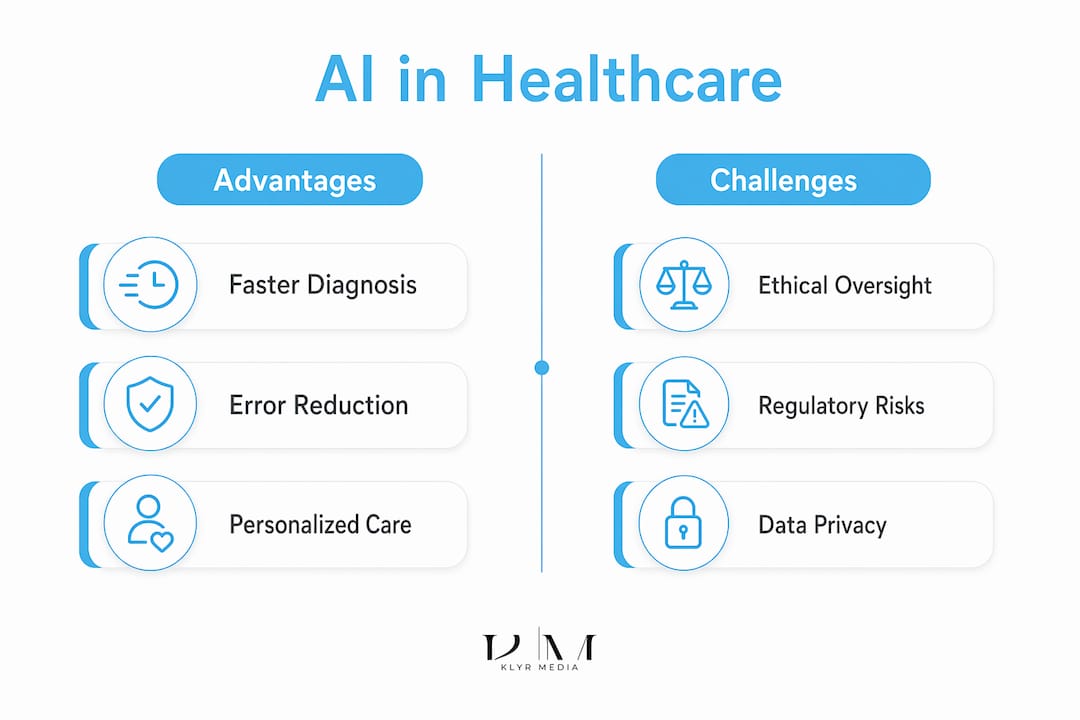
The advantages of AI in healthcare are measurable, not theoretical. Faster diagnosis, fewer errors, better resource use, and more personalized care are all documented outcomes at institutions that have deployed AI thoughtfully.
On the cost side, the European Commission highlights that AI-driven personalized treatment plans reduce the financial burden on healthcare systems by improving treatment effectiveness and reducing unnecessary interventions. In diagnostics, earlier and more accurate detection leads to less invasive, more cost-effective treatment options.
Patient engagement improves when AI is in the mix. Automated follow-up tools, personalized health reminders, and AI-driven care coordination keep patients connected to their care plans between appointments. For underserved communities with limited access to specialists, AI-powered diagnostic tools and telemedicine platforms can extend the reach of expert care without requiring a patient to travel hours for a consultation.
The equity angle is one that both the WHO and the European Commission flag explicitly. AI has the potential to reduce health disparities — but only if the training data reflects diverse populations and the deployment is governed with fairness in mind.
Challenges and ethical considerations you cannot ignore
AI in healthcare is not a plug-and-play solution. The barriers to adoption are real, and skipping over them is how you end up with a tool that harms patients or violates federal law.
The core challenges break down into four categories:
- Data privacy and HIPAA compliance: AI systems require access to sensitive patient data. Every deployment must meet HIPAA standards, and any breach carries serious legal and reputational consequences.
- Algorithmic bias: AI trained on non-representative data produces biased outputs. A model trained mostly on data from white male patients will perform worse on women and people of color — a documented problem in cardiac and dermatology AI tools.
- Interoperability: Most US health systems run on fragmented EHR platforms that do not talk to each other cleanly. Getting AI tools to work across those silos is a genuine technical challenge.
- Clinical acceptance: Physicians who do not understand how an AI reached a conclusion are unlikely to trust it. Explainability is not a nice feature; it is a prerequisite for adoption.
- Regulatory compliance: The FDA regulates AI-based medical devices, and the regulatory landscape is still evolving. Staying compliant requires ongoing attention.
The WHO calls for safe and ethical AI that prioritizes transparency, equity, and human clinical oversight to prevent worsening health disparities. That is not just a global aspiration — it is a practical framework for any US healthcare organization deploying AI.
On the clinical advice front, research warns explicitly against fully autonomous AI chatbots giving medical advice without human review. The risk is not hypothetical: an AI that confidently gives a wrong diagnosis to a patient who trusts it can cause real harm. Human-in-the-loop models, where AI flags and recommends but a clinician confirms, are the standard that responsible deployments follow.
Pro Tip: Before deploying any AI tool in a clinical or patient-facing context, map out exactly where a human reviews the output. If you cannot identify that checkpoint, the tool is not ready for deployment.
What emerging AI trends are reshaping healthcare in 2026?
The pace of change in healthcare AI has not slowed. Foundation models — large, general-purpose AI systems trained on massive datasets — are being adapted for clinical use, enabling capabilities that narrow, task-specific models cannot match. Conversational AI has matured enough that patients can now interact with AI-driven interfaces for appointment booking, symptom triage, and medication reminders without the experience feeling robotic.
AI-driven patient journey simulation is one of the more underappreciated advances of the past two years. These models predict where patients drop off in their care journey — whether that is failing to schedule a follow-up, abandoning a patient portal, or not filling a prescription — and enable targeted interventions before the dropout happens. That kind of friction-mapping was invisible to intuition; now it is quantifiable.
Integration with telemedicine platforms is accelerating. AI tools that analyze video consultations for signs of distress, flag medication adherence gaps from wearable data, or route patients to the right level of care are moving from pilot programs to standard features at forward-thinking health systems.
The regulatory environment is also shifting. The WHO, the European Commission, and US federal agencies are all developing governance frameworks for AI in healthcare, with a shared emphasis on transparency, accountability, and equity. For US healthcare providers, that means the compliance requirements around AI will tighten, not loosen, over the next few years.
How AI is changing healthcare marketing and operations in the US
The role of AI in healthcare marketing has shifted from a curiosity to a core operational function. Predictive analytics now score patient leads by likelihood to convert, so marketing spend goes to the people most likely to book an appointment rather than being spread thin across a broad audience. AI-driven targeting significantly reduces patient acquisition costs, a meaningful advantage as those costs have climbed steadily over recent years.
Content production is another area where the math has changed. Generative AI can compress content production costs by 40 to 70 percent while maintaining compliance in healthcare marketing, when combined with a rigorous compliance review process. That means a clinic can publish more patient education content, more local SEO pages, and more follow-up email sequences without proportionally expanding its marketing budget. The catch is that a human must review every piece before it goes live. AI is the production layer; compliance and brand judgment stay with your team.
HIPAA compliance is non-negotiable in this context. Any AI tool that touches patient data for marketing purposes — retargeting, CRM segmentation, automated follow-up — must operate within HIPAA’s rules. That means no using protected health information for ad targeting without proper authorization, and no storing patient data in non-compliant third-party platforms.
For independent pharmacies and clinics, the practical applications of AI in healthcare marketing include automated appointment reminders, personalized post-visit follow-up sequences, and AI-powered chat on the website that answers common questions and routes patients to the right service. These tools do not replace your front desk staff; they handle the volume that would otherwise go to voicemail.
What skills do healthcare professionals need to work effectively with AI?
AI tools do not run themselves, and the healthcare professionals who get the most out of them are the ones who understand what the tools can and cannot do. That does not mean every nurse needs to learn Python. It means the workforce needs a baseline of AI literacy — enough to ask the right questions, spot a bad output, and know when to escalate.
Successful AI deployment requires multidisciplinary collaboration, clinician AI literacy, and regulatory frameworks to ensure safety and accountability. In practice, that looks like physicians who can interpret an AI-generated risk score without treating it as gospel, nurses who know how to flag an anomalous alert, and administrators who understand the compliance requirements of the tools they are purchasing.
Training programs are emerging at medical schools, nursing programs, and continuing education providers across the US. The American Medical Association has published guidance on AI competencies for physicians. Health systems are building internal AI governance committees that include clinicians, ethicists, IT staff, and legal counsel — because no single discipline has all the answers.
For marketing and operations staff at healthcare organizations, the skill gap is different but equally real. Understanding how to prompt an AI content tool, review its output for clinical accuracy, and route it through a compliance check is a new workflow that most teams are still building. The organizations that invest in that training now will have a meaningful advantage as AI becomes standard infrastructure.
Real AI implementations at US healthcare institutions
Several US health systems have moved well past the pilot stage and are running AI at scale. The results are instructive.
Mayo Clinic has deployed AI tools for ECG analysis that detect conditions like low ejection fraction — a marker of heart failure — from a standard 12-lead ECG that a cardiologist might read as normal. The AI catches a signal the human eye misses, prompting further workup that leads to earlier treatment.
Cleveland Clinic uses AI-driven predictive models to identify patients at high risk for hospital readmission before they are discharged. Care coordinators use those risk scores to prioritize follow-up calls, reducing readmissions and the associated costs.
Kaiser Permanente has integrated NLP tools into its EHR workflow to surface relevant clinical information during patient encounters, reducing the time physicians spend searching through records and increasing the time they spend talking to patients.
On the administrative side, health systems using AI-powered prior authorization tools have cut the average turnaround time from days to hours, reducing the administrative burden on both providers and patients. Ambient documentation tools from companies like Nuance (now part of Microsoft) are being adopted by health systems nationwide, with physicians reporting meaningful reductions in after-hours charting time.
These are not edge cases. They are early indicators of where the entire industry is heading, and the gap between organizations that have adopted AI and those that have not is widening every year.
How Klyrmedia helps healthcare providers put AI to work
If you are running an independent pharmacy, a medical clinic, or a specialty practice, you are probably watching larger health systems deploy AI and wondering how any of it applies to you. The honest answer is that most of it does, and you do not need an enterprise IT budget to start.
Klyrmedia builds HIPAA-compliant websites and AI-powered marketing systems specifically for healthcare providers in the US. That means automated patient follow-up, local SEO built for your market, and AI-driven tools that keep your practice visible and your appointment calendar full, without cutting corners on compliance. The digital marketing trends shaping healthcare in 2026 reward providers who act now, not the ones who wait until the technology feels comfortable.
If you want to see what AI-driven growth actually looks like for a practice your size, Klyrmedia is the partner built for exactly that conversation.
Key Takeaways
AI’s most durable advantage in healthcare is that it makes both clinical decisions and operational workflows faster, more accurate, and more personalized without removing the human judgment that patients and regulators require.
| Point | Details |
|---|---|
| AI spans clinical and operational roles | Applications range from imaging diagnostics and sepsis prediction to scheduling automation and EHR documentation. |
| No-show reduction is measurable | AI-powered scheduling tools reduce patient no-shows by an average of 42%. |
| Content cost savings are real | Generative AI can compress content production costs by 40 to 70 percent when paired with a compliance review process. |
| Ethical governance is non-negotiable | The WHO and European Commission both require transparency, equity, and human oversight in every AI healthcare deployment. |
| Workforce AI literacy drives adoption | Successful AI use requires clinicians and staff who can interpret outputs, flag errors, and maintain regulatory accountability. |

