
Missed Call Text Back for Clinics: Setup, Wording, HIPAA
How a missed call text back works for a clinic or pharmacy: what to send, how to stay inside HIPAA and TCPA rules, and how to handle replies and urgent needs.

Missed Call Text Back for Clinics: Setup, Wording, HIPAA
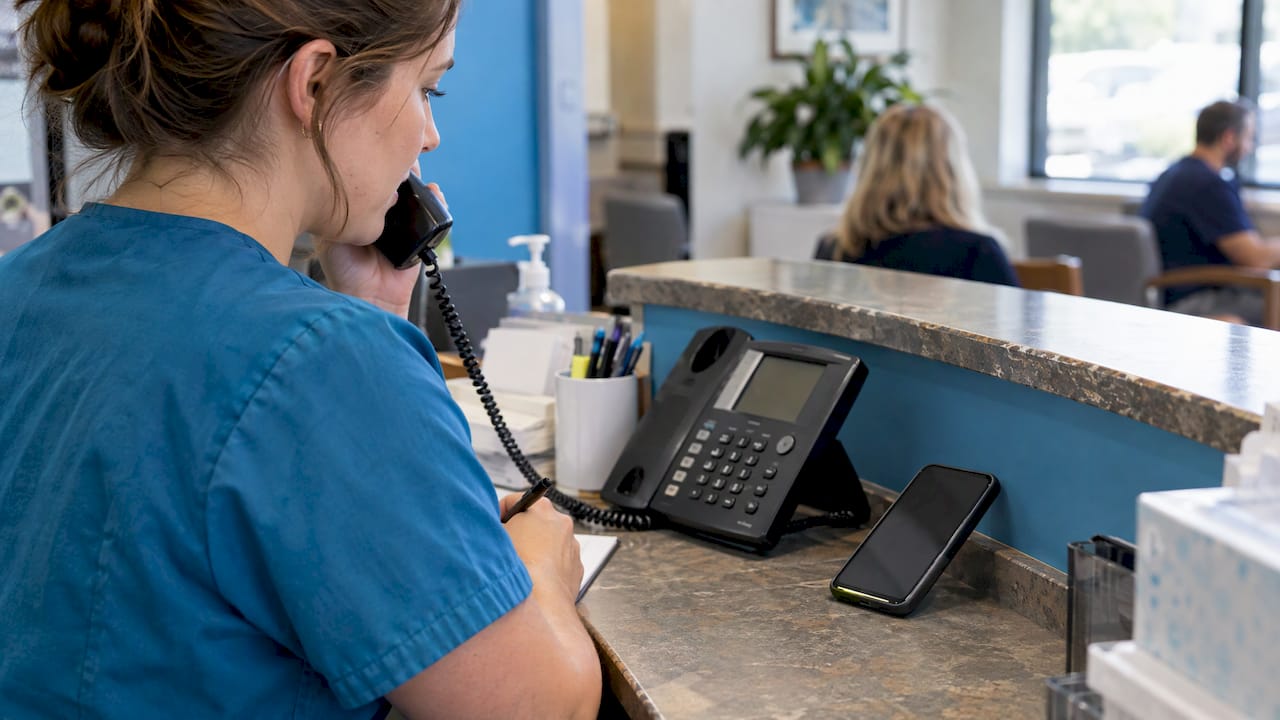
A patient calls your front desk. Nobody picks up. Ten seconds later they are dialing the next practice on the Google Maps list. That is revenue that never walked in, and it leaks every day your phones are busy, your staff is at lunch, or the office is closed.
A missed call text back fixes the first minute of that problem: when a call goes unanswered, the system sends the caller a short text from your practice number, and the conversation moves to a channel your team can answer when it is free. Done well, it is a compliant, plain-worded message that names your practice, invites a reply and never exposes health information. Done badly, it is a TCPA complaint waiting to happen. This guide covers how to set it up, what to write, and what the rules say.
TL;DR
- A missed call text back sends an automatic text to a caller you did not answer, so a patient who would have moved on gets a reply within seconds.
- HIPAA does not forbid contacting patients this way, but the message should reveal as little as possible: your practice name, your number and an invitation to reply or call back.
- Under TCPA rules, keep the text short, honor any opt-out word such as STOP, and never mix in promotions.
- The message is only half the system. Replies, after-hours handling, urgent-need routing and reporting decide whether it recovers patients or just creates a new inbox nobody watches.
- Choose a messaging setup built for healthcare, with a business associate agreement in place, and connect it to your scheduling and follow-up workflow.
Table of Contents
- What a missed call text back actually does
- The rules first: HIPAA and TCPA in plain English
- Setting it up step by step
- What the text should say
- Handling the reply
- What to check when choosing a system
- Where this fits in your patient acquisition
- Where we come in
- Our perspective
- FAQ
- Sources
What a missed call text back actually does
The mechanics are simple. Your phone system detects a call that rang out, went to voicemail, or was abandoned. It triggers a pre-written text to that number. If the caller replies, the thread lands in an inbox or app where staff can continue the conversation.
That matters because of how people behave. A patient with a sore tooth, a sick child or a refill running out does not leave a voicemail and wait. They call the next listing. A text that arrives while they are still holding the phone gives them a reason to stay with you, and lets them answer on their own time without waiting on hold.
For an independent pharmacy, the pattern is familiar. The phone is what breaks. Refill requests, insurance questions and transfer calls stack up at the counter while the technician is mid-fill. For a clinic, it is the front desk juggling check-ins with a ringing line. The text back does not replace anyone. It buys your team a few minutes and keeps the caller engaged.
What it is not
It is not a chatbot that diagnoses or advises. It is not a marketing blast. And it is not a substitute for a way to reach a human when something is urgent. Keep those three lines clear and most of the compliance and patient-safety questions answer themselves.
The rules first: HIPAA and TCPA in plain English
Two sets of rules touch every missed-call text. HIPAA governs what you say about a patient’s health. The TCPA (Telephone Consumer Protection Act, enforced by the FCC) governs automated texts to cell phones.
HIPAA: say less than you think you need to
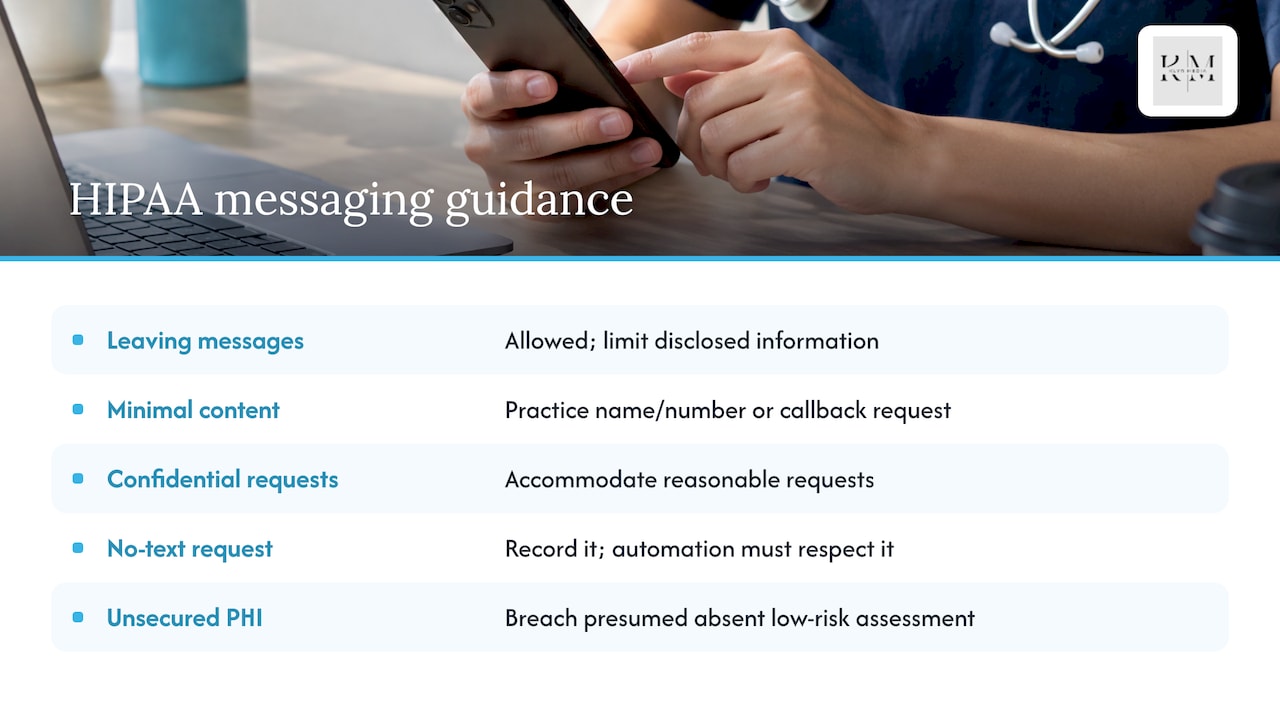
HHS states that the Privacy Rule permits providers to communicate with patients by phone or other means and does not prohibit leaving messages. The same guidance says providers should limit what they disclose, for example leaving only the practice name and number or asking the patient to call back. It also says you must accommodate reasonable requests for confidential communications under 45 CFR 164.522(b). If a patient tells you not to text, that goes in their record and the automation has to respect it.
The practical read: a missed-call text should never mention a condition, a medication, a test result, a provider’s specialty that implies a diagnosis, or an appointment type that would embarrass someone if a family member saw the screen. “Sorry we missed your call” is safe. “Sorry we missed your call about your lab results” is not.
HHS’s Privacy Rule guidance also expects covered entities to apply reasonable safeguards and minimum necessary policies to incidental disclosures. A short, generic text is how you meet that standard in practice.
Once a patient replies and the thread starts to include health details, the platform itself becomes part of your PHI (protected health information) handling. HHS’s audit protocol says a breach of unsecured PHI is presumed unless a risk assessment shows a low probability of compromise, with notice to affected individuals due without unreasonable delay and within 60 calendar days of discovery. That is why the platform choice, covered below, is not a side detail.
TCPA: the text itself has rules
The FCC’s 2015 ruling treats a patient giving their number to a HIPAA-covered provider as prior express consent for healthcare calls and texts. It also exempts certain non-marketing healthcare texts, such as appointment confirmations and prescription notifications, from the written-consent requirement, on conditions. Those conditions are:
- sent only to the patient’s own wireless number
- name the provider and give contact information
- 160 characters or fewer
- no more than one message per day and three per week
- an opt-out by replying STOP, honored immediately
The American Dental Association’s guidance for practices lists the same conditions and adds that the message must contain no marketing or financial content and be free to the recipient. It also recommends having patients sign a consent form, checking that contact numbers are current, and recording phone-number changes promptly.
Two things to notice for missed-call texts specifically. First, the caller may not be an existing patient. A new-patient inquiry is closer to a business conversation than a treatment reminder, so keep that first text neutral and let the caller start the thread. Second, the one-message-per-day limit is a design constraint: your system should send one text per caller per day, not one per missed call.
Opt-outs got stricter
The FCC’s 2024 order, published in the Federal Register on March 5, 2024, says consumers may revoke consent by any reasonable method. It treats replies such as stop, quit, end, revoke, opt out, cancel or unsubscribe as reasonable per se, bars senders from designating an exclusive revocation method, and requires revocations to be honored within a reasonable time not to exceed 10 business days. The order also allows one confirmation text after a revocation as long as it only confirms the opt-out and contains no marketing.
So your setup needs to catch those words, not just the single word STOP, and it needs to suppress future automated texts to that number. A staff member who hears “please stop texting me” at the counter has to be able to record it too. Rules in this area have moved in recent years, so have your compliance counsel confirm what applies to your practice before you launch.
Setting it up step by step
1. Confirm which calls trigger a text
Decide what counts as missed: rang out, sent to voicemail, abandoned in the queue, or after-hours. Most practices want all four, with different wording for after hours. Exclude numbers that are clearly not patients, such as your own staff lines and known vendors.
Where it goes wrong: texting landlines. A text to a landline either fails or reaches no one. Make sure your system checks that the number is a mobile line before sending.
2. Set the limits
One automatic text per number per day. A hard stop on any number that has opted out. Business-hours and after-hours versions. Typical platform settings let you cap auto-replies this way, and this is the setting that keeps you inside the one-per-day condition above.
Where it goes wrong: leaving the default on. Defaults are built for general businesses, not for TCPA healthcare conditions.
3. Write the message
See the next section for wording. Keep it under 160 characters, name the practice, give a callback number, and include opt-out language.
4. Decide who answers replies, and how fast
Assign a person, not “the front desk.” Set an internal target for responding to a reply, say within the hour during business hours, and write down what happens when that person is out. A text back that gets a reply and then sits for two days is worse than no text at all, because the patient knows you saw it.
5. Build the urgent-need path
Texting is not a safe channel for emergencies. Your after-hours message should tell the caller to call 911 for an emergency, and your team should know that a reply describing urgent symptoms gets a phone call, not a text exchange. Clinical triage belongs with your licensed clinicians and your existing protocols, so have your medical director sign off on the after-hours language.
6. Connect it to scheduling and follow-up
The best result is a caller who books. If the reply can flow into your CRM or scheduling workflow, and the patient gets a compliant appointment reminder afterward, the missed call becomes a booked visit rather than a loose thread. Our guide to compliance-first appointment reminders covers that next stage.
7. Track it
Measure four numbers monthly: missed calls, texts sent, replies received, and appointments or fills booked from those replies. Without the last two you are guessing whether it works.
What the text should say
Short, plain, human, and free of health details. Here are three starting points, each under 160 characters:
| Situation | Example text |
|---|---|
| Business hours | Hi, this is Maple Street Pharmacy. Sorry we missed your call. Reply here or call 555-0142 and we’ll get back to you shortly. Reply STOP to opt out. |
| After hours | Thanks for calling Lakeside Family Clinic. We’re closed now. Reply with a good time to reach you, or call 555-0188. For an emergency, call 911. Reply STOP to opt out. |
| Busy line | Hi, Lakeside Family Clinic here. All lines were busy. Reply here and we’ll reach you soon, or call 555-0188. Reply STOP to opt out. |
The names and numbers are placeholders. Check the character count after you swap in your own details, because a long practice name pushes you past 160 fast.
A few writing rules that hold up:
- Name the practice first. Callers see an unfamiliar number and need to know who it is.
- Do not mention services, conditions or drugs. The caller may have dialed from a shared or work phone.
- No promotions. A discount or a flu-shot push turns a healthcare text into marketing and changes the consent you need. For more on that line, see our breakdown of what your practice can text under the TCPA.
- Ask one easy question. “What’s a good time to call you?” gets more replies than “How can we help?”
Handling the reply
The first text is the easy part. What happens next is where practices win or lose the patient.
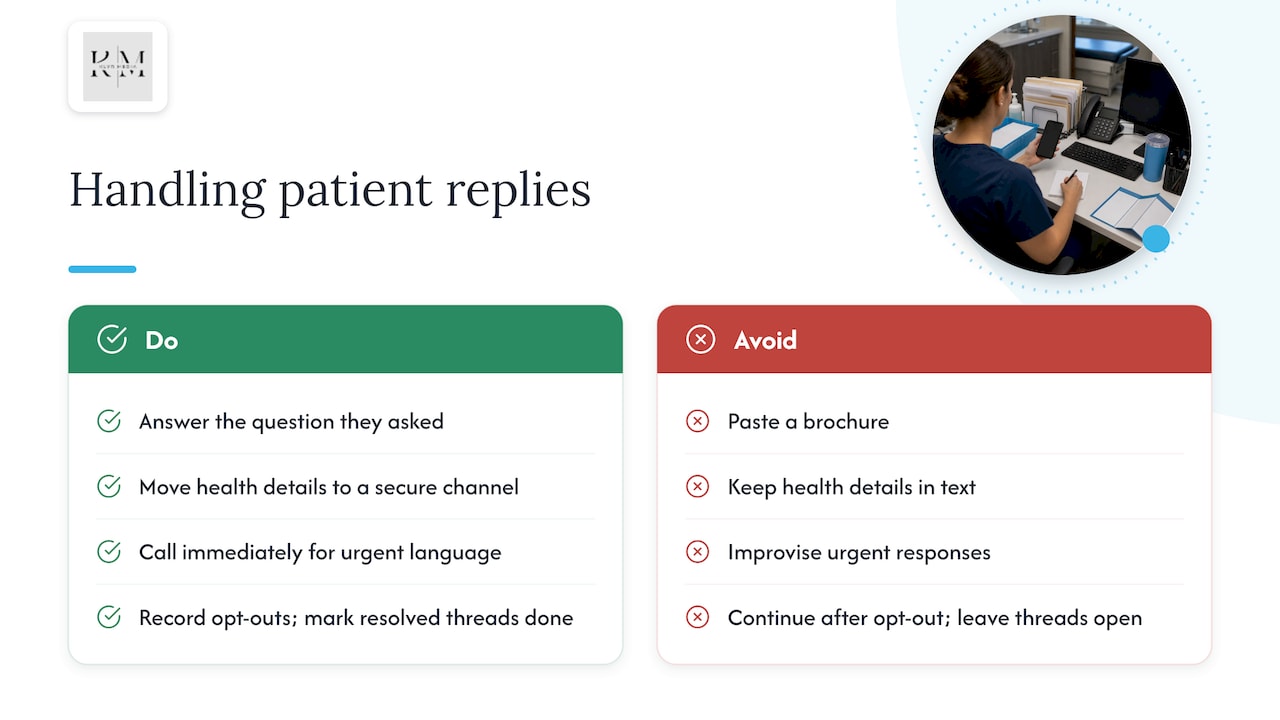
Reply to the question they asked, not the one you wish they had asked. If they wrote “Is my refill ready?”, answer that, or call. Do not paste a brochure.
Move health details to a secure channel. Once the thread turns toward symptoms, results or medications, switch to a phone call or your patient portal. Keep the text thread for logistics: times, callbacks, directions.
Watch for urgent language. Pain, bleeding, breathing trouble, suicidal thoughts. A staff member who spots it calls immediately and follows your clinical protocol. Write this rule down and train it, so no one improvises at 6 p.m. on a Friday.
Respect opt-outs and confidentiality requests. Any reasonable opt-out phrase ends the automation for that number. A patient who asks not to be texted gets recorded as such, in line with HHS’s confidential-communications requirement above.
Close the loop. When the thread ends in a booking, a fill or a resolved question, mark it done. Open threads are how callers get double-contacted.
What to check when choosing a system
Not every text-back tool is built for a practice that handles PHI. Before you commit, work through this list.
- A business associate agreement. If the platform will store or transmit messages that include PHI, you need a signed BAA with the vendor. Our guide to the five documents to get from a HIPAA-compliant SMS platform walks through what to ask for.
- Carrier registration. Business texting in the U.S. runs through 10DLC (10-digit long code) registration. Unregistered traffic gets filtered or blocked, so a text back that never arrives looks like it works while recovering nothing. Our 7-step HIPAA SMS marketing plan covers registration alongside TCPA basics.
- Frequency and opt-out controls. Can you cap one text per number per day? Does it recognize the full set of opt-out words? Does it keep a record?
- Access controls and audit trail. Who can read patient threads, and can you see who did what?
- Secure handoff. Can staff move a conversation to a secure message or call without copying details into a personal phone?
- Reporting. You need missed calls, replies and bookings in one view, not three exports.
- Integration. The text back should connect with your scheduling, CRM and reminder flows. Our overview of secure messaging in healthcare explains how those pieces fit together.
Where this fits in your patient acquisition
A missed call text back only helps if people are calling. The calls come from your Google Business Profile, your local search rankings, your paid ads and your website. When those channels work, every unanswered ring is more expensive. When the follow-up is automated, every ring that does reach you has a better chance of ending in a visit.
Where we come in
We built Klyrmedia for independent pharmacies, medical clinics and healthcare practices in the United States, and compliance is part of the design from day one. Our Retention Automation Service covers email, SMS and CRM-integrated follow-up workflows, and our intelligent chatbots and automation work sits alongside it for practices that want faster responses across channels. If you want the callers you already earn through healthcare SEO and healthcare PPC to turn into booked patients, talk to us about building the follow-up around your phones, your front desk and your rules.
Start at klyrmedia.com and tell us how many calls your team misses in a typical week.
Our perspective
We talk to independent owners all the time, and the same story keeps coming back. The marketing works, the phone rings, and then the call hits a busy desk and vanishes. Nobody sees the loss because a missed call leaves no record of the patient who went elsewhere.
That is why we treat follow-up as part of growth, not an add-on. A text back is a small tool, but it sits at the moment where the most expensive thing you do, getting a patient to call, either pays off or does not.
We also think it has to be built for healthcare from the start. Generic automation does not know about HIPAA, the TCPA conditions on healthcare texts or the difference between a safe message and a risky one. Our systems are designed around compliance and integration, so the text back, the reminder, the reactivation message and the reporting work as one system rather than four tools stitched together.
Independent practices are competing with chains and online giants. You will not beat them on ad budget. You can beat them on responsiveness.
Opinly
FAQ
Is it legal to text someone who called and was not answered?
Generally, yes, when you follow the conditions. HHS says HIPAA does not prohibit contacting patients by phone or other means, and the FCC’s healthcare framework allows certain non-marketing texts to patients if they are short, name your practice, are limited in frequency and include an opt-out. Because rules and your situation vary, confirm your setup with your compliance counsel.
Can the text mention why the patient called?
No. You do not know who is holding the phone, and HHS guidance points providers toward limiting what is disclosed, such as the practice name and number or a request to call back. Keep the first text generic and move specifics to a call or secure channel.
How many missed-call texts can I send the same person?
The FCC’s healthcare exemption conditions limit messages to one per day and three per week per patient. Set your system to send one automatic text per number per day and to stop entirely after an opt-out.
What if the caller replies STOP, or something else?
Honor it right away. The FCC’s 2024 order treats several words, including stop, quit, end, revoke, opt out, cancel and unsubscribe, as reasonable ways to revoke consent. A single confirmation text is allowed if it only confirms the opt-out.
Does a missed call text back work for pharmacies as well as clinics?
Yes. The mechanics and rules are the same: a short, neutral message that names the pharmacy, gives a number and offers an opt-out. Pharmacies often get the most value because refill and transfer calls come in while staff are mid-fill.
Sources
- HHS: May health care providers leave messages for patients?
- OCR Privacy Rule guidance
- HHS HIPAA Audit Protocol, updated July 2018
- FCC 15-72 Omnibus Declaratory Ruling, 2015
- American Dental Association: Follow the Rules When Phoning Patients
- Federal Register, March 5, 2024: TCPA consent revocation order (PDF)
- Federal Register, March 5, 2024: TCPA consent revocation order (full text)

