
Entity Linked Medical FAQ Schema for Clinics, HIPAA Safe, AI Ready
Build JSON-LD medical FAQ pages with 5–15 clinician reviewed Q&As, add medical entity layering, HIPAA safe tracking, and an AI citation checklist.

Entity Linked Medical FAQ Schema for Clinics, HIPAA Safe, AI Ready

Yes. FAQPage JSON-LD is still a valid, useful structured-data type for healthcare sites, even after Google trimmed the rich-result carousel it used to trigger on the search results page. The immediate move: build dedicated FAQ pages with 5 to 15 clinician-reviewed Q&As, mark them up in JSON-LD, layer in medical Schema.org types, validate the markup, and keep patient-specific data out of it entirely.
TL;DR:
- Implement FAQPage schema with 5 to 15 clinician-reviewed questions and answers, ensuring each question matches visible content exactly.
- Use JSON-LD format with medical-specific schema types such as MedicalCondition, MedicalProcedure, Physician, or MedicalOrganization when relevant.
- Place the schema script in the page head or just before closing body, and include accurate metadata like reviewedBy and dateModified to support AI and search engine trust.
- Avoid marking up FAQ schema on marketing pages or content hidden behind JavaScript accordions that do not render in static HTML.
- Maintain HIPAA compliance by using server-side de-identified tracking, signed BAAs, and confirming no patient-specific data appears in schema or tracking pixels.
Table of Contents
- What Medical Schema Types Actually Belong on a FAQ Page
- How Do You Implement JSON-LD for a Medical FAQ Page?
- Keeping FAQ Content HIPAA-Aware
- Validating and Monitoring Your FAQ Markup
- Why FAQ Schema Still Matters When AI Reads Before Patients Do
- A Rollout Plan for Teams With Limited Bandwidth
- Get Your Medical FAQ Schema Built Right the First Time
- Sources
- FAQ
What Medical Schema Types Actually Belong on a FAQ Page
FAQPage is the container. Inside it, each question and answer pair uses the Question and Answer types, and Schema.org recommends JSON-LD as the preferred format because it keeps the markup separate from your visible HTML instead of tangling it into every element like microdata does. That separation matters for anyone maintaining templates across dozens of clinic or pharmacy pages. One script block, one clean source of truth.
Healthcare content, though, needs more than the generic FAQ type. Schema.org’s health and medical types documentation lays out a family of medical entities built specifically for this purpose: MedicalWebPage, MedicalCondition, MedicalProcedure, Physician, and MedicalOrganization. When a searcher asks “what’s the recovery time after a knee scope,” you’re not just answering a question, you’re describing a procedure tied to a condition, performed by a provider, at an organization. Layering those types turns a flat FAQ into a small knowledge graph search engines and AI systems can actually traverse.
Here’s when each piece earns its place:
- MedicalWebPage wraps the whole page when the content is clinical or health-related, signaling to crawlers that this isn’t a blog post about wellness trends.
- MedicalCondition attaches when an answer names a diagnosis, symptom set, or disease.
- MedicalProcedure attaches when the answer describes a treatment, test, or surgery.
- Physician or MedicalOrganization attaches when a specific provider or practice is the subject of the answer.
One rule that trips up a lot of teams: FAQ schema belongs on dedicated FAQ pages, not on marketing landing pages dressed up with a few Q&As at the bottom to game the rich result. And whatever you mark up has to actually render in the page’s HTML. If your answers only appear after a JavaScript accordion fires, and a crawler doesn’t execute that script, you’ve built schema for content that technically doesn’t exist yet.
How Do You Implement JSON-LD for a Medical FAQ Page?
Building this correctly is less about clever code and more about discipline. Follow these steps in order, and don’t skip the metadata.
- Draft your Q&As first, schema second. Write 5 to 15 real patient questions with answers a clinician has reviewed. Schema formats content, it doesn’t create it.
- Structure the JSON-LD block. Your
@typeisFAQPage, containing amainEntityarray ofQuestionobjects, each with aname(the question text) and anacceptedAnswerof typeAnswerwith atextproperty. - Add authorship and review metadata. Include
author,reviewedBynaming the reviewing physician,datePublished, anddateModified. AddmedicalAudienceif the content targets patients versus clinicians specifically. - Place the script in the page head or just before the closing body tag, wherever your CMS template consistently renders it without getting stripped by a caching layer.
- Match visible content to markup exactly. Every question and answer in the JSON-LD must appear, word for word in meaning, in the readable page content.
- Run a template checklist before publishing: unique questions per page (no duplicate Q&As copy-pasted across ten clinic locations), correct type nesting, zero marketing language in the answer text.
The most common errors are mundane. Invalid JSON from a missing comma or an unescaped quotation mark inside an answer. A missing acceptedAnswer property. Answer text that got truncated when someone copied it from a Word document, bringing along hidden formatting characters. A JSON-LD schema generator can catch structural mistakes before they ever reach staging, which saves you the slower cycle of debugging in a validator after deploy. For a broader view of which schema to prioritize across your whole site, see what healthcare schema markup should you add first.
Pro Tip: Keep one answer template with every required property already stubbed in (author, reviewedBy, dateModified). Copying a complete template is faster and far less error-prone than writing each FAQ’s JSON-LD from a blank file.
Keeping FAQ Content HIPAA-Aware
General medical information is fair game for a public FAQ page: what a condition is, how a procedure works, typical recovery timelines. The line gets crossed when a page starts responding to something specific to an individual patient, a symptom checker that stores inputs, a chat widget that logs a visitor’s health details tied to an identifiable session. That’s where FAQ content stops being marketing copy and starts being a compliance liability.

The technical fix is server-side conversion tracking with PHI stripped or hashed before it ever reaches a third-party analytics tool, paired with signed business associate agreements with every vendor touching that data. De-identification and an audit trail aren’t optional extras, they’re the difference between a page that helps patients and one that exposes your practice.
On the editorial side: every answer gets clinician authorship or review, a defined update cadence (quarterly is reasonable for most conditions), and a visible dateModified stamp so both patients and search engines can see the content is current. Before rollout, run the whole page past legal or compliance: confirm no patient-identifiable data flows through the schema, the tracking pixels, or the form behind the FAQ. For more on the line between compliant and non-compliant service page content, building HIPAA-aware medical service pages covers the same tension from the service-page angle.
- Server-side tracking with de-identified or hashed PHI
- Signed BAAs with every analytics and tagging vendor
- Clinician review on a fixed cadence, logged with
dateModified - Legal sign-off before any FAQ page with clinical claims goes live
Validating and Monitoring Your FAQ Markup
Bad JSON-LD is worse than no JSON-LD, because it can silently fail without breaking your page. Run every FAQ template through Validator and Google’s Rich Results Test before it ever reaches production. Both tools catch missing required properties, malformed nesting, and syntax errors that a human proofreading the visible page would never spot.
If you’re deploying schema across more than a handful of templates, build the check into your deployment pipeline rather than relying on someone remembering to paste code into a browser tool. A staged validation step that blocks a push when markup fails is far more reliable than a manual habit.
Once live, monitoring shifts. Watch for:
- Page-level organic traffic and query click-through rate shifts after launch
- Core Web Vitals, since slow-loading FAQ pages get crawled and cited less reliably
- Direct referrals or citations from AI tools, tracked through internal telemetry since dashboard reporting hasn’t caught up
- Periodic manual checks of AI Overview responses for your target questions, to see whether your content is being surfaced
Search Console’s older FAQ-specific reporting has thinned out, so a lot of that measurement now happens through custom tracking rather than a built-in dashboard. For the metrics side of this, what is healthcare SEO walks through how schema fits into a broader measurement plan, and page-speed fundamentals get more attention in medical website design for 2026.
Why FAQ Schema Still Matters When AI Reads Before Patients Do
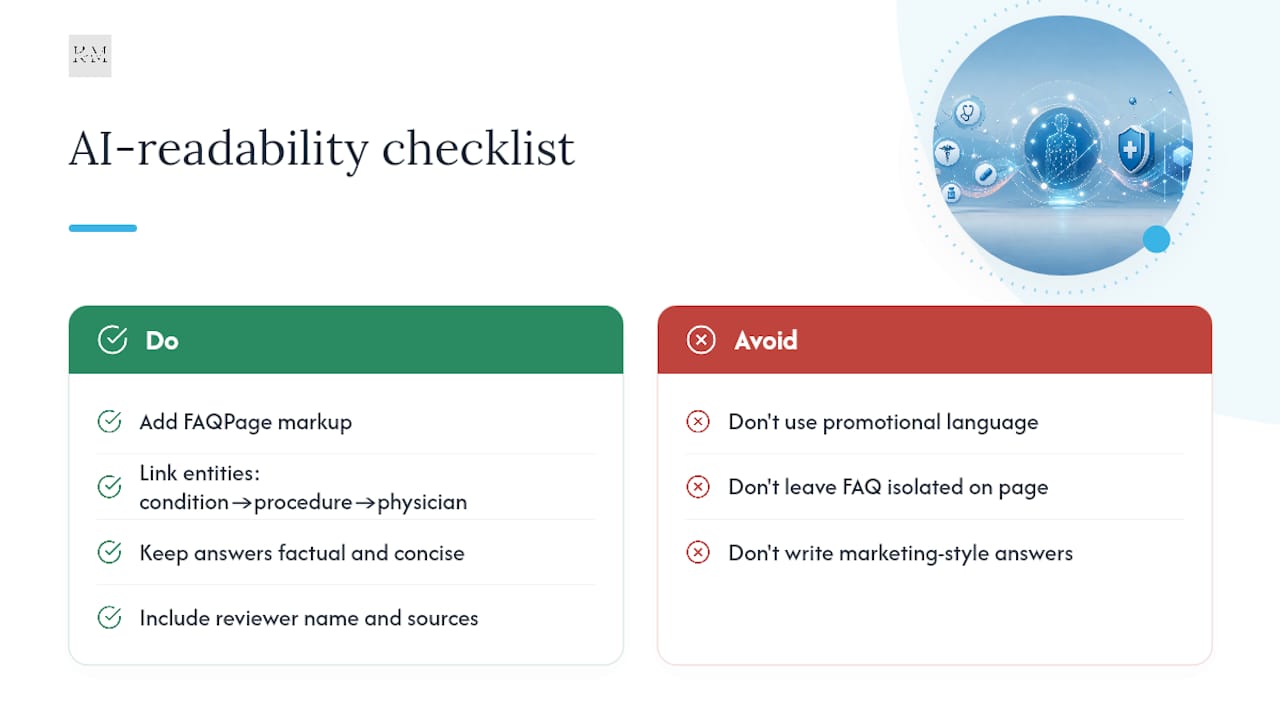
The rich-result dropdown was never the real prize. It was a visible symptom of something more useful underneath: structured, unambiguous content that machines can parse without guessing. That underlying value survived the visual change intact. FAQPage markup, combined with connected medical entities, still helps large language models and AI Overviews locate and cite accurate medical answers, arguably more than it ever helped the old carousel.
The design rules for AI-readable answers are different from the rules for writing persuasive marketing copy. Keep answers factual and concise. Name the reviewing clinician. Cite a source where a claim needs one. Strip out anything that reads like a pitch, because AI systems tend to treat promotional language as a signal to look elsewhere for a cleaner answer.
A tightly connected entity graph, MedicalCondition linked to MedicalProcedure linked to Physician and MedicalOrganization, with persistent identifiers and reviewer metadata, gives a language model something to traverse. An isolated FAQ block sitting alone on a page gives it a dead end.
Set expectations accordingly. You may see AI citations climb in the coming months even if the old visual dropdown never comes back to the search results page. That’s a fair trade for most healthcare sites, since a citation inside an AI answer often reaches a patient at the exact moment they’re deciding whether to call your office.
A Rollout Plan for Teams With Limited Bandwidth
Don’t try to schema-mark your entire site catalog in one sprint. Pick one to three high-traffic conditions or procedures, write 5 to 15 real Q&As for each, get clinician sign-off, add the JSON-LD, validate it, and measure for a full quarter before expanding.
Governance matters more than volume here. Name one clinical owner per condition category who reviews content on a fixed schedule, and one technical owner who owns the templates and validation pipeline. When the work outgrows internal bandwidth, that’s the signal to bring in outside help for a full schema audit, server-side tagging setup, or vendor BAAs, rather than letting markup drift out of date while everyone’s attention is elsewhere.
— Opinly
Get Your Medical FAQ Schema Built Right the First Time
If you’re an independent pharmacy or clinic administrator trying to squeeze schema implementation between patient calls and staffing gaps, Klyrmedia built its entire model around not asking you to. Klyrmedia specializes exclusively in healthcare, which means the HIPAA-compliant web design work already accounts for PHI-safe tracking and clinician metadata, so you’re not explaining medical compliance basics to a generalist agency on your own clock.
Klyrmedia’s healthcare SEO service covers schema implementation as part of a broader technical foundation, including validation, medical entity layering, and server-side tracking configured with BAAs already in mind. And because patient retention doesn’t stop once someone finds your FAQ page, the retention automation service picks up the privacy-aware tracking thread on the conversion side, so the same PHI-safe standards apply from search result to appointment booking. Request a schema audit and implementation estimate to see exactly what your current FAQ pages are missing.
This article is general information, not a substitute for advice from a qualified doctor. Consult a qualified healthcare professional about your own circumstances before acting on anything here.
Sources
- Health and medical types
- Schema Markup Validator
- Schema Markup for Healthcare AI Search: FAQ, Article… | Curve
FAQ
Is There a ChatGPT for Medical Questions?
General-purpose AI tools like ChatGPT can answer medical questions, but they aren’t a substitute for reviewing a specific practice’s clinically verified content. Well-structured FAQPage markup with reviewedBy metadata gives these tools cleaner, more trustworthy material to draw from when a patient asks about your practice specifically.
What Does FAQ Schema Actually Do?
FAQPage markup tells search engines and AI systems exactly which text on your page is a question and which is its answer, using structured Question and Answer types. It doesn’t guarantee a visual rich result anymore, but it still improves how accurately machines parse and cite your content.
What Should Be Included in a Physician-Reviewed FAQ?
A clinician-reviewed medical FAQ answer should include the reviewing physician’s name, a dateModified stamp showing when it was last checked, and language free of promotional claims. Pairing the answer with relevant MedicalCondition or MedicalProcedure schema strengthens the entity connections that help AI systems trust and cite the content.
How Many FAQs Should a Medical Page Have?
Most healthcare-focused guidance recommends 5 to 15 well-written Q&A pairs per dedicated FAQ page, each created or reviewed by a medical professional. Fewer than that rarely justifies a dedicated page, and more tends to dilute focus and invite duplicate questions across a site.
Does Klyrmedia Handle Medical FAQ Schema Implementation?
Yes, Klyrmedia builds FAQ schema and broader structured data as part of its healthcare SEO service, including validation and PHI-safe tracking setup. Pricing is available on request through the site.

