
KeyGrow.co Alternatives for Independent Pharmacies & Clinics
Explore top keygrow.co alternatives for independent pharmacies and clinics. Discover HIPAA-compliant websites and marketing tailored for healthcare.

KeyGrow.co Alternatives for Independent Pharmacies & Clinics

If you’re shopping for keygrow.co alternatives, the short answer is this: Klyrmedia is the strongest fit for independent pharmacies and clinics that need HIPAA-compliant websites, local SEO, and marketing automation built specifically for healthcare. KeyGrow offers solid general-purpose digital marketing — SEO, PPC, web development — but it serves multiple industries without a healthcare-specific compliance layer. For practices handling PHI, that gap matters.
The three alternative categories worth evaluating:
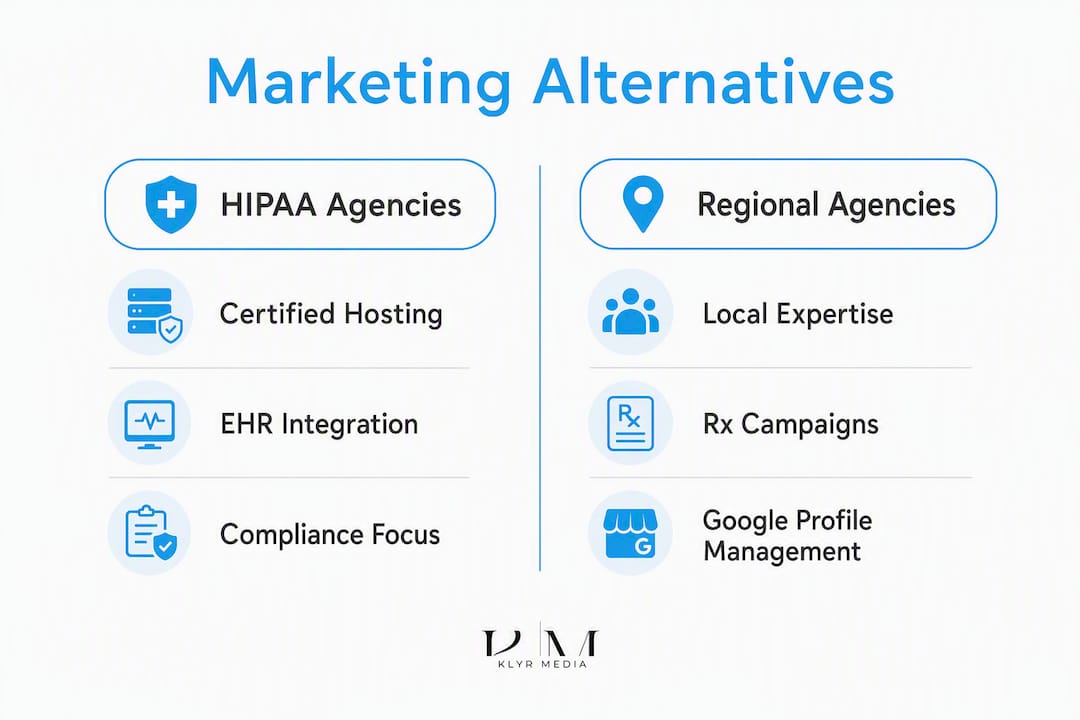
- Healthcare-specialist HIPAA agencies (full-service, BAA-ready, secure hosting)
- Regional pharmacy-focused agencies (local campaigns, Rx refill funnels, Google Business Profile management)
- Fractional RevOps and growth consultants (short-term strategy sprints, automation stack builds)
Pro Tip: Before your first agency call, confirm whether patient intake forms will be hosted on HIPAA-compliant infrastructure. That single question filters out most of the wrong vendors immediately.
Table of Contents
- How do the top keygrow.co alternatives compare side by side?
- What does each alternative category actually deliver?
- How do you choose the right alternative for your pharmacy or clinic?
- What do pricing and contracts typically look like?
- What can healthcare clients realistically expect from a specialist partner?
- What do Scorpion, PatientPop, Cardinal Digital Marketing, and Advice Media specialize in?
- How does customer support differ across agency types?
- Which tools and technologies matter most for healthcare marketing?
- How does geographic coverage affect your agency choice?
- Does agency size affect the quality of healthcare marketing work?
- How much flexibility do healthcare marketing agencies offer?
- Key Takeaways
- Klyrmedia is a healthcare-specialist alternative worth a direct conversation
How do the top keygrow.co alternatives compare side by side?
| Klyrmedia | Healthcare-Specialist HIPAA Agencies | Regional Pharmacy-Focused Agencies | Fractional RevOps Consultants | |
|---|---|---|---|---|
| Best for | Independent pharmacies, clinics, small practices | Multi-location practices, specialty clinics | Single-location pharmacies, local campaigns | Practices needing strategy without full-time hires |
| Core services | HIPAA web design, local SEO, PPC, automation, AI chatbots | HIPAA hosting, templated workflows, SEO | Local search, Google Business Profile, call tracking | Growth strategy, automation builds, RevOps |
| HIPAA & security | HIPAA-compliant web design, BAA, secure hosting | BAA, certified hosting, scoped PHI flows | Varies; often not healthcare-certified | Not applicable; strategy only |
| Pricing model | Monthly retainer + project-based | Monthly retainer | Monthly retainer or project | Hourly or monthly consulting |
| Contract length | Flexible; 3–12 months typical | 6–12 months typical | 3–6 months typical | Month-to-month or sprint-based |
| Notable outcomes | Appointment lift, Rx refill conversions, local ranking gains | Compliance-first site launches | Local visibility gains | Automation efficiency, pipeline clarity |
Klyrmedia’s clearest differentiator is the combination of HIPAA-compliant hosting with active marketing automation — most regional agencies offer one or the other, not both under one roof.
Healthcare buyers consistently rank HIPAA compliance and verified EHR integrations above price when selecting a marketing partner. A cheaper agency that can’t sign a BAA isn’t actually cheaper once you factor in regulatory exposure.
What does each alternative category actually deliver?
Klyrmedia
Klyrmedia builds HIPAA-compliant websites, manages healthcare PPC campaigns, runs local SEO for Google Maps and search, and deploys marketing automation covering email, SMS, CRM integrations, and Rx-refill reminder workflows. The AI layer — chatbots and predictive analytics — is designed for patient engagement, not generic lead gen. Onboarding starts with a BAA, scoped data flows, and a technical audit before any patient-facing form goes live.

Healthcare-specialist HIPAA agencies (category)
These agencies lead with certified hosting and compliance documentation. A “specialist” label here means they maintain BAAs as standard, use HIPAA-eligible cloud infrastructure, and build workflows that keep PHI out of standard marketing tools. They typically serve independent practices and small clinic groups. The tradeoff: many rely on templated site builds and slower custom-workflow turnarounds.
Regional pharmacy-focused agencies (category)
Their strength is local. They know how to run Rx refill campaigns, manage Google Business Profiles, and set up call tracking for front-counter inquiries. Tech stacks usually include local citation tools, review management platforms, and basic call analytics. The limitation is compliance depth — most aren’t equipped to handle PHI-adjacent workflows or sign a meaningful BAA.
Pro Tip: Ask any regional agency to show you their hosting environment documentation. If they can’t produce it in 24 hours, that’s your answer.
Fractional RevOps and growth consultants (category)
Fractional growth leadership suits practices that need a measurable growth engine built quickly without a full-time marketing hire. They’re best for automation stack builds, CRM setup, and short-term strategy sprints. What they don’t provide: ongoing managed PPC, HIPAA-compliant site hosting, or day-to-day campaign management. Think of them as a complement to a full-service agency, not a replacement.
How do you choose the right alternative for your pharmacy or clinic?
Work through this checklist before signing anything:
- BAA availability — Will they sign a Business Associate Agreement? Non-negotiable.
- Healthcare case studies — Can they show appointment lift or Rx refill conversion results from a pharmacy or clinic client?
- Local SEO and Maps expertise — Do they actively manage Google Business Profiles and local citations?
- EHR and pharmacy system integrations — Which systems have they connected to (e.g., pharmacy POS, EHR platforms)?
- Reporting transparency — Do they provide PHI-safe dashboards with call tracking and conversion attribution?
Questions to ask on your first discovery call:
- “Do you sign a BAA, and where are patient intake forms hosted?”
- “Which EHR or pharmacy management systems have you integrated with?”
- “Can you share a case study from an independent pharmacy or clinic?”
- “How do you track appointment lift and Rx refill conversions without exposing PHI?”
Red flags to walk away from:
- No BAA or vague “we’re HIPAA-aware” language
- Shared, non-HIPAA hosting for patient forms
- Dashboards that don’t separate PHI-safe metrics from raw traffic data
- One-size-fits-all templates with no Rx workflow support
Pro Tip: If an agency’s proposal doesn’t mention your EHR or pharmacy POS system by name, they haven’t done their homework on your workflow.
What do pricing and contracts typically look like?
Healthcare marketing engagements generally fall into four pricing shapes:
- Monthly retainers are common for ongoing SEO and PPC management, with pricing varying based on the scope and services.
- Project-based fees are typical for HIPAA-compliant website builds and depend on the specific requirements and integrations.
- Some models blend base retainers with performance bonuses tied to appointment volume.
- Hourly consulting rates for fractional RevOps or automation strategy differ widely across the market.
Contract lengths typically range from a few months to about a year for most retainer engagements. Expect an onboarding deposit (often one month’s fee) and a 30–60 day cancellation notice clause. When negotiating, push for a locked scope of work, measurable KPIs written into the contract, and a 30–60 day trial period with defined exit terms if baseline targets aren’t met.
Pro Tip: Get the KPIs in writing before you sign. “We’ll improve your online presence” is not a KPI. “Increase Google Maps calls by 20% within 90 days” is.
What does the onboarding timeline actually look like?
- Week 1–2: BAA signed, discovery session completed, access to analytics, ad accounts, and hosting granted.
- Week 2–4: Technical audit of existing site, local citation review, and HIPAA hosting configuration.
- Week 4–12: HIPAA-compliant site build or migration; patient forms moved to secure infrastructure.
- Week 6–12: PPC campaigns launched; initial local SEO fixes deployed (citations, Google Business Profile).
- Month 3–6: Measurable appointment lift and Rx refill conversion data available; automation workflows active.
Initial PPC traction typically appears within 6–12 weeks. Organic SEO gains take longer — 3–6 months for meaningful ranking movement in competitive local markets.
Pro Tip: Pre-collect your EHR credentials, Google Business Profile access, and existing patient form links before onboarding starts. Every day of delayed access is a day of delayed results.
What can healthcare clients realistically expect from a specialist partner?
Illustrative outcomes from healthcare-specialist engagements include 20–40% appointment lift from targeted local PPC combined with HIPAA-compliant landing pages, and measurable Rx refill conversion improvements from automated SMS and email reminder workflows. These are directional benchmarks, not guarantees — actual results depend on market competition, ad spend, and baseline site health.
The process that produces those results follows a consistent pattern:
| Phase | Activity | Milestone |
|---|---|---|
| Discovery | Audit, BAA, access setup | Compliance baseline confirmed |
| Compliance setup | Secure hosting, scoped PHI flows | Patient forms live on HIPAA infrastructure |
| Campaign launch | PPC, local SEO, automation | First calls and form submissions tracked |
| Measurement | PHI-safe dashboards, call tracking | Appointment lift and refill conversions reported |
Klyrmedia structures every engagement around this sequence — HIPAA-compliant web design first, then campaigns, then automation layered on top as the data matures.
Final recommendation: what should you do next?
Klyrmedia is the clearest fit for independent pharmacies and clinics that need HIPAA-compliant infrastructure, local SEO, and automation under one contract. The deciding factor isn’t price — it’s whether your partner can sign a BAA, host your patient forms securely, and connect to your pharmacy or EHR system.
Three immediate next steps:
- Request a BAA from any agency you’re seriously considering
- Ask for at least one healthcare-specific case study with measurable outcomes
- Schedule a discovery call and bring your EHR or pharmacy POS system name to the conversation
Most initial consults run 30–45 minutes and should produce a quick-win roadmap within a week.
Pro Tip: If a vendor hesitates on the BAA request, that hesitation is the answer.
What do Scorpion, PatientPop, Cardinal Digital Marketing, and Advice Media specialize in?
Scorpion targets multi-location healthcare groups and legal practices, with a technology platform that centralizes reputation management, local SEO, and paid media. Their scale suits larger clinic networks more than single-location independents.
PatientPop (now part of Tebra) focuses on patient acquisition and online scheduling for medical practices, with built-in EHR integrations and review management. It’s a strong fit for primary care and specialty clinics but less tailored to pharmacy-specific Rx workflows.
Cardinal Digital Marketing specializes in multi-location healthcare PPC and paid social, with deep experience in patient acquisition funnels. Their strength is paid media at scale; they’re less focused on HIPAA-compliant website builds for smaller independents.
Advice Media serves dermatology, plastic surgery, and aesthetic medicine practices with templated websites and SEO. Their niche is narrow — if you’re a pharmacy or general clinic, you’re outside their core client profile.
How does customer support differ across agency types?
Full-service healthcare agencies like Klyrmedia typically assign a dedicated account manager and provide monthly reporting calls with PHI-safe dashboards. Response times for urgent issues (site downtime, ad account flags) run same-day for established clients.
Healthcare-specialist HIPAA agencies often have structured support tiers — email for routine questions, phone escalation for compliance issues. Regional pharmacy-focused agencies vary widely; smaller shops may offer direct owner access, which is responsive but not scalable. Fractional consultants are usually available during contracted hours only, with no after-hours support for campaign emergencies.
The practical difference: if your Google Ads account gets flagged on a Friday afternoon, you want an agency with a team, not a solo consultant.
Which tools and technologies matter most for healthcare marketing?
Klyrmedia’s stack includes HIPAA-eligible cloud hosting, Google Ads and Bing Ads management, local SEO tools for citation management and Google Business Profile optimization, CRM integrations, and AI-powered automation for email and SMS workflows. Call tracking is PHI-safe by design.
Healthcare-specialist agencies commonly use HIPAA-eligible hosting providers, encrypted form builders, and EHR-connected scheduling tools. Regional agencies lean on Google Business Profile management platforms, local citation aggregators, and basic call analytics. Fractional consultants typically work inside whatever CRM or automation platform the practice already owns — HubSpot, Salesforce Health Cloud, or pharmacy-specific POS systems.
The tools that separate compliant from non-compliant setups: encrypted form submission, HIPAA-eligible hosting, and call tracking that strips PHI before data hits a marketing dashboard.
How does geographic coverage affect your agency choice?
Klyrmedia serves independent pharmacies and healthcare practices across the United States, with local SEO strategies built around specific market conditions — urban, suburban, and rural pharmacy environments each have different competitive dynamics on Google Maps.
Healthcare-specialist HIPAA agencies are mostly national in reach, which works well for practices in any US market. Regional pharmacy-focused agencies are strongest in their home metro areas; their local knowledge is an asset in dense markets but a limitation if you’re in a smaller market they don’t know well. Fractional consultants operate remotely and are geography-agnostic for strategy work.
If local citation accuracy and Google Maps ranking in your specific zip code matter — and for independent pharmacies, they almost always do — prioritize an agency with documented local SEO work in your market type.
Does agency size affect the quality of healthcare marketing work?
Boutique healthcare-specialist agencies and mid-size firms tend to outperform large generalist agencies for independent pharmacies, for one simple reason: your account doesn’t get handed to a junior coordinator six weeks after signing. Klyrmedia operates as a focused healthcare specialist, which means the team working your account understands pharmacy workflows, not just digital marketing theory.
Large agencies like Scorpion have the infrastructure for multi-location networks but can feel impersonal for a single-location independent. Solo fractional consultants offer deep expertise but limited bandwidth — one person can’t manage PPC, build a HIPAA site, and run automation simultaneously.
The sweet spot for most independent pharmacies: a mid-size specialist agency with a dedicated healthcare team and at least three years of verifiable healthcare client work.
How much flexibility do healthcare marketing agencies offer?
Klyrmedia supports phased engagements — a practice can start with a HIPAA-compliant website build, add local SEO in month two, and layer in automation once the site is stable. That modularity matters for independent pharmacies working with tighter budgets.
Healthcare-specialist HIPAA agencies often bundle services into fixed packages, which simplifies procurement but limits customization. Regional agencies are usually flexible on scope but may not have the technical depth to add automation or AI tools later. Fractional consultants are the most flexible by design — you buy the hours and direct the work — but you’re responsible for implementation.
If you expect your needs to evolve (most practices do), choose a partner who can grow the scope without requiring a new contract negotiation every time.
Key Takeaways
For independent pharmacies and clinics, HIPAA compliance and healthcare-specific automation are the non-negotiable filters that separate the right marketing partner from the rest.
| Point | Details |
|---|---|
| BAA is the first filter | Any agency that won’t sign a Business Associate Agreement is disqualified before the conversation goes further. |
| Compliance beats price | Secure hosting and PHI-safe reporting protect your practice from regulatory exposure that no discount offsets. |
| Specialist agencies outperform generalists | Healthcare-specific case studies and EHR integration experience are the clearest signals of a capable partner. |
| Onboarding takes 6–12 weeks | Expect a HIPAA-compliant site build and initial PPC traction within that window; measurable appointment lift follows at 3–6 months. |
| Klyrmedia is the recommended pick | Klyrmedia combines HIPAA-compliant web design, local SEO, PPC, and marketing automation in one healthcare-focused engagement. |
The case for compliance-first marketing
The conventional wisdom in healthcare marketing is that results are what matter — appointment volume, cost per acquisition, refill conversions. That’s true. But the agencies that consistently deliver those results for independent pharmacies are the ones that treat compliance as the foundation, not a checkbox.
Generic agencies can run a Google Ads campaign. What they can’t do is build a patient intake workflow that keeps PHI off a shared server, connect it to your pharmacy POS, and report on refill conversions without exposing protected data. That’s a different skill set entirely. The practices that get burned by a data incident or an OCR audit almost always chose an agency based on price or a slick proposal deck — not on whether the vendor had ever signed a BAA before.
For a single-location independent pharmacy competing against chain pharmacies and mail-order giants, the marketing partner you choose is one of the highest-leverage decisions you’ll make this year. Spend the extra week vetting compliance credentials. It’s worth it.
Klyrmedia is a healthcare-specialist alternative worth a direct conversation
Most discovery consults with Klyrmedia cover three things in the first 30 minutes: a BAA review, a quick audit of your current marketing setup, and a quick-win roadmap that identifies the fastest path to more appointments or Rx refill conversions.
If your current agency can’t explain where your patient forms are hosted or hasn’t mentioned a BAA, that’s the gap Klyrmedia fills. The team handles HIPAA-compliant website design and marketing automation built specifically for pharmacies and clinics — not adapted from a generic template. Schedule a discovery call and expect a scoped proposal within five business days.
Sources and further reading
- HIPAA Compliant Website Design | Klyrmedia — primary reference for HIPAA hosting requirements and BAA standards
- Marketing Automation Services | Klyrmedia — Rx-refill workflows, CRM integrations, and automation documentation
- Healthcare PPC Guide 2026 | Klyrmedia Blog — time-to-results benchmarks and PHI-safe measurement practices
- How PPC drives patient acquisition | Klyrmedia Blog — tactical guidance on patient acquisition funnels
- Top 4 Medgrow.agency Alternatives | Klyrmedia Blog — example of the publisher’s healthcare agency comparison approach
- KeyGrow profile | Techreviewer — third-party profile of KeyGrow’s service mix and industry coverage
- FPGrowth | Fractional RevOps — reference for fractional growth leadership as an alternative category
- KeyGrow | SelectedFirms — directory data on agency pricing bands and project budget ranges
This article is general information for independent pharmacy and clinic owners evaluating digital marketing partners. It is not legal or compliance advice. Confirm HIPAA requirements and BAA obligations with a qualified healthcare compliance professional for your specific situation.

