
How PPC drives patient acquisition for healthcare providers
Discover the critical role of PPC in patient acquisition for healthcare providers. Learn how to maximize visibility and attract patients now!

How PPC drives patient acquisition for healthcare providers

Most healthcare providers assume PPC is either too expensive, too risky under HIPAA, or just not worth the complexity. That’s a costly misconception. Capturing high-intent demand immediately through search and converting it into trackable calls, form fills, and appointment bookings is exactly what well-structured healthcare PPC does, and it does it faster than any other digital channel available to you right now.
Table of Contents
- Why PPC is critical for patient acquisition in healthcare
- How HIPAA impacts PPC advertising and tracking
- Healthcare PPC benchmarks by specialty and market
- Best practices for structuring high-converting healthcare PPC campaigns
- Integrating PPC insights to boost your overall marketing strategy
- What most healthcare PPC strategies overlook
- Accelerate patient acquisition with secure, compliant PPC and web solutions
- Frequently asked questions
Key Takeaways
| Point | Details |
|---|---|
| Immediate patient capture | PPC enables fast, measurable patient inquiries by targeting high-intent searches. |
| HIPAA compliance matters | Strict privacy rules require compliant ad setup and tracking methods for healthcare PPC. |
| Benchmarks vary widely | Patient acquisition costs can differ drastically by specialty, so plan budgets carefully. |
| Campaign structure drives results | Targeted keywords, local ad groups, and compliant landing pages are crucial for success. |
| PPC insights fuel growth | Leverage PPC data to improve SEO and long-term marketing strategies for your practice. |
Why PPC is critical for patient acquisition in healthcare
Let’s be direct. SEO is essential, but it takes time. Word of mouth is great, but you can’t scale it. PPC, specifically paid search advertising, is the only channel that puts your practice in front of a patient the exact moment they search for the service you provide.
Think about what happens when someone searches “urgent care near me” or “pediatric allergist accepting new patients.” They’re not browsing. They’re ready to book. That search intent is about as high as it gets in digital marketing, and healthcare PPC management is built specifically to intercept that moment.
Here’s what makes PPC uniquely powerful for healthcare patient acquisition:
- Immediate visibility: Your ad appears in search results the same day your campaign launches, while organic rankings take months to build.
- Trackable outcomes: Every call, form submission, and booking can be tied back to the specific ad, keyword, and campaign that drove it.
- Service line targeting: You can run separate campaigns for primary care, specialty services, or urgent care, each with tailored messaging.
- Geographic precision: Ads are shown only to people searching within the service area you define, so you’re not paying for clicks from patients you can’t serve.
- Budget control: You set the daily cap and adjust anytime, which means no runaway spend and full flexibility to scale what works.
“PPC’s role in patient acquisition is to capture high-intent demand immediately and turn it into trackable conversions through service- and location-focused campaign structure and landing pages.” Healthcare PPC Advertising
Compare that to a billboard or a radio spot, where you have zero idea whether a single patient walked through your door because of it. PPC gives you targeted healthcare advertising with actual numbers attached. That’s the difference between guessing and knowing.
How HIPAA impacts PPC advertising and tracking
Here’s where a lot of healthcare providers get nervous, and honestly, for good reason. HIPAA adds a layer of complexity to PPC that simply doesn’t exist in retail or e-commerce. You can’t just install a standard pixel and start retargeting everyone who visited your cardiology landing page. That’s a compliance problem.
HIPAA compliance materially constrains PPC measurement and targeting in the United States. The core issues come down to this: you cannot use, collect, or expose protected health information (PHI) through your advertising infrastructure. That means your tracking setup, your ad copy, and your remarketing strategy all need to be evaluated through a compliance lens.
Key HIPAA constraints to know before you run a single ad:
- No PHI in ad copy: Never reference a specific patient condition in a way that could identify or imply a relationship between an individual and a health service.
- Standard remarketing is risky: Placing a cookie on someone who visited your mental health services page and then showing them ads for that service elsewhere can expose sensitive condition-related information. This is a violation risk most practices don’t consider.
- Client-side tracking issues: Standard Google Ads conversion tags and Meta pixels can send sensitive behavioral data to third-party servers, which may not be HIPAA-covered under a business associate agreement (BAA).
- BAAs are non-negotiable: If any third-party tool processes data from your healthcare site, you need a signed BAA. Not every vendor will provide one.
Pro Tip: Use server-side conversion tracking or consent-mode configurations rather than relying on standard browser-based pixels. This keeps personally identifiable data on your server and reduces the risk of unauthorized PHI transmission to ad platforms.
The good news is that compliance marketing best practices have matured significantly. You can still measure campaign performance effectively while staying compliant. It just requires intentional setup from the start. Don’t treat compliance as an afterthought once the campaigns are live. Build it in from day one, and you’ll avoid the expensive fixes that come with doing it backward. Learn more about navigating this in the context of HIPAA-compliant Google Ads campaigns.
Healthcare PPC benchmarks by specialty and market
Understanding compliance is essential. But you also need to know what PPC actually costs in healthcare before you commit a budget. The numbers might surprise you.
Healthcare PPC is not cheap compared to most industries, but the lifetime value of a loyal patient more than justifies the acquisition cost when campaigns are built correctly. Healthcare PPC performance varies strongly by specialty and market, with CPC, conversion rate (CVR), and cost per lead (CPL) being the key metrics for evaluating whether your spend is producing results.

Here’s a general benchmark table based on specialty data:
| Specialty | Avg. CPC | Avg. CVR | Est. CPL |
|---|---|---|---|
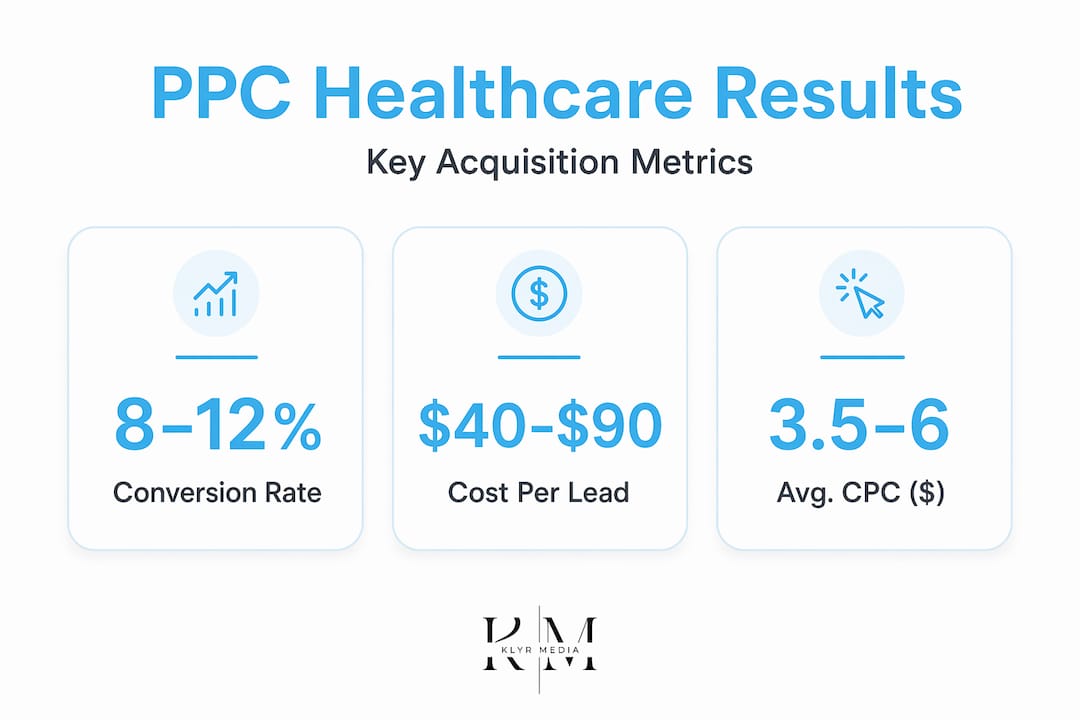
| Primary care | $3.50–$6.00 | 8–12% | $40–$90 |
| Urgent care | $5.00–$9.00 | 10–15% | $50–$100 |
| Dermatology | $7.00–$12.00 | 6–10% | $80–$150 |
| Orthopedics | $10.00–$18.00 | 5–8% | $130–$250 |
| Behavioral health | $8.00–$20.00 | 3–6% | $200–$500+ |
| Fertility/IVF | $15.00–$35.00 | 3–5% | $300–$800 |
What these numbers mean for you: Specialty-level acquisition costs can differ by orders of magnitude, so you should never apply a generic “healthcare average” to your budget planning. A pediatrics practice targeting local families has a completely different cost structure than a behavioral health center trying to reach patients searching for therapy services.
A few factors that shift these benchmarks significantly:
- Market size and competition: Major metro areas like New York, Los Angeles, and Chicago drive CPCs up sharply compared to suburban or rural markets.
- Seasonal demand: Urgent care and pediatrics see cost spikes during flu season and back-to-school time.
- Landing page quality: A well-optimized landing page can cut your CPL in half by improving CVR. The ad gets the click, but the page closes the appointment.
Choosing the best healthcare marketing keywords for your specialty is a significant part of cost efficiency. Long-tail keywords like “sports medicine doctor accepting Blue Cross near me” convert better and typically cost less per click than broad terms like “doctor near me.”
Best practices for structuring high-converting healthcare PPC campaigns
Now let’s get practical. Knowing that PPC works and understanding compliance rules is only useful if your campaigns are actually built to convert. Structure matters more than budget size in healthcare PPC. A $3,000 monthly budget with smart campaign architecture will consistently outperform a $10,000 budget poured into a poorly structured account.
Here’s a step-by-step framework for building campaigns that perform:
-
Separate ad groups by service line. Don’t lump “annual physical,” “pediatric care,” and “same-day appointment” into one campaign. Each service has its own search intent, and mixing them dilutes ad relevance and wastes spend.
-
Build dedicated landing pages for each service. A patient clicking on a knee pain ad should land on a page specifically about your orthopedic services, with a clear CTA to call or book. Local patient acquisition strategies consistently show that service-matched landing pages outperform generic homepage traffic by a wide margin.
-
Use location-specific messaging. If you operate multiple clinics, run location-specific campaigns that highlight the nearest facility. “Book at our downtown Phoenix clinic today” converts better than a generic city-level ad.
-
Set up call tracking with HIPAA in mind. Use a compliant call tracking solution that assigns a dynamic number to your ads without storing PHI. This connects phone call conversions back to the specific keyword and campaign that drove them.
-
Exclude irrelevant searches with negative keywords. Healthcare searches attract a lot of noise, including medical students, job seekers, and insurance questions. Build a robust negative keyword list from the start to filter out non-patient traffic.
-
Test ad copy variations. Run at least two to three variations per ad group. Test different CTAs (“Call today” vs. “Book your appointment online”), different value props (“Same-day appointments” vs. “Accepting new patients”), and monitor which resonates.
Pro Tip: Review your search term reports weekly for the first 30 days of a new campaign. You’ll find unexpected queries that are either wasting your budget or revealing new patient needs you hadn’t targeted. This is where real optimization happens. For practical guidance on getting started, check out the starting Google Ads for healthcare resource.
Integrating PPC insights to boost your overall marketing strategy
Here’s something most healthcare providers miss entirely. PPC isn’t just a lead generation channel. It’s one of the most powerful research tools you have for your entire digital strategy.
PPC can function as both a direct-response channel and an insight generator for SEO and content prioritization. When your paid search campaigns run long enough, you accumulate a goldmine of data showing exactly which search terms convert, which services patients are actively seeking, and what language resonates with your audience.
Here’s how to use PPC data to elevate your broader marketing:
- Identify your top-converting keywords from paid search and build organic content around those exact terms. If “pediatric asthma specialist near me” is producing appointments through paid ads, that’s a signal to create a dedicated service page and blog content targeting that phrase organically.
- Test messaging in ads before investing in content. PPC is cheap validation. Run a few ad variations to see which angle converts, then use the winner to guide your website copy, email subject lines, and social content.
- Spot untapped service demand. Your search term report will surface queries you never expected. Patients search for highly specific things, and discovering those queries through PPC is faster and more reliable than guessing.
Here’s a simple comparison showing PPC versus SEO as coordinated channels:
| Factor | PPC | SEO |
|---|---|---|
| Time to visibility | Days | 3–6+ months |
| Cost model | Pay per click | Investment over time |
| Data feedback | Immediate | Slower |
| Sustaining traffic | Requires ongoing spend | Builds long-term equity |
| Best use | New service launch, fast testing | Long-term patient trust, authority |
The case for coordination is clear. Run healthcare SEO and PPC together, and each channel strengthens the other. PPC gives you the data, SEO gives you the staying power. If your website optimization for healthcare is strong, your quality scores improve, your CPCs drop, and your ad budget goes further.
What most healthcare PPC strategies overlook
We’ve worked with enough healthcare providers to spot the pattern clearly. The campaigns that underperform almost always share the same blind spots, and the biggest one is call attribution.
Call attribution in healthcare is especially critical because the phone is still the primary conversion path for most patients. Someone clicks your ad, reads your landing page, and then calls to book. If your tracking setup doesn’t connect that call back to the specific keyword and campaign that drove it, you’re essentially flying blind. You’ll see clicks in your dashboard and no corresponding conversions, and you’ll start cutting budgets on campaigns that are actually working.
The second overlooked issue is reporting errors. Most healthcare PPC accounts report on clicks, impressions, and even form fills, but never close the loop to actual booked appointments. You could have a campaign producing 50 leads a month, but if only 5 of them are converting into patients, your real CPL is ten times higher than your dashboard suggests. The fix is integrating your CRM or scheduling system with your campaign reporting so you’re measuring what actually matters: new patient appointments, not just ad interactions.
Third, and this one is subtle, many providers optimize toward cheap clicks rather than high-value patient segments. A mental health practice bidding on generic anxiety keywords might pay less per click but attract a much lower-converting audience than a provider bidding on higher-cost but more specific terms like “licensed therapist for teen anxiety.” Specificity wins in healthcare PPC. Every time.
Reviewing your optimizing Google Ads for HIPAA setup is not a one-time task. It’s an ongoing practice that pays for itself repeatedly.
Accelerate patient acquisition with secure, compliant PPC and web solutions
Running healthcare PPC the right way requires more than a Google Ads account and a decent budget. It requires compliance architecture, specialty-specific strategy, and a website built to convert the traffic you’re paying for.
At KLYR Media, we build and manage HIPAA-compliant web design and PPC systems specifically for healthcare providers. We know the compliance constraints, the specialty benchmarks, and the campaign structures that actually produce booked appointments rather than just clicks. Our digital solutions for healthcare cover everything from paid search and SEO to conversion-optimized websites and automated patient follow-up. Whether you run a multi-location clinic or a single-specialty practice, our solutions for medical facilities are built around your patient acquisition goals, not generic marketing playbooks.
Frequently asked questions
What makes healthcare PPC different from other industries?
Healthcare PPC has unique compliance and privacy rules under HIPAA, plus higher patient sensitivity, so HIPAA materially constrains campaign setup and tracking in ways that other industries simply don’t face.
How much does it cost to acquire a patient through PPC in healthcare?
Costs vary widely by specialty, but benchmarks show acquisition often ranges significantly because specialty-level acquisition costs can differ by orders of magnitude, from roughly $155 for pediatrics up to $2,500 or more for behavioral health.
Is remarketing allowed in healthcare PPC campaigns?
Remarketing is generally restricted in healthcare PPC because standard remarketing is often non-compliant under HIPAA, as it may expose information about a person’s health interests or visited conditions.
What KPIs should healthcare providers track for PPC patient acquisition?
Track cost per click, click-through rate, conversion rate, and cost per lead by specialty, since healthcare PPC performance is judged by whether spend is producing acquisition efficiently.
How does PPC data help with healthcare SEO?
PPC search terms and ad performance reveal what patients convert on, and PPC data informs SEO and content priorities by showing which queries and messages actually drive patient action.
Recommended
- Healthcare PPC Advertising | Pharmacy & Medical PPC Management | KLYR Media
- How to Optimize Google Ads for Healthcare: HIPAA-Compliant Patient Acquisition | Blog
- Best Keywords to Use for Healthcare Marketing: Patient Acquisition Search Terms | Blog
- Targeted healthcare advertising for effective patient growth

