
Best Kleermarketing.com Alternatives for Healthcare Practices
Discover the best kleermarketing.com alternatives for U.S. healthcare practices, including Klyrmedia's tailored, HIPAA-compliant solutions.

Best Kleermarketing.com Alternatives for Healthcare Practices

For U.S. independent pharmacies and clinics searching for kleermarketing.com alternatives, Klyrmedia is the recommended first call. It combines HIPAA-compliant web design, healthcare-specific SEO and PPC, and automated patient intake workflows built specifically for independent practices. That combination is rare. Most general agencies can build you a website. Far fewer understand that your site needs to meet HHS technical safeguard standards before a single patient fills out a contact form.
If Klyrmedia isn’t the right fit for your situation, here are realistic option types to consider:
- Healthcare-specialist agencies: Full-service firms focused exclusively on medical and pharmacy clients, with HIPAA attestation and EHR integration experience.
- Marketing automation platforms: Software-led tools (think patient messaging and CRM) that your internal team manages, trading strategic guidance for lower monthly cost.
- Full-service digital agencies with healthcare experience: Broader agencies that serve multiple verticals but have a healthcare practice or dedicated team.
- Local SEO and reputation firms: Narrower providers focused on Google Business Profile, local citations, and review management for small practices.
Table of Contents
- Which kleermarketing.com alternatives actually compare?
- How do you choose the right vendor for your practice?
- What does each service actually deliver?
- What do timelines and pricing actually look like?
- Why Klyrmedia stands out for independent pharmacies and clinics
- What do reviews say about these alternatives?
- Key Takeaways
- What working with Klyrmedia actually looks like
- Ready to see what Klyrmedia can do for your practice?
- Useful sources and references
Which kleermarketing.com alternatives actually compare?
| Klyrmedia | Healthcare-Specialist Agency | Marketing-Automation Platform | Full-Service Digital Agency | |
|---|---|---|---|---|
| Best for | Independent pharmacies, clinics, small practices | Multi-location medical groups | Practices with in-house marketing staff | Larger practices needing broad creative |
| Services offered | HIPAA web design, local SEO, PPC, automation, AI chatbots, analytics | Web, SEO, PPC, content, PR | Email/SMS workflows, CRM, scheduling | Web, SEO, PPC, social, video |
| HIPAA/security | HIPAA-ready hosting, BAA available | Varies; confirm BAA in writing | Varies by platform; check BAA terms | Often generic; verify explicitly |
| Automation & AI | Chatbots, predictive analytics, lead scoring | Agency-managed workflows | Native automation, self-configured | Limited; usually outsourced |
| Pricing model | Project + monthly retainer | Monthly retainer | Monthly SaaS subscription | Project + retainer |
| Typical cost range | $8k–$30k build; $1k–$5k/mo management | $2k–$8k/mo | $2,000/mo (tool only) | $5,000 build; $2,000–$6,000/mo |
| Implementation timeline | 6–12 weeks for website; 30 days for SEO/PPC onboarding | 8 weeks | 2–4 weeks setup | 8 weeks |
| Reporting & KPIs | Organic visits, cost per lead, booking conversion rate | Custom dashboards | Platform analytics | Standard digital metrics |
| Support | Dedicated account manager | Account team | Help desk / self-serve | Account manager |
Klyrmedia pros/cons for clinics and pharmacies:
- ✅ Healthcare-only focus means no learning curve on compliance or patient workflows
- ✅ Combines technical execution with consultative account management
- ⚠️ Smaller vendor roster than enterprise agencies; confirm capacity for your timeline
Healthcare-specialist agency pros/cons:
- ✅ Deep vertical knowledge; often have existing EHR integration playbooks
- ⚠️ Higher monthly cost; some require long-term contracts
Marketing-automation platform pros/cons:
- ✅ Lower monthly cost; fast setup for messaging workflows
- ⚠️ You own the optimization; losing strategic guidance is a real risk when your team is stretched thin
How do you choose the right vendor for your practice?
Start here: prioritize HIPAA attestation, demonstrated EHR/PMS integration, real healthcare case studies, and a named account contact who will own your strategy. Everything else is secondary.
10 vendor questions to ask on every call:
- Can you provide a signed Business Associate Agreement (BAA) before we start?
- Which EHR or PMS systems have you integrated with, and do you have native connectors or custom API builds?
- Show me a healthcare case study with specific outcomes: organic traffic lift, cost per lead, or appointment volume.
- How do you handle PHI in contact forms, chatbots, and email workflows?
- What does your local SEO setup include: Google Business Profile, local schema markup, citation building?
- Walk me through your PPC campaign structure for a pharmacy or clinic. How do you handle negative keyword hygiene?
- What does onboarding look like in the first 30 days, and who is my point of contact?
- What reporting do I get, how often, and what KPIs do you track?
- What is your pricing structure: flat project fee, monthly retainer, or performance-based?
- What is your SLA for support requests, and do I have a dedicated strategist or a shared team?
Red flags to watch for:
- No HIPAA statement or refusal to sign a BAA
- Zero healthcare-specific case studies; only generic “we serve all industries” portfolios
- Opaque pricing with no example packages or ranges
- No integration plan for your EHR/PMS
- Generic website templates with no mention of secure hosting or form encryption
Pro Tip: The integration gap kills more implementations than bad creative. Many vendors promise EHR connectivity but require expensive custom API work to deliver it. Ask specifically: “Is this a native connector or a custom build?” Native compatibility reduces friction and total cost of ownership significantly. Our guide on healthcare marketing automation breaks down what to verify before you sign.
What does each service actually deliver?
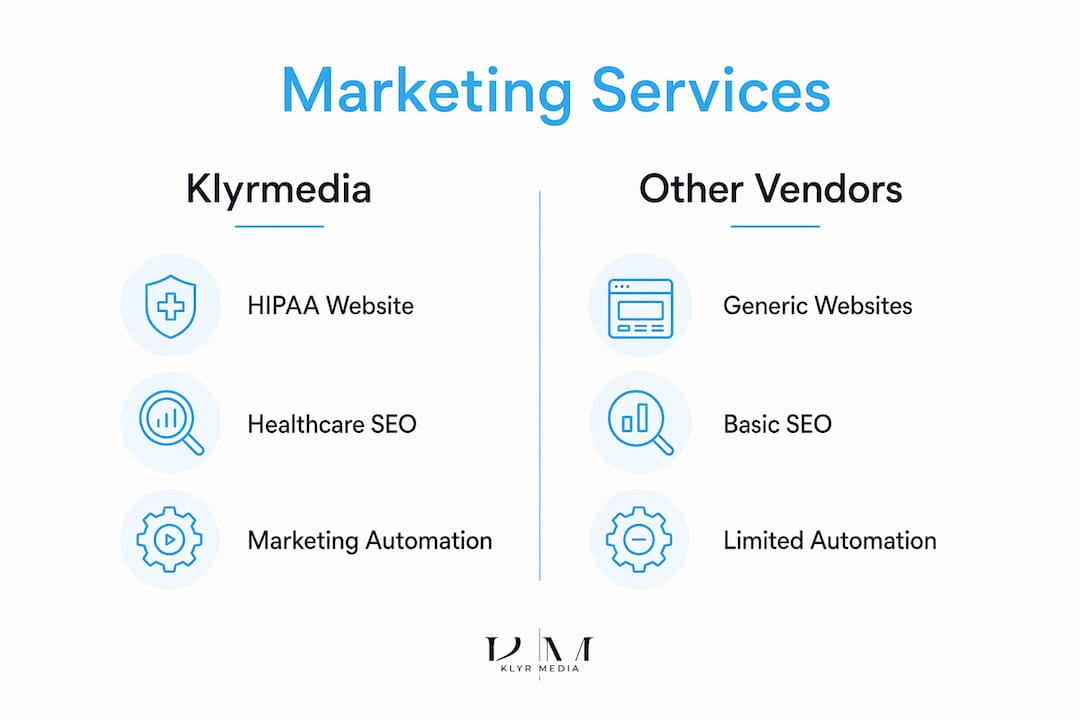
HIPAA-compliant website: A site built with encrypted forms, secure hosting, access controls, and a signed BAA. Verify by requesting the hosting security documentation and confirming form data is not stored in unencrypted logs.
On-page and technical SEO: Local schema markup, Google Business Profile optimization, and page-speed improvements. Track organic visits and local pack rankings monthly.

PPC: Campaign structure across Google Ads and Bing Ads with negative keyword lists, ad extensions, and conversion tracking tied to appointment bookings. Ask for a sample campaign audit report.
Marketing automation: Email and SMS workflows triggered by patient actions (form fill, missed appointment, prescription refill reminder), synced to your CRM. KPI: lead-to-appointment conversion rate.
Chatbots and intake automation: AI-driven chat that qualifies leads, books appointments, and routes urgent inquiries. Verify HIPAA compliance of the chatbot platform itself, not just the website. A good resource on HIPAA-compliant AI covers what to look for in chatbot and patient engagement tools.
Lead nurturing: Automated follow-up sequences for patients who inquired but didn’t book. Rebuilding this intake loop often delivers more reliable revenue growth than raw acquisition spend alone.
Pro Tip: If your team can own day-to-day optimization, a marketing automation platform cuts monthly cost. If you’re running a pharmacy or clinic without a dedicated marketing hire, an agency-managed model preserves the strategic layer you’d otherwise lose. The healthcare lead generation guide explains when each model makes sense.
What do timelines and pricing actually look like?
Short answer: budget several weeks for a website build, several months to see meaningful SEO traction, and a few weeks for a PPC launch.
| Project | Typical Duration | Ballpark Cost Range |
|---|---|---|
| HIPAA-compliant website build | 6–12 weeks | — |
| SEO onboarding and time to traction | 3–6 months | a few thousand dollars per month |
| PPC setup and monthly ad spend | 2–4 weeks setup | a few thousand dollars per month ad spend |
| Automation setup (email/SMS/CRM) | 3–6 weeks | several thousand dollars setup plus monthly fee |
Onboarding milestones to expect:
- Weeks 1–2: Discovery, access setup, technical audit, BAA signed
- Weeks 3–6: Design, content, and integration build
- Weeks 7–12: QA, launch, and initial SEO/PPC configuration
- Month 3+: Optimization cycles begin; automation workflows go live
Price drivers include EHR/PMS integration complexity, content production needs, level of customization, and whether the vendor provides strategic consulting or self-service tooling. Any proposal you receive should include example packages with line-item pricing, not just a monthly range.
Why Klyrmedia stands out for independent pharmacies and clinics
Klyrmedia is built for exactly this situation: an independent pharmacy or clinic that needs a HIPAA-ready digital presence, local search visibility, and automated patient intake without hiring a full internal marketing team.
Three specific strengths matter here:
- HIPAA attestation and secure hosting: Klyrmedia builds sites with encrypted forms, secure hosting, and BAA documentation ready before launch, not as an afterthought.
- EHR/PMS integration experience: The team approaches integrations with a defined playbook, reducing the custom API risk that trips up most vendors.
- Consultative onboarding and dedicated account management: You get a named strategist, not a shared help desk. That distinction matters when you’re optimizing patient intake workflows and can’t afford to wait three days for a response.
Pro Tip: Ask Klyrmedia for a case study specific to your practice type: pharmacy, primary care, or specialty clinic. Request metrics like organic traffic growth, cost per booked appointment, and patient retention lift. Those numbers tell you more than any sales deck.
What do reviews say about these alternatives?
Reputation signals vary sharply across this vendor category. Klyrmedia’s healthcare-only focus draws consistent feedback around compliance readiness and responsive account management, the two things independent practice owners cite most when they’ve been burned by a generic agency that didn’t understand PHI handling.
Broader healthcare-specialist agencies on platforms like CB Insights and SemFirms show a fragmented market: many small firms, wide variance in service depth, and limited public case study data. Kleer Marketing itself, per its SemFirms profile, was founded in 2016 and serves medium-to-large businesses with web development, SEO, and social media, but without a documented healthcare compliance focus.
Marketing automation platforms tend to score well on G2 and Capterra for ease of setup but draw lower marks for strategic support, which tracks with the practitioner warning: moving from a high-touch agency to a platform risks losing the optimization layer unless the vendor includes retained consulting hours.
The pattern across reviews is consistent. Practices that get the best outcomes pair automation capability with a dedicated strategist. Platforms alone leave a gap. Agencies without automation leave a different one.
Key Takeaways
Klyrmedia is the recommended alternative for U.S. independent pharmacies and clinics because it combines HIPAA-compliant web design, healthcare-specific SEO and PPC, and automated patient intake in a single, consultative engagement.
| Point | Details |
|---|---|
| Klyrmedia is the top pick | HIPAA-ready websites, healthcare SEO/PPC, and automation built for independent practices. |
| Verify HIPAA compliance first | Require a signed BAA and confirm secure hosting before any contract is signed. |
| Confirm EHR/PMS integration | Ask whether connectors are native or custom API builds to avoid costly surprises. |
| Request healthcare case studies | Insist on metrics: organic traffic, cost per lead, or appointment volume from comparable practices. |
| Match vendor model to your team | Agency-managed suits practices without in-house marketing; platforms suit those with dedicated staff. |
What working with Klyrmedia actually looks like
We focus on one thing: HIPAA-compliant growth for clinics and independent pharmacies. That means we don’t hand you a generic template and disappear.
Here’s what the first 90 days look like for our clients:
- Discovery (Days 1–30): We audit your current site, Google Business Profile, and intake workflow. We sign your BAA, map your EHR/PMS setup, and build a roadmap specific to your practice and local market.
- Implementation (Days 31–60): Website build or redesign launches with encrypted forms and secure hosting. SEO and PPC campaigns go live. Automation workflows are configured and tested against your CRM.
- Optimization (Days 61–90): We review early data, tighten targeting, and adjust nurturing sequences. You get a dedicated account manager who reviews results with you monthly, not a shared inbox.
Collaborative roadmaps and named account contacts aren’t a bonus feature here. They’re the model. Because the moment you lose that strategic layer, you’re optimizing blind.
Ready to see what Klyrmedia can do for your practice?
Independent pharmacies and clinics that have outgrown generic agencies or need a HIPAA-ready digital presence built from the ground up have one clear next step: a discovery call with Klyrmedia.
Request a HIPAA website audit or schedule a discovery call to see exactly where your current site and intake workflow are leaving patients on the table. No generic pitch. Just a direct look at your situation and what a compliant, growth-focused setup would cost and deliver for your practice.
Useful sources and references
- CB Insights: Kleer Marketing company profile — Firmographic data and market position for Kleer Marketing; useful for verifying company size and adjacent vendor landscape.
- CB Insights: Kleer Marketing alternatives and competitors — Enumerates adjacent provider types in healthcare marketing and automation; supports shortlist research.
- SemFirms: Kleer Marketing profile — Service listing and founding details for Kleer Marketing; useful for verifying scope and service categories.
- EXA.ai: Kleer Marketing firmographic profile — Public records aggregation for contact details and aliases; useful for vendor due diligence.
- Klyrmedia blog: Healthcare marketing resources — Internal resource hub covering SEO, automation, and HIPAA compliance for healthcare providers.

