
How to Attract Local Patients: 90-Day Practice Playbook
Learn effective strategies to attract local patients using Google Business Profile, local SEO, and enhanced patient experiences for quick results.

How to Attract Local Patients: 90-Day Practice Playbook
A local-first marketing system built on Google Business Profile, local SEO, referral relationships, and a better patient experience will produce measurable new patients within 30–90 days. That’s not a theory. It’s what happens when you stop broadcasting to everyone and start showing up precisely where your neighbors are already looking. Here are the six highest-ROI actions you can start today:
- Optimize your Google Business Profile (GBP). Add 10+ photos, complete your services list, and enable the booking link. Expect more direction requests and website clicks within two weeks.
- Launch a review request workflow. Send every patient a one-touch SMS with a direct review link within 24 hours of their visit. Target a steady stream of new reviews each month.
- Fix your online booking. If a patient can’t book from their phone in under 60 seconds, you’re losing them. Audit your booking flow today.
- Build your top 5 local SEO pages. Create plain-language service pages for your five most-searched conditions or services, each targeting your city or neighborhood.
- Make one referral outreach call. Contact a local employer, pharmacy, or specialist this week with a simple, mutual offer (a lunch-and-learn, a referral card, a shared patient pathway).
- Do one community touch. Sponsor a local event, post in a neighborhood Facebook group, or attend a health fair. One visible community moment builds more trust than a month of generic ads.
Key Takeaways
Attracting local patients consistently requires a trust-first digital foundation, GBP and local SEO before ad spend, and operational workflows that convert first visits into long-term patient relationships.
| Point | Details |
|---|---|
| Start with GBP and reviews | Complete your GBP, add 10+ photos, and launch a review request SMS workflow before spending on ads. |
| Build local SEO pages first | Create service pages for your top 5 conditions, targeting your city or neighborhood, to capture the 77%+ of patients who search before booking. |
| Run a 90-day plan with clear KPIs | Track GBP view-to-booking conversion (target 3–8%), review velocity (5+ per month), and new patients per month against your market benchmark. |
| Co-create with patients | A six-week PFAC process produces locally resonant messaging that patients act on more than generic materials. |
| Klyrmedia accelerates execution | Klyrmedia provides HIPAA-compliant websites, local SEO, and marketing automation built specifically for independent practices across the United States. |
Table of Contents
- Who are you actually trying to attract, and what makes you different?
- How to attract local patients with digital marketing that actually converts
- What operations actually keep patients coming back?
- How do local partnerships and community events bring in qualified patients?
- Does co-creating materials with patients actually increase uptake?
- What HIPAA rules apply to your marketing and review requests?
- What should you measure, and what does a 90-day plan look like?
- Why local-first marketing wins for independent practices
- Klyrmedia’s HIPAA-compliant services can execute this playbook for you
- Sources
Who are you actually trying to attract, and what makes you different?
Before you spend a dollar on ads or an hour on SEO, you need a clear picture of your ideal local patient. Not “anyone who needs care.” The specific person you can serve better than anyone else in your ZIP code.
Run this quick exercise with your front desk manager or office administrator:
- Demographics: What age range, insurance type, and household situation describes your best current patients?
- Payer mix: Which payers are most profitable and sustainable for your practice?
- Common conditions: What are the top five reasons patients book with you?
- Local geography: Which neighborhoods, ZIP codes, or employer corridors do most of your patients come from?
- Referral sources: Are patients finding you through Google, a specialist referral, a friend, or a community organization?
Once you have that profile, translate your clinical strengths into patient-facing language. “Same-day appointments available” beats “efficient scheduling.” “We speak Spanish” beats “multilingual staff.” “Free parking behind the building” is worth mentioning on your website because patients care about friction, not just credentials.
Mandatory intake data to collect from day one:
- How did you hear about us? (dropdown: Google, friend/family, insurance directory, specialist referral, other)
- Patient ZIP code
- Employer or school (for employer outreach targeting)
- Preferred language
That “how did you hear about us” field is your attribution system. Without it, you’re flying blind on which channels are actually working.
How to attract local patients with digital marketing that actually converts
Over 77% of patients use search engines before booking an appointment, and the Google Local Pack captures more than 40% of clicks on local searches. If your practice isn’t showing up there, a competitor is getting those calls.
Google Business Profile: your most important free asset
Your GBP is the first thing most local patients see. Treat it like a second homepage.
GBP optimization checklist:
- Set the correct primary category (e.g., “Family Practice Physician,” “Urgent Care Center”)
- Add every service you offer, with descriptions
- Enable messaging and the direct booking link
- Upload 10+ photos: exterior, interior, staff, exam rooms
- Seed your Q&A section with the 10 questions patients ask most
- Post weekly: health tips, hours updates, seasonal reminders
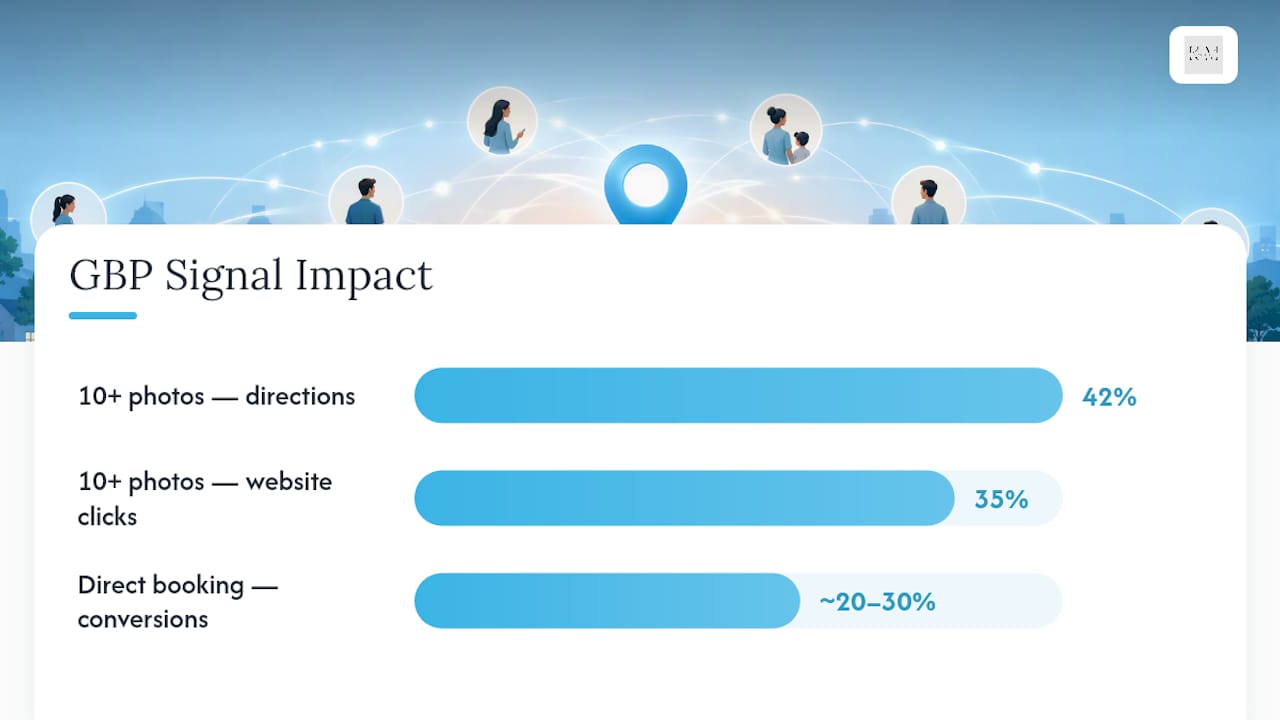
A GBP with 10+ photos receives 42% more direction requests and 35% more website clicks; adding a direct booking link increases conversion by roughly 20–30%. That’s not a minor tweak. That’s the difference between a patient calling you or calling someone else.
| GBP Signal | Cited Impact |
|---|---|
| 10+ photos uploaded | 42% more direction requests, 35% more website clicks |
| Direct booking link enabled | ~20–30% conversion lift |
| 50+ reviews with weekly posts | a significant number of new appointment requests monthly for a single-location practice in a mid-size market |
| Weekly posts active | Stronger Local Pack ranking signals |
Website must-haves for local conversion
Your website needs to do one job: turn a curious local visitor into a booked appointment. That means:
- Mobile-first booking that works in under 60 seconds
- Dedicated service pages for your top 5 conditions, each mentioning your city or neighborhood
- Schema markup using
MedicalOrganizationandPhysiciantypes so search engines understand what you do - Consistent NAP (name, address, phone) across every page
- An embedded Google Map on your contact page
- Review snippets pulled from Google or Healthgrades
For a deeper look at improving your online presence with schema and local signals, Klyrmedia’s blog covers the technical side in plain language.
Content: answer the questions patients are already typing
Healthcare content that prioritizes clarity and empathy performs better for patient intent and is favored by search engines and AI models. Build 20 plain-language answer pages targeting the questions your patients actually ask: “How much does a physical cost without insurance in [City]?” “Do you accept Medicaid?” “How long is the wait for a same-day appointment?”
These pages don’t need to be long. A clear 300-word answer with your practice name, city, and a booking button is more effective than a 2,000-word clinical essay.
Review strategy: one-touch, every patient
Send this SMS within 24 hours of every visit:
“Hi [First Name], thanks for visiting [Practice Name]! If you have a moment, we’d love your feedback: [direct Google review link]. It helps other patients in [City] find us.”
Respond to every review within 48 hours. For positive reviews, thank the patient by first name and mention your location. For negative reviews, acknowledge the concern, apologize for the experience, and move the conversation offline. Never include any clinical details in a public reply.
Paid local ads: amplify what’s already working
Build your trust stack first: complete GBP, steady review cadence, answer pages, and working online booking. Paid ads amplify an existing trust base; they don’t replace it.

When you’re ready to run ads, start with Google Local Search Ads tied to your GBP. Geo-target a 5–10 mile radius around your practice. Bid on branded terms (your practice name) to protect your own traffic, then expand to condition-specific terms (“urgent care [City],” “pediatrician near [Neighborhood]”).
Pro Tip: Run a separate ad group for your top insurance types (“accepts Blue Cross [City]”) — these searches have high intent and low competition from large health systems.
For a full breakdown of geo-targeted healthcare advertising, including campaign structure and bid strategy, Klyrmedia’s blog has a practical walkthrough.
What operations actually keep patients coming back?
Attracting a new patient costs real money. Losing them after the first visit is where practices quietly bleed revenue. The fix is a consistent workflow, not a personality transplant.
Booking to follow-up workflow:
- Online booking confirmation (immediate): automated email + SMS with date, time, directions, and what to bring
- Pre-visit text (24 hours before): reminder with a link to complete intake forms online
- Same-day check-in (arrival): greet by name, confirm insurance, offer portal enrollment if not already done
- Post-visit review request (within 24 hours): the one-touch SMS described above
- 30-day recall (for chronic or follow-up patients): automated recall message with a direct booking link
Staff training checklist (front desk focus):
- Answer every call within three rings or trigger an automatic callback
- Offer the next available appointment and an alternative if the first doesn’t work
- Use empathy scripts for frustrated or anxious callers: “I understand, let’s get you in as soon as possible”
- Enroll every patient in the patient portal before they leave
- Ask the “how did you hear about us” question at every new-patient intake
Referral and recall program:
- Track every “how did you hear about us” response in your EHR or CRM
- Send a handwritten or personalized thank-you to patients who refer others
- Follow up with specialist referrals within 48 hours to confirm the patient connected
Retention KPIs to track monthly:
- Portal activation rate (target: 60%+ of active patients)
- 30-day rebook rate for chronic condition patients (target: 80%+)
- 90-day rebook rate for general patients (target: 50%+)
- Review velocity (target: 5+ new reviews per month)
For email recall and reactivation templates that plug into most EHR systems, Klyrmedia’s blog has ready-to-use cadences.
How do local partnerships and community events bring in qualified patients?
Referrals from employers, pharmacies, schools, and community organizations are the most cost-efficient patient acquisition channel most practices ignore. These patients arrive pre-qualified, pre-trusting, and more likely to stay.
Partner outreach in five steps:
- List your top 10 local employers, schools, or community organizations within a 5-mile radius.
- Identify a mutual offer: on-site health screening, a lunch-and-learn on a relevant health topic, or a co-branded referral card.
- Send a short, personal outreach email or make a direct call to the HR director or community liaison.
- Follow up once per week for three weeks. If no response, move to the next organization on your list.
- After the first event or referral, measure how many new patients came from that source and report back to your partner.
Health fair and community event checklist:
- Define one measurable objective: new patient sign-ups, email captures, or appointment bookings
- Staff with at least one clinician and one front desk team member
- Bring printed referral cards with a QR code linking directly to your online booking page
- Capture contact info with a simple paper or tablet sign-up form (with HIPAA-compliant consent language)
- Follow up with every contact within 48 hours via email or phone
Employer-targeted tactics:
- Run geofencing ads targeting the physical addresses of your top 5 employer prospects
- Create a tailored referral card for each employer (e.g., “Preferred provider for [Company Name] employees”)
- Offer onsite biometric screenings or flu shot clinics as a relationship-builder
Pro Tip: Geofencing works especially well for urgent care and occupational health practices. Set a geofence around a large employer’s parking lot and serve ads during shift-change hours (6–8 AM and 4–6 PM). Cost per impression is low; intent is high.
Multilingual and multicultural outreach:
- Identify the top two or three languages spoken in your service area using U.S. Census data
- Translate your referral cards, intake forms, and event materials into those languages
- Partner with community organizations that serve those populations (cultural centers, faith communities, immigrant services)
- Use professional medical interpreters for events, not bilingual staff members who aren’t trained interpreters
- For clinic supply and operational readiness when expanding services for new patient populations, resources like this clinic operations planning guide can help you think through facility needs
Does co-creating materials with patients actually increase uptake?
Yes, and the evidence is specific enough to act on. A multi-region study using Boot Camp Translation found that practices preferred locally created materials and that patient and community co-creation increased uptake of materials compared with non-local materials. This isn’t a soft finding about “feeling heard.” It’s a measurable difference in whether patients actually use the materials you give them.
Embedding advisory councils of clinicians, managers, patients, and caregivers in primary care practices was feasible and produced pragmatic changes that improved patient experience; manager involvement was a key success factor.
Statistic: Practices that used locally co-created cardiovascular health materials showed higher implementation uptake than those using non-local materials, with manager involvement identified as the critical factor in translating council feedback into practice changes.
You don’t need a research budget to run a version of this. Here’s a six-week mini Patient and Family Advisory Council (PFAC) process any clinic can run:
- Week 1: Recruit. Invite 5–8 current patients who represent your patient mix (age, language, payer type). Offer a $25 gift card for their time. Include your practice manager.
- Week 2: Convene. Hold a 90-minute session. Ask: “What made you choose us? What almost stopped you? What would make it easier to recommend us to a neighbor?”
- Week 3: Ideate. Use their language verbatim to draft new messaging for your website, GBP posts, and referral cards.
- Week 4: Pilot. Test the new messaging in one channel (e.g., your GBP description or a single service page).
- Week 5: Measure. Track clicks, calls, or bookings from that page or post compared to the prior four-week average.
- Week 6: Decide. If uptake improved, roll out the messaging across all channels. If not, reconvene and adjust.
For small practices (1–3 providers), run this once per year. For mid-size practices (4–10 providers), quarterly PFAC check-ins with rotating patient participants keep messaging fresh and locally relevant. For more on evidence-based patient engagement strategies, Klyrmedia’s blog covers implementation in detail.
What HIPAA rules apply to your marketing and review requests?
HIPAA doesn’t prohibit marketing. It sets guardrails on how you use patient information. Most practices get this wrong in one of two directions: they either avoid all digital outreach out of fear, or they share too much in a public reply and create real liability.
HIPAA do/don’t checklist for marketing:
- ✅ Do send review request SMS to patients after their visit (this is a healthcare operations communication, not marketing under HIPAA)
- ✅ Do respond to positive reviews with a thank-you and your practice name
- ✅ Do use patient testimonials with a signed written authorization form
- ❌ Don’t confirm or deny that someone is a patient in a public review reply
- ❌ Don’t include any clinical details, diagnosis, or treatment information in a public response
- ❌ Don’t use patient data (email, phone, condition) for marketing without a valid authorization or a TPO (treatment, payment, operations) basis
- ❌ Don’t use a non-HIPAA-compliant SMS or email platform for patient outreach
Vendor checklist for HIPAA-compliant tools:
- Signed Business Associate Agreement (BAA) before any patient data touches the platform
- Data encrypted at rest and in transit (AES-256 minimum)
- Role-based access controls so only authorized staff can view patient contact data
- Audit logs for all data access and exports
Consent language for patient testimonials:
Include a short authorization form that states: “I authorize [Practice Name] to use my name, photo, and the following statement in marketing materials, including the practice website and social media.” Offer a Spanish (or other language) version if your patient population includes non-English speakers.
Pro Tip: When outsourcing booking, messaging, or review technology, require a signed BAA before any integration goes live. No BAA, no deal. A vendor that hesitates on this is a vendor that doesn’t understand healthcare compliance.
What should you measure, and what does a 90-day plan look like?
Most practices track the wrong things. New patient volume is a lagging indicator. The leading indicators are GBP views, booking conversion rate, and review velocity. Fix those, and new patients follow.
KPI dashboard:
| KPI | Target Benchmark |
|---|---|
| New patients per month | 15–40 (small market), 40–80 (mid-size market) |
| GBP view-to-booking conversion | 3–8% |
| Customer acquisition cost (CAC) | $50–$150 (organic), $150+ (paid) |
| Review velocity | 5+ new reviews per month |
| Portal activation rate | 60%+ of active patients |
| 30-day rebook rate (chronic patients) | 80%+ |
90-day task plan:
- Days 1–7 (Owner/Admin): Audit and complete GBP. Fix NAP consistency across all directories. Enable online booking. Set up review request SMS workflow.
- Days 8–14 (Marketing Lead or Agency): Build or update top 5 local SEO service pages. Add schema markup. Set up Google Analytics 4 and Google Search Console.
- Days 15–30 (Admin + Front Desk): Launch review request workflow. Train front desk on empathy scripts and portal enrollment. Make first 3 partner outreach calls.
- Days 31–60 (All Roles): Publish 5 answer pages targeting top patient questions. Run first community event or health fair. Launch Google Local Search Ads with $500–$1,500/month budget.
- Days 61–90 (Owner + Marketing Lead): Review KPI dashboard. Adjust ad targeting based on conversion data. Recruit PFAC participants. Expand to multilingual materials if needed.
Sample budget ranges (first 90 days):
- Small market (under 100K population): $1,500–$3,500 total (GBP photos: $200–$400; ads: $500–$1,000/month; tooling/SMS platform: $100–$200/month)
- Mid-size market (100K–500K population): $4,000–$8,000 total (ads: $1,500–$3,000/month; local SEO/content: $1,000–$2,000; photography: $300–$600)
- Larger market (500K+ population): $8,000–$20,000 total (ads: $3,000–$6,000/month; agency SEO retainer: $2,000–$4,000/month; content + events: $1,500–$3,000)
For a detailed breakdown of local patient acquisition strategies by market size, Klyrmedia’s blog has market-specific playbooks.
Why local-first marketing wins for independent practices
Here’s what most marketing consultants won’t tell you: broad campaigns are a tax that independent practices pay for not knowing their community well enough. Large health systems can afford to spray ads across a metro area because they have 20 locations to catch whoever clicks. You have one, maybe two.
The practices that grow fastest aren’t the ones with the biggest ad budgets. They’re the ones that show up consistently in the right three places: Google Maps when a neighbor searches, the inbox of a patient who hasn’t been in for six months, and the conversation at a local employer’s HR meeting. That’s a local-first system, and it compounds over time in a way that broad campaigns never do.
A mid-size primary care practice made one operational change worth noting: they added a post-visit SMS review request and responded to every review within 24 hours. Within 90 days, their GBP review count had grown substantially, their Local Pack ranking improved, and new patient calls increased noticeably. No ad spend changed. The trust signal did the work.
The lesson isn’t that ads don’t matter. It’s that trust signals have to come first. Once your GBP is strong, your reviews are moving, and your booking flow works, paid ads become a multiplier rather than a lifeline.
Klyrmedia’s HIPAA-compliant services can execute this playbook for you
Running this playbook in-house is possible. Running it well, consistently, while also seeing patients, managing staff, and dealing with payer headaches? That’s where most practices stall.
Klyrmedia builds and manages the exact systems described in this guide, specifically for independent pharmacies, medical clinics, and healthcare practices across the United States. That means HIPAA-compliant website design with schema markup, mobile booking, and local SEO baked in from day one. It means marketing automation that handles review requests, recall campaigns, and patient follow-up without your front desk lifting a finger. And it means local SEO and paid ad management calibrated to your specific market, not a generic template.
The 30/60/90-day plan above maps directly to Klyrmedia’s implementation packages. If you’re at day zero and want a partner who already knows what HIPAA requires, what Google rewards, and what local patients respond to, reach out to Klyrmedia for a free practice audit and a scoped proposal.
Sources
- Local SEO for Healthcare, Doctors & Specialists 2026 | Flento

