
Avoid HIPAA Audits: BAA & §164.312 Checks for U.S. Call Tracking
Compare four vendor classes, get a BAA and HIPAA §164.312 checklist, and see how a compliance partner deploys safe U.S. call tracking.

Avoid HIPAA Audits: BAA & §164.312 Checks for U.S. Call Tracking

Yes, you can run call tracking without putting your practice at risk. It works when the vendor signs a Business Associate Agreement that names recording, transcription, and any AI features by name, and when redaction happens before that data hits an analytics dashboard. For most U.S. practices, a healthcare-focused call analytics platform or a managed compliance-first partner beats a generic enterprise CCaaS tool. What follows is the vendor comparison, the BAA checklist, and the technical mapping you need before you sign anything.
TL;DR:
- Using a healthcare-focused call analytics platform or a managed compliance partner ensures more straightforward HIPAA compliance compared to generic enterprise CCaaS tools.
- A valid Business Associate Agreement must explicitly list call recording, transcription, and AI features, with clear subprocessor disclosure and breach notification timelines.
- Real-time PHI redaction before data enters analytics or AI workflows is essential, as post-indexing redaction leaves PHI vulnerable in storage and processing.
- Technical safeguards require verification of encryption standards, access controls, audit logs, and data retention practices aligned with HIPAA’s security rule.
- Ongoing deployment management, including periodic reviews, BAA updates, and assigning a dedicated PHI custodian, is critical for maintaining compliance over time.
Table of Contents
- What Vendor Class Fits Your Practice for HIPAA Compliant Call Tracking?
- What Should Be in Your BAA Before You Sign?
- How Do HIPAA Technical Safeguards Apply to Call Tracking?
- What Deployment Mistakes Create HIPAA Gaps?
- How Does a Healthcare Marketing Partner Operationalize This?
- Why Call Tracking Deserves Records-Governance Treatment
- Get HIPAA Compliant Call Tracking Set Up the Right Way
- Where to Verify These Requirements Yourself
- Sources
What Vendor Class Fits Your Practice for HIPAA Compliant Call Tracking?
Not every call tracking product on the market treats patient calls the same way, and the differences show up fast once you start asking vendors direct questions. There are four real categories worth considering, and each one solves a different problem.
Enterprise CCaaS platforms with a healthcare tier are built for scale. Think large health systems running dozens of locations that need one dashboard for every call center agent, every location, and every compliance officer. These platforms usually bolt a healthcare tier onto an already massive product, which means you get enterprise audit trails and security certifications, but you pay enterprise prices and often wait months for full deployment. Bright Pattern and RingCentral both operate in this space, offering contact center suites where the healthcare and compliance features exist as an add on rather than the core design.
Healthcare-focused call analytics platforms were built with medical marketing in mind from day one. Invoca and CallRail both market directly to healthcare organizations and publish language addressing how their HIPAA-compliant call tracking supports marketing teams without exposing protected health information in call transcripts. These tools tend to have clearer BAA language specifically covering call transcription and conversation analytics because that is their core business, not an afterthought.
Small-practice, out-of-the-box HIPAA solutions trade advanced features for speed. Emitrr and Avoxi fall into this category, aiming at single-location clinics that want a working, compliant phone and texting system without a six-month implementation. Emitrr in particular has published detailed guidance on what HIPAA-compliant call tracking actually requires, reflecting the smaller-practice audience it serves. The tradeoff: fewer AI features, which incidentally reduces subprocessor risk since there is less third-party data routing happening behind the scenes.
KLYR Media operates differently from all three categories above. Rather than selecting and self-managing a platform, clinics that want a hands-off, compliance-first approach get a partner who handles vendor selection, BAA negotiation, secure integration into a marketing automation stack, and ongoing monitoring. For a practice without a dedicated IT security team, that difference matters more than any single product feature. Patient Prism, another name you will encounter in this space, focuses specifically on call scoring and lead conversion analytics for healthcare and dental practices, layering conversation intelligence on top of a compliant call infrastructure.
Here is how the four classes stack up on the dimensions that actually determine whether you pass a HIPAA audit:
| Vendor class | BAA coverage | Encryption & transmission | PHI redaction | Audit logs & retention | Subprocessor transparency | Deployment speed |
|---|---|---|---|---|---|---|
| KLYR Media (managed partner) | Full BAA handling as part of engagement | Enforced via vendor selection criteria | Verified before go-live | Configured and monitored ongoing | Vetted during procurement | Weeks, guided rollout |
| Enterprise CCaaS (healthcare tier) | Available at healthcare tier | TLS/SRTP, AES typically documented | Varies; often post-indexing | Enterprise-grade, long retention | Named in enterprise contracts | Months, complex integration |
| Healthcare call analytics platforms | Explicit for transcription/analytics | Documented in compliance pages | Real-time in newer builds | Standard, tier-dependent | Usually disclosed | Weeks to a couple months |
| Small-practice HIPAA solutions | BAA-ready tiers, limited scope | Baseline TLS/AES | Limited AI, lower exposure | Basic, may need configuration | Fewer subprocessors by design | Days to weeks |
The pattern worth noticing: deployment speed and feature depth move in opposite directions almost every time. The platforms that redact PHI in real time and offer the richest conversation analytics also tend to carry the most subprocessor complexity, because that intelligence usually comes from a third-party AI model provider. That is not a reason to avoid those features. It is a reason to ask precisely who touches your call data before you sign.
A quick gut check for narrowing your shortlist:
- If you run more than five locations and already have a compliance team, look at enterprise CCaaS with the healthcare tier enabled.
- If your priority is marketing attribution and lead conversion from calls, a healthcare-focused analytics platform like Invoca or CallRail fits the job.
- If you are a single clinic wanting something simple and fast, Emitrr or Avoxi will get you compliant without a lengthy procurement cycle.
- If you would rather have someone else own the vendor relationship, the BAA paperwork, and the integration work, a managed partner is the more realistic fit.
What Should Be in Your BAA Before You Sign?
A signed BAA is not optional. It is a legally mandatory contract between your practice and any vendor that touches protected health information, and a vague one is worse than no BAA at all because it creates false confidence. Here is what procurement and compliance teams need to demand before signing.
- A covered-services addendum that names call recording, transcription, and AI features explicitly. A generic BAA that only mentions “communications services” does not protect you if a vendor later adds AI-generated call summaries. Get every current and planned feature listed by name.
- Confirmation that transcription and speech analytics fall inside BAA scope, not outside it. Many vendors sign a BAA for the phone system itself but quietly route transcripts through a separate AI tool that was never covered.
- A subprocessor list with sub-BAAs for every third party that touches audio or transcript data. If your vendor uses an outside AI model provider for transcription, that provider needs its own signed agreement. Without it, that data transfer counts as unauthorized disclosure, regardless of what your primary BAA says.
- Written breach notification timelines, not vague language about “prompt notice.” Get a specific number of days.
- Data deletion and export terms for contract termination, including what happens to call recordings, transcripts, and metadata when you switch vendors.
Beyond the contract language, ask for operational proof, not verbal assurance. Request a current SOC 2 Type II report, not just a SOC 1 or a vendor’s self-assessment. Ask for a sample of append-only audit logs so you can see the actual fields captured, not a marketing screenshot. Request evidence of MFA and SSO enforcement, ideally a screenshot of the admin configuration screen. If the vendor uses cryptographic checksums for call recordings, ask for an example hash output tied to a real (redacted) file.
Pro Tip: Ask every vendor the same question during a demo: “Walk me through exactly what happens to a call the moment it ends, from recording to transcript to storage.” If the answer includes an unnamed third-party AI service, stop and ask for that provider’s sub-BAA before you go further.
Red flags worth walking away from: a vendor that offers a BAA only at a higher paid tier without disclosing what falls outside it; a sales rep who cannot name their cloud storage provider; and any contract that describes encryption as “industry standard” without naming a specific algorithm. Every one of these checklist items maps directly to what a healthcare-focused call tracking vendor evaluation should cover, and a solid BAA procurement walkthrough can save weeks of back-and-forth with legal.
How Do HIPAA Technical Safeguards Apply to Call Tracking?
HIPAA’s Security Rule at §164.312 lays out four technical safeguard categories, and each one translates into a specific, checkable product feature. This is the mapping your IT and security teams need to verify against every vendor’s spec sheet, not just their sales deck.
| HIPAA safeguard | What it requires | What to verify in the product |
|---|---|---|
| Access control | Unique user identification, role-based limits | SSO plus MFA, role-based access control (RBAC), automatic session timeout |
| Audit controls | Record and examine activity in systems with ePHI | Append-only logs capturing user, action, resource, timestamp, and source IP, retained a minimum of six years |
| Integrity | Protect ePHI from improper alteration or destruction | Checksums on recordings, documented chain of custody |
| Transmission security | Guard against unauthorized access during transmission | TLS 1.3 for call signaling, SRTP for media streams, AES for data at rest |
Each row is a floor, not a ceiling. TLS 1.2 is technically acceptable under some frameworks, but TLS 1.3 is the stronger standard and worth insisting on when a vendor gives you a choice. The same goes for SMS: a text message sent through a standard carrier path is not compliant on its own. It needs an application-layer encrypted wrapper and storage inside the same BAA-covered environment as your call data.
The redaction question deserves its own attention, because this is where most vendors quietly cut corners. Redaction happens two ways: real-time, where named entity recognition (NER) strips patient names, dates of birth, and other identifiers from a transcript as it is generated, or post-indexing, where the raw transcript gets stored first and redaction happens afterward, sometimes hours later. Real-time redaction is the safer approach because it prevents PHI from ever touching an analytics engine or a search index in the first place. Post-indexing redaction leaves a window, sometimes brief, sometimes not, where unredacted PHI sits in a system that was never built to protect it.
AI-driven quality monitoring changes the stakes here too. Full-coverage automated call monitoring can convert compliance checking from a random sampling exercise into continuous review, flagging script deviations and potential PHI exposure the moment they happen rather than during a quarterly audit. That is a real advantage, but it only works safely if redaction happens before the AI model sees the transcript, not after.
What Deployment Mistakes Create HIPAA Gaps?
Most compliance failures in call tracking do not come from a bad vendor. They come from a rushed or incomplete rollout of a good one. Here is where practices most often trip.
- A BAA that never mentions AI transcription or subprocessors. The platform itself is covered, but the transcription add-on someone enabled last quarter was never added to the agreement.
- Turning on phrase-spotting or sentiment analytics before redaction is configured. This sends raw, identifiable patient conversations straight into an analytics pipeline that was never scoped for PHI.
- Storing transcripts in a general-purpose search index with looser access controls than the audio recordings themselves, creating a backdoor around your access restrictions.
- Letting retention settings default to “forever” instead of aligning with your documented policy, or exporting data at contract termination without encryption.
- Skipping the boring operational stuff: nobody reviews the audit logs monthly, MFA is optional rather than enforced, and no single person is named as the PHI custodian responsible for call data.
Pro Tip: Assign one named person as your call-data PHI custodian before go-live, not after. “IT will handle it” is not a policy, and auditors know the difference.
How Does a Healthcare Marketing Partner Operationalize This?
KLYR Media approaches call tracking compliance as a process, not a purchase. The sequence runs compliance scoping first (what does this specific practice’s call volume and feature list actually require), then BAA negotiation with the selected vendor, then secure deployment integrated into the practice’s existing marketing automation, then ongoing monitoring rather than a one-time setup.
That last step is where most self-managed deployments quietly fail. A BAA signed in January does not protect a feature enabled in June without anyone updating the paperwork.
The operational checks that matter in this process:
- Confirming hosted environments and cloud infrastructure carry current SOC 2 documentation.
- Verifying every BAA is fully executed and covers the exact feature set in use, not a generic template.
- Mapping call tracking data flows into the practice’s broader marketing automation stack so patient follow-up workflows stay inside the same compliance boundary as the calls themselves.
- Running periodic reviews rather than treating compliance as a launch-day checkbox.
For a practice without a full-time compliance officer, having someone own that ongoing verification cycle is often the difference between a compliant system on paper and one that stays compliant six months later.
Why Call Tracking Deserves Records-Governance Treatment
Most practices file call tracking under “marketing tool” and move on. That is the mistake. A recorded patient call is a medical record the moment it captures a symptom, a medication name, or an appointment reason, and it deserves the same governance as anything in your EHR.
My honest read: treat vendor selection like you would treat choosing an EHR, not choosing an ad platform. Run a proof of concept, walk your BAA checklist line by line, and name a PHI custodian before launch, not during an audit. Fold your retention and audit-log schedule for calls into whatever cadence you already use for other patient records. That single step catches most of the gaps this article covers.
— Opinly
Get HIPAA Compliant Call Tracking Set Up the Right Way
Comparing four vendor classes and a dozen BAA clauses is a lot to manage on top of running a practice. Some agencies offer an alternative to piecing this together yourself: instead of researching platforms, negotiating BAA language, and auditing subprocessors solo, you get a partner who has already done that legwork and builds the result directly into your marketing and patient follow-up systems.
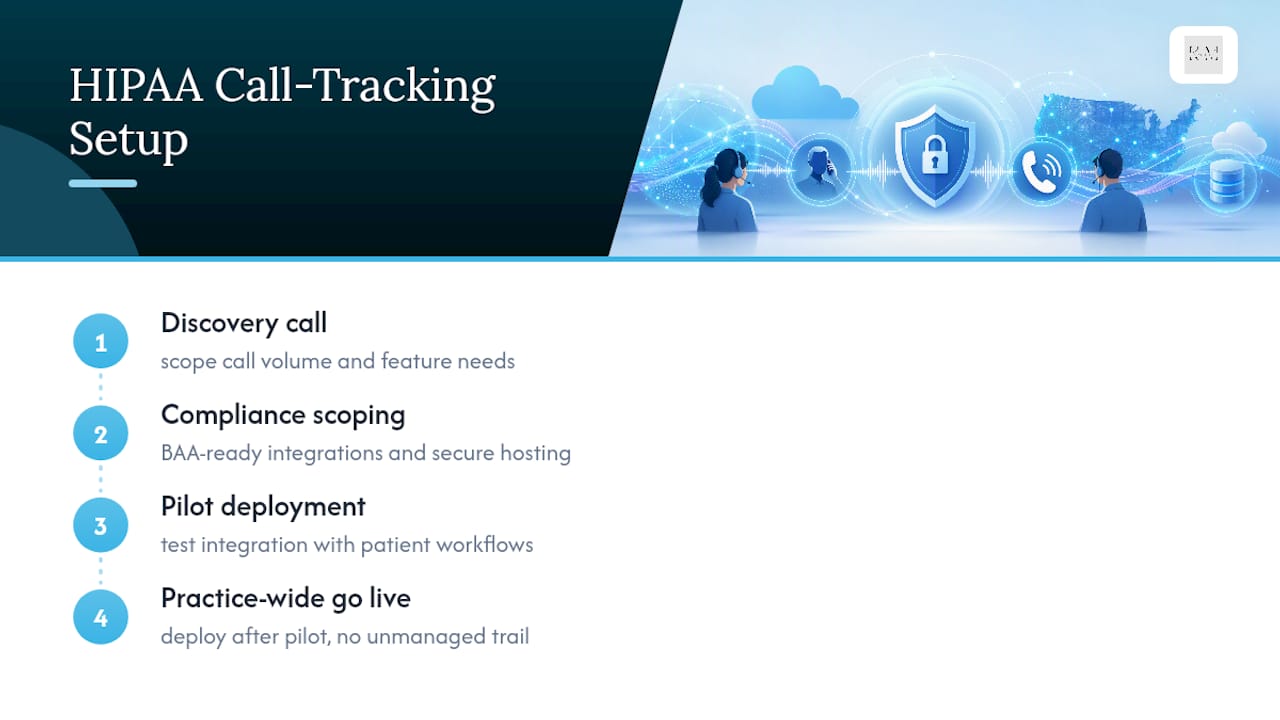
Klyrmedia’s HIPAA-compliant website design service and marketing automation offering both start from the same compliance-first foundation described throughout this guide: BAA-ready integrations, secure hosting, and call tracking that feeds directly into patient follow-up workflows without creating a separate, unmanaged data trail. The process starts with a discovery call to scope your current call volume and feature needs, followed by compliance scoping and a pilot deployment before anything goes live practice-wide.
If your practice is ready to stop treating call tracking as a side project and start treating it as protected patient data, consider requesting a discovery consultation through a marketing automation provider’s page and get a compliance scoping session on the calendar.
Where to Verify These Requirements Yourself
Compliance officers should not take any vendor’s word alone. Start with the HHS guidance on HIPAA breach notification to confirm BAA obligations, then review the HHS Security Rule resources for the full technical safeguard text behind §164.312. For a practical vendor-side checklist, Bright Pattern’s compliance guide walks through what to look for during procurement, and reviewing a specialist content and social partner can help if you need outside support building patient-facing communication around your new system.
Sources
- HHS: HIPAA breach notification and guidance for professionals
- DialPhone: HIPAA compliant contact center (technical mapping)
- Columbia University: HIPAA privacy record-retention policy

