
HIPAA Compliant Marketing Automation Features for Healthcare
Discover essential HIPAA compliant marketing automation features to protect patient data and enhance your healthcare campaigns effectively.

HIPAA Compliant Marketing Automation Features for Healthcare

HIPAA compliant marketing automation features are the specific technical and operational controls that allow healthcare marketers to run automated campaigns without exposing protected health information (PHI). The industry standard term for this category is “HIPAA-compliant marketing technology,” and it sits at the intersection of the Health Insurance Portability and Accountability Act, the HITECH Act, and modern patient engagement strategy. If you run marketing for a clinic, independent pharmacy, or multi-location practice, getting these features right is not optional. A single PHI breach can trigger Office for Civil Rights (OCR) investigations, six-figure fines, and patient trust that takes years to rebuild.
1. What are HIPAA compliant marketing automation features?
HIPAA compliant marketing automation features are software controls that protect PHI at every stage of a marketing workflow. They cover how patient data is stored, who can access it, how messages are sent, and how results are tracked. The distinction matters because generic marketing platforms were not built with healthcare regulations in mind. Plugging a standard email tool into your patient database creates liability the moment it processes appointment history or diagnosis-related data.
The core regulatory framework comes from HIPAA’s Security Rule, the Privacy Rule, and HITECH’s breach notification requirements. Together, they define what counts as PHI, who qualifies as a Business Associate, and what technical safeguards must be in place. Any marketing platform that touches patient data must sign a Business Associate Agreement (BAA) with your organization before you send a single message.

2. Encryption and access controls that protect PHI
Encryption is the first line of defense in any compliant marketing platform. AES-256 encryption is the current standard for PHI at rest and in transit. Systems built to this standard pass independent HIPAA security assessments on first submission. That is not a small thing. Most generic platforms encrypt data in transit but leave it unprotected at rest, which is where most breaches actually happen.
Role-based access control (RBAC) limits which team members can see patient data inside your marketing platform. A campaign coordinator does not need access to diagnosis codes. A billing analyst does not need to see email engagement history tied to individual patients. RBAC enforces those boundaries automatically.
- AES-256 encryption for data at rest and in transit
- RBAC to restrict PHI access by job function
- Full audit trails that log every data access event with timestamps
- Automatic session timeouts to prevent unauthorized access on shared devices
- BAA documentation built into the platform’s onboarding process
Pro Tip: Ask any vendor to show you their most recent third-party HIPAA security assessment before signing. If they cannot produce one, that tells you everything.
Audit logging is the feature most healthcare marketers overlook until they need it. Audit trails and access logs create an accountable record of who touched what data and when. During an OCR audit, that log is your proof of compliance.
3. AI-driven patient segmentation within HIPAA guidelines
AI segmentation is where compliant marketing automation starts generating real revenue. The idea is straightforward: instead of sending the same recall email to every patient, the system groups patients by diagnosis codes, visit recency, engagement scores, and care gaps. Each group gets messaging that fits their actual situation. That specificity drives response rates up and no-show rates down.
A 2026 case study across 47 clinics showed no-show rates dropped from 34% to 19% after implementing AI-driven segmentation and automation. That reduction translated to $3.2M in attributed revenue. The math is simple: fewer empty appointment slots means more procedures completed and more patients retained.
- Diagnosis-code segmentation for condition-specific outreach
- Visit recency scoring to identify patients at risk of churning
- Engagement scoring to prioritize high-intent patients for outreach
- Automated recall workflows for preventive care and chronic disease management
- Consent flags embedded in every segment to block non-consenting patients
Automated multi-channel workflows trigger timely outreach that increases patient loyalty and care plan compliance. That is not a marketing claim. It is what happens when the right message reaches the right patient at the right moment in their care journey.
Pro Tip: Build your segments around care gaps first, not demographics. A 45-year-old patient overdue for a diabetes A1C check responds to a different message than a 45-year-old who just completed a wellness visit.
For a deeper look at building these workflows, Klyrmedia’s guide on automating healthcare marketing covers the full setup process for 2026.
4. Multi-channel outreach features for compliant patient communication
Multi-channel outreach is the engine of patient retention. Compliant platforms support email, SMS, patient portals, and interactive voice response (IVR) systems. Each channel carries its own compliance requirements, and a good platform manages all of them from a single consent record.
Encrypted email delivery and two-way SMS messaging with automated responses are the baseline standard for compliant healthcare marketing automation. Email templates must strip PHI from subject lines, since subject lines are not encrypted in most email clients. SMS messages must be sent over encrypted channels and must honor opt-out requests immediately.
- HIPAA-safe email templates with PHI-free subject lines
- Encrypted two-way SMS with automated appointment reminders and responses
- Patient portal integration for secure message delivery and feedback collection
- IVR systems for automated phone reminders with opt-out handling
- Unified consent management that syncs opt-in and opt-out status across all channels
Granular consent management across channels is what separates compliant platforms from risky ones. A patient who opts out of SMS must be blocked from SMS across every campaign, not just the one they responded to. Platforms that manage consent at the channel level rather than the campaign level create serious liability gaps.
For practical guidance on compliant email campaigns, Klyrmedia’s email marketing guide for clinics covers channel-specific best practices in detail.
5. Revenue attribution dashboards that protect PHI
Attribution is the feature that proves your marketing budget is working. Compliant attribution dashboards link marketing touches to actual appointments and revenue collected, without exposing individual patient records in the reporting layer. That distinction matters because most analytics tools aggregate data at the campaign level, not the patient level, which keeps PHI out of the dashboard entirely.
End-to-end attribution dashboards track the full funnel from first marketing touch to revenue collected, while maintaining patient confidentiality. The table below shows what a compliant attribution dashboard tracks versus what it deliberately excludes.
| Tracked in Dashboard | Excluded from Dashboard |
|---|---|
| Campaign click-through rate | Individual patient names |
| Appointments booked per campaign | Specific diagnosis codes per patient |
| Revenue attributed per channel | PHI-linked engagement history |
| No-show rate by segment | Patient contact details |
| Cost per acquired appointment | Individual visit records |
Pro Tip: If your attribution dashboard lets you drill down to individual patient records, that is a compliance red flag. Aggregate reporting protects PHI and still gives you the campaign data you need.
Linking marketing activity to financial outcomes without PHI exposure is the core value of compliant analytics. You can see which campaigns fill your schedule and which ones waste budget, all without touching a single identifiable patient record.
6. People-based marketing as a compliant alternative to pixel tracking
Pixel-based tracking is a liability in healthcare marketing. When a patient visits a page about a specific condition and a tracking pixel fires, that visit can constitute PHI disclosure to a third party. The OCR has issued guidance making clear that standard analytics pixels on medical websites may violate the Privacy Rule. That guidance sent a wave of healthcare organizations scrambling to audit their websites.
People-based marketing platforms build audiences from verified opt-in profiles instead of cookies or pixels. These platforms carry no PHI and no cookie data, which eliminates the compliance risk entirely. Targeting accuracy actually improves because verified opt-in profiles reflect real patient preferences, not inferred browsing behavior.
HIPAA-certified people-based platforms build audiences from over 250 million verified profiles with no PHI or cookie data. That scale enables precise targeting across email, programmatic display, and connected TV without touching a single piece of identifiable health information.
The shift from pixel tracking to verified opt-in audiences also improves attribution clarity. When you know exactly who received a message and whether they booked an appointment, your attribution model is cleaner than anything a pixel can produce. For context on how verified patient profiles fit into a broader strategy, Klyrmedia’s overview of healthcare marketing types covers the full channel mix.
You can also explore how clinic storytelling strategy connects with patient engagement outcomes when paired with compliant automation.
Key Takeaways
HIPAA compliant marketing automation features protect PHI through encryption, RBAC, and consent management while driving measurable patient acquisition and retention results.
| Point | Details |
|---|---|
| Encryption is non-negotiable | AES-256 encryption for data at rest and in transit is the baseline standard for any compliant platform. |
| AI segmentation drives revenue | A 2026 case study linked AI-driven segmentation to a 15-point drop in no-show rates and $3.2M in revenue. |
| Consent management spans all channels | Opt-out status must sync across email, SMS, IVR, and portals to avoid compliance gaps. |
| Pixel tracking creates PHI liability | Verified opt-in, people-based audiences eliminate pixel risk and improve targeting accuracy. |
| Attribution protects PHI at the reporting layer | Compliant dashboards aggregate campaign data without exposing individual patient records. |
What I’ve learned about picking the right compliant platform
Most healthcare marketers I talk to focus on features first and compliance architecture second. That order gets you into trouble. The platforms that actually hold up under OCR scrutiny are the ones where HIPAA controls were built into the engineering from day one, not bolted on as a checkbox after the product shipped.
The AI segmentation piece is where I see the biggest gap between what practices think they have and what they actually have. Running a recall campaign based on visit recency is not the same as running one based on care gaps identified from diagnosis codes. The second approach requires a platform that can ingest clinical data securely, and most entry-level tools cannot do that without creating a PHI exposure risk.
The pixel tracking issue is more urgent than most marketing teams realize. I have seen practices running Google Analytics and Meta Pixel on their appointment booking pages without understanding that those pixels may be transmitting condition-related browsing data to third parties. The OCR’s 2022 guidance on tracking technologies made this a live enforcement issue, not a theoretical one. Switching to verified opt-in audiences is not just safer. It produces better data.
My honest recommendation: before you evaluate any platform’s feature list, ask for their BAA, their most recent security assessment, and a demonstration of how consent is managed across channels. If those three things are not immediately available, keep looking.
— Opinly
Klyrmedia’s approach to compliant healthcare marketing automation
Healthcare marketing is not a place for generic tools or guesswork on compliance. Klyrmedia builds HIPAA-compliant marketing systems specifically for independent pharmacies, medical clinics, and multi-location practices across the United States.
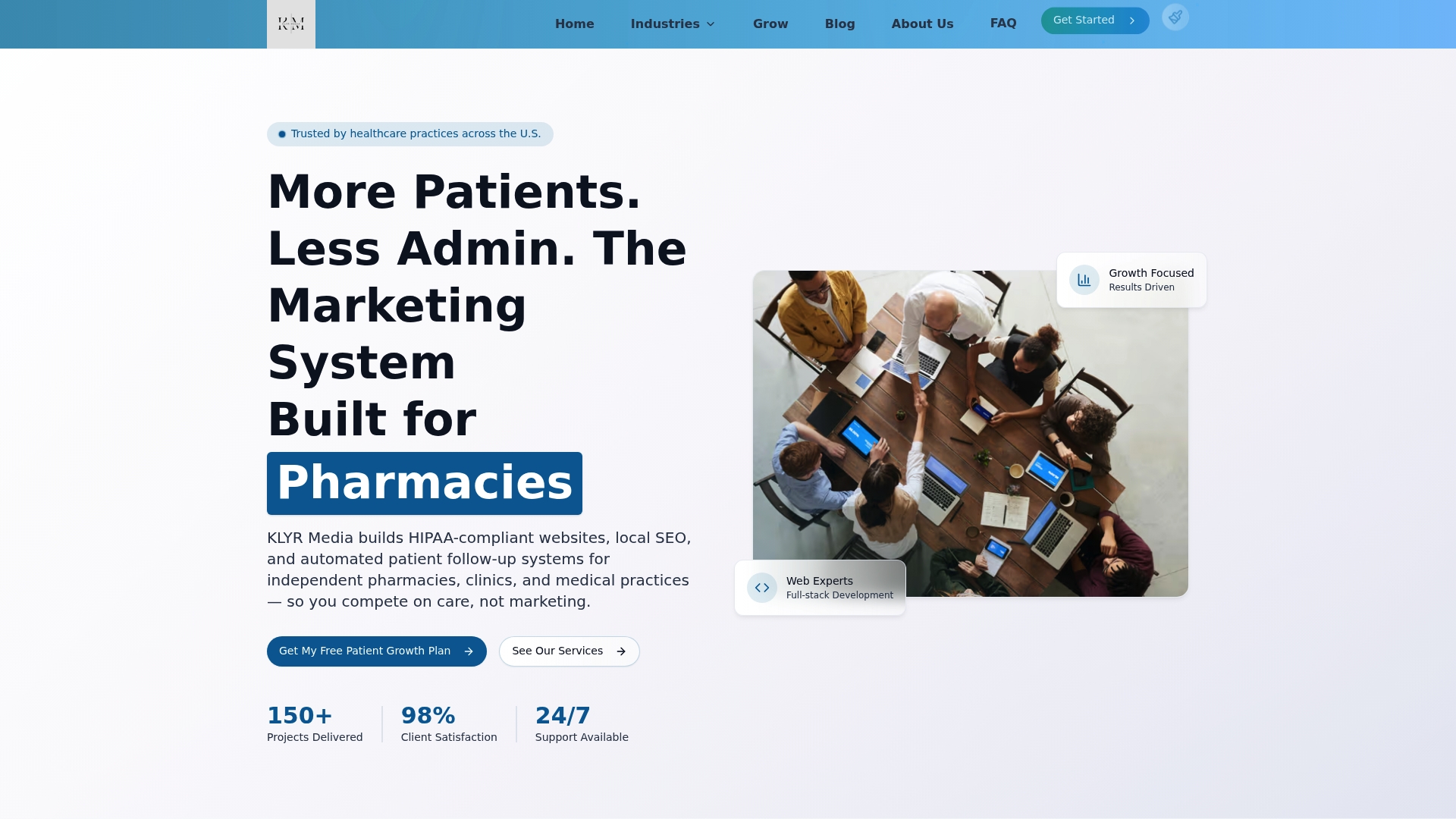
Klyrmedia’s AI-powered marketing automation covers patient segmentation, encrypted multi-channel outreach, consent management, and revenue attribution, all within a HIPAA-compliant architecture. Every engagement starts with understanding your patient acquisition goals and ends with a system that fills your schedule without putting PHI at risk. If you are ready to replace manual follow-up and pixel-based tracking with a compliant, automated system, Klyrmedia is the place to start.
FAQ
What makes a marketing automation platform HIPAA compliant?
A HIPAA compliant platform must sign a Business Associate Agreement, use AES-256 encryption, enforce role-based access controls, and maintain full audit logs. It must also manage patient consent across every communication channel.
Can I use standard email marketing tools for patient outreach?
Standard email tools are not HIPAA compliant unless they offer a BAA and encrypted delivery. Most consumer email platforms do not meet these requirements and should not be used for patient communications that include PHI.
How does AI segmentation stay compliant with HIPAA?
Compliant AI segmentation processes PHI within a secure, encrypted environment and never exposes individual patient data in campaign outputs. Segments are built from aggregated signals, and consent flags block non-consenting patients from every workflow.
Why is pixel tracking risky for healthcare websites?
Tracking pixels can transmit condition-related browsing behavior to third-party platforms, which may constitute a PHI disclosure under HIPAA’s Privacy Rule. The OCR issued guidance in 2022 confirming this risk, making pixel removal a compliance priority for healthcare sites.
What is people-based marketing in a healthcare context?
People-based marketing uses verified opt-in patient profiles instead of cookies or pixels to build targeting audiences. These profiles contain no PHI and carry no cookie data, making them a compliant and accurate alternative for email, programmatic, and connected TV campaigns.

