
Conversion Rate Optimization in Healthcare: 2026 Guide
Learn defining conversion rate optimization healthcare to boost patient actions. Discover strategies that increase website effectiveness in 2026.

Conversion Rate Optimization in Healthcare: 2026 Guide

Conversion rate optimization in healthcare, commonly called healthcare CRO, is defined as the systematic process of increasing the percentage of website visitors who complete a desired patient action, such as booking an appointment, submitting a contact form, or calling the practice. The industry standard term is “conversion rate optimization,” and it applies to healthcare with one major difference: every tactic must account for HIPAA compliance and patient trust. Average hospital website conversion rates sit between 1% and 3.1%, while top-performing healthcare sites reach 6.5% or higher. That gap is not luck. It is the direct result of deliberate, data-driven optimization. If you are a healthcare marketer or administrator trying to grow patient volume, defining conversion rate optimization in healthcare is your first step toward closing that gap.
What are the most important conversions on a healthcare website?
Not every click is a conversion. A conversion is any action that moves a visitor closer to becoming a patient or deepening their relationship with your practice.
Macro-conversions are the high-value actions that directly drive revenue:
- Appointment bookings (online scheduler completions)
- Phone calls from a click-to-call button
- New patient intake form submissions
- Patient portal registrations
Micro-conversions signal intent before a visitor is ready to commit:
- Map or directions clicks
- Insurance verification page views
- Chatbot interactions
- Provider profile views
- Downloadable health guide requests
Micro-conversions matter because they tell you where patients are in their decision process. A visitor who clicks your map three times but never books is a patient with friction in the funnel, not a lost cause. Tracking both macro and micro-conversions gives you a complete picture of patient behavior.
The key performance indicators (KPIs) to watch are appointment booking rate, phone call volume from web traffic, form completion rate, and patient portal sign-up rate. Set up goal tracking in Google Analytics 4 or a comparable analytics platform to capture each of these. Without that baseline, you are guessing.
Which CRO strategies most effectively improve patient conversion?
The highest-impact healthcare conversion strategies target three areas: reducing friction, building trust, and improving technical performance.
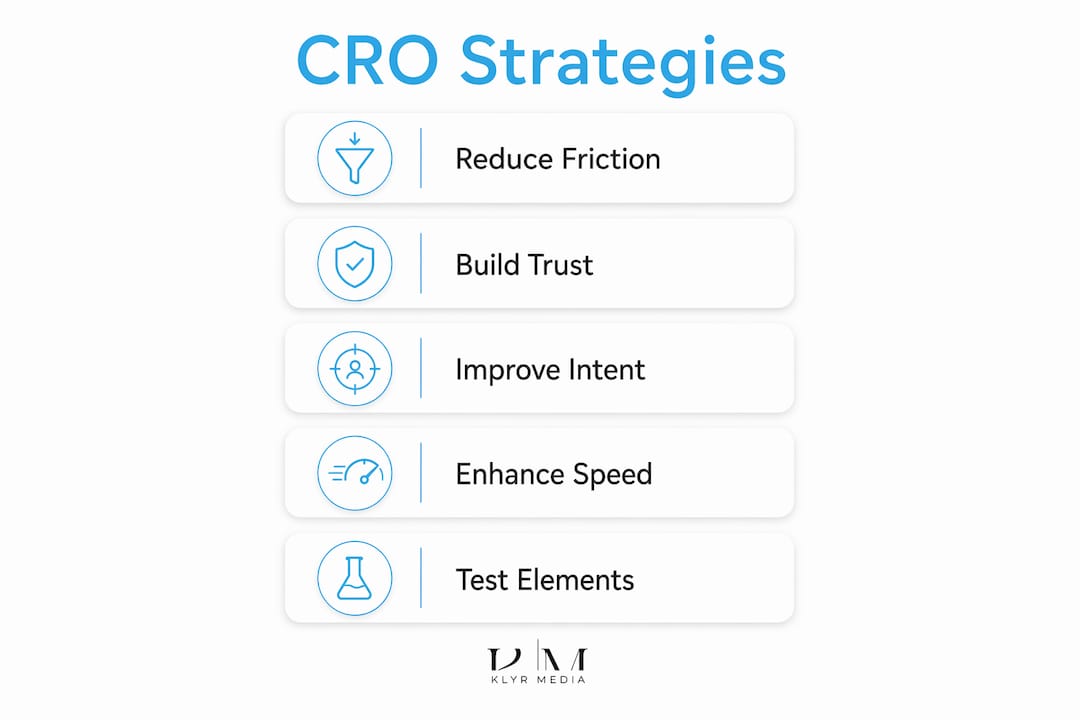
Reduce friction in the booking funnel
Simplifying booking funnels by testing fewer form fields, progressive disclosure, and smart defaults measurably boosts form completion rates. Progressive disclosure means showing patients only the fields they need at each step, rather than a wall of questions on page one. A single-step form asking for name, phone number, and preferred appointment time outperforms a five-field intake form every time in initial conversion testing.

Build trust with every element near your CTA
Verified patient reviews, professional credentials, and clear insurance and pricing information significantly reduce patient anxiety and improve conversion. Place trust signals directly adjacent to your call-to-action button, not buried in a footer. A “Board Certified” badge next to a “Book Now” button does more work than a full credentials page that patients never visit.
Optimize landing pages for specific patient intent
Landing pages designed for specific patient search intent, with clear CTAs and trust badges, guide visitors to take immediate action. A general homepage cannot serve a patient searching for “same-day urgent care near me” as well as a dedicated urgent care landing page with a prominent booking button and a wait time estimate. Match the page to the search, and conversions follow.
Fix your page speed first
As page load time increases from 1 to 3 seconds, bounce rates jump by 32%. That means nearly one in three potential patients leaves before your page even loads. Speed is not a technical nicety. It is a conversion lever. Run your site through Google PageSpeed Insights and address any issues scoring below 80 on mobile.
Use A/B testing on the right elements
Targeted A/B testing on mobile experience, CTA copy, and homepage hero messaging produces the highest win rates in healthcare CRO, with mobile experience improvements winning 38% of tests, CTA changes winning 35%, and hero messaging changes winning 31%. Test one element at a time. Run each test for at least two weeks to reach statistical significance.
Pro Tip: Never test a new CTA without also testing the trust signal next to it. A button that says “Book Now” with a star rating nearby consistently outperforms the same button with no social proof.
For a deeper look at how design choices affect patient behavior, Klyrmedia’s guide on healthcare website design covers mobile experience, CTA placement, and layout decisions that directly affect booking rates.
What metrics should you track for healthcare CRO performance?
Measuring healthcare digital optimization requires more than watching your overall conversion rate. You need to diagnose where patients drop off and why.
The core metrics to monitor are:
- Conversion rate: Total conversions divided by total visitors, expressed as a percentage. The industry benchmark is 1–3.1% for average sites and 6.5%+ for top performers.
- Bounce rate: The percentage of visitors who leave after viewing only one page. A high bounce rate on a service page signals a mismatch between ad copy and page content.
- Session duration: How long visitors spend on your site. Short sessions on key service pages indicate unclear messaging or poor layout.
- Form abandonment rate: The percentage of visitors who start a form but do not submit it. High abandonment usually means too many fields or a confusing layout.
- Cost per acquisition (CPA): The total marketing spend divided by the number of new patients acquired. This ties CRO directly to budget efficiency.
Funnel analysis is where the real insight lives. Map the path from landing page to booking confirmation, then identify the step with the highest drop-off rate. That step is your highest-priority optimization target.
Heatmaps and session replay tools show you exactly where patients click, scroll, and stop. If patients consistently stop scrolling before they reach your booking button, the button needs to move up the page. Behavioral data removes the guesswork from prioritization.
| Metric | What it tells you |
|---|---|
| Conversion rate | Overall funnel health and site effectiveness |
| Bounce rate | Landing page relevance and first impression quality |
| Form abandonment rate | Friction points in the booking or intake process |
| Session duration | Content clarity and patient engagement depth |
| Cost per acquisition | Marketing efficiency and return on ad spend |
Set realistic benchmarks before you start testing. If your current conversion rate is 1.2%, a realistic three-month target is 1.8%, not 6%. Incremental gains compound over time.
How does HIPAA compliance affect your CRO strategy?
HIPAA compliance is not optional, and it shapes every CRO decision you make. HIPAA and other regulatory requirements heavily restrict messaging and data collection options in healthcare CRO, pushing the focus toward trust, transparency, and patient privacy rather than aggressive marketing tactics.
Here is what that means in practice:
- Forms cannot collect protected health information (PHI) without proper encryption and business associate agreements (BAAs) in place with your technology vendors.
- Retargeting ads based on specific health conditions or page visits to condition-specific pages may violate HIPAA if they reveal patient health status.
- A/B testing tools that store session data must be HIPAA-compliant. Not every standard analytics or testing platform qualifies.
- Chatbots that collect patient information must route data through HIPAA-compliant storage and transmission systems.
The practical implication is that you cannot simply copy a CRO playbook from e-commerce and apply it to a medical practice. Every test, every form, and every data collection point needs a compliance review before it goes live.
The good news is that HIPAA compliance and high conversion rates are not mutually exclusive. A secure, HIPAA-compliant website actually builds the patient trust that drives conversions. Patients who see security badges, clear privacy policies, and transparent data practices are more likely to complete a booking form than patients who feel uncertain about where their information goes.
Pro Tip: Before launching any new form or tracking pixel, confirm your vendor has signed a BAA. This single step protects your practice and keeps your CRO program legally sound.
For healthcare practices running paid search alongside CRO efforts, Klyrmedia’s guide on HIPAA-compliant Google Ads covers compliant advertising strategies that feed qualified traffic into your optimized funnel.
Key Takeaways
Healthcare CRO is the process of systematically removing barriers between a website visitor and a completed patient action, measured against an industry benchmark of 1–3.1% for average sites and 6.5% for top performers.
| Point | Details |
|---|---|
| Know your conversion types | Track both macro-conversions (bookings, calls) and micro-conversions (map clicks, chatbot use) to see the full patient journey. |
| Fix speed and friction first | A 2-second page load delay raises bounce rates by 32%, making speed the fastest CRO win available. |
| A/B test the right elements | Mobile experience, CTA copy, and hero messaging produce the highest win rates in healthcare testing. |
| Compliance shapes every tactic | HIPAA restricts data collection and retargeting, so every test and form needs a compliance check before launch. |
| Measure what moves patients | Track conversion rate, form abandonment, and cost per acquisition together to diagnose and fix funnel drop-offs. |
What most healthcare CRO articles get wrong
The standard advice is to add more CTAs, run more tests, and watch the numbers climb. That framing misses the point entirely in healthcare.
Patients are not buying shoes. They are deciding whether to trust a stranger with their health. The friction that kills healthcare conversions is almost never a button color or a headline. It is uncertainty. Patients abandon booking forms because they do not know if their insurance is accepted, whether the doctor is taking new patients, or how long they will wait. Those are information gaps, not design problems.
The most effective healthcare CRO work I have seen focuses on answering patient questions before they become objections. Put insurance information on the booking page. Show real wait times. Display the doctor’s photo and a two-sentence bio next to the “Schedule” button. These changes reduce the cognitive load that makes patients close the tab.
The other thing most articles skip is the compliance reality check. You cannot run a standard retargeting pixel on a page about mental health services and call it a day. The practices that grow fastest are the ones that build their CRO program on a compliant foundation from the start, because they never have to pause and rebuild after a compliance incident. Slow and compliant beats fast and exposed every time.
— Opinly
Klyrmedia’s approach to healthcare conversion growth
Independent pharmacies, medical clinics, and healthcare practices face a real problem: their websites attract visitors but do not convert them into patients. Klyrmedia builds HIPAA-compliant healthcare websites designed specifically to close that gap, with secure architecture, mobile-first design, and booking funnels built around patient behavior.
Beyond the website itself, Klyrmedia’s healthcare SEO services and marketing automation programs bring qualified local patients to your site and keep them engaged through the entire decision process. If your practice is ready to move from average conversion rates to top-performer territory, Klyrmedia offers a free strategy consultation to identify your highest-priority CRO opportunities.
FAQ
What is conversion rate optimization in healthcare?
Healthcare CRO is the process of increasing the percentage of website visitors who complete a patient action, such as booking an appointment or submitting a form. It combines A/B testing, user experience improvements, and trust-building within HIPAA compliance requirements.
What is a good conversion rate for a healthcare website?
The average healthcare website converts between 1% and 3.1% of visitors. Top-performing sites reach 6.5% or higher, making that the realistic target for a well-optimized practice website.
Why do healthcare websites have low conversion rates?
Low conversion rates in healthcare are most often caused by unclear CTAs, slow page loads, and missing trust signals like patient reviews and provider credentials. Fixing these three areas produces the fastest gains.
How does HIPAA affect A/B testing and CRO?
HIPAA restricts which data collection tools and retargeting methods are permissible, requiring healthcare marketers to use only HIPAA-compliant analytics and testing platforms with signed business associate agreements in place.
What is the difference between a macro and micro-conversion in healthcare?
A macro-conversion is a high-value action like an appointment booking or phone call. A micro-conversion is a smaller intent signal, such as a map click or chatbot interaction, that indicates a patient is moving toward a decision.

