
Procurement Ready BAAs for Marketing Vendors in U.S. Healthcare
BAA guide for U.S. healthcare marketing teams: one hour vendor triage, a scope matrix, and vendor workflows to prevent PHI exposure.

Procurement Ready BAAs for Marketing Vendors in U.S. Healthcare

If a marketing vendor will create, receive, maintain, or transmit protected health information for your organization, you need a signed Business Associate Agreement before any data moves. That requirement comes straight from 45 CFR §164.504(e). If you’re not certain a vendor is covered, stop transferring PHI now, map exactly what that vendor can access, and either get an executed BAA or redesign the workflow to remove patient identifiers entirely.
TL;DR:
- Vendors that handle PHI in any way must have a signed Business Associate Agreement before data transfer, with scope clearly documented.
- A BAA is HIPAA-specific and differs from Data Processing Agreements, requiring specific clauses like breach notification and PHI return or destruction.
- Most healthcare marketing tools, including CRMs, appointment services, and analytics, require a BAA once they access identifiable patient data.
- When vendors refuse to sign a BAA, options include de-identifying data, limiting scope, or replacing the vendor with one that will sign.
- Ongoing vendor management should track BAA status, scope, audit evidence, and enforce safeguards consistently to maintain HIPAA compliance.
Table of Contents
- Quick Checklist: Triage Your Marketing Vendors Now
- What Is a BAA and Where Does HIPAA Require It?
- Which Marketing Vendors Actually Need a BAA?
- What Should a Marketing Vendor BAA Actually Include?
- When Do You Actually Need One, and What If the Vendor Says No?
- Red Flags That Signal a Bad-Faith BAA Negotiation
- Managing BAAs Across a Full Marketing Program
- Why Working With a Healthcare-Focused Marketing Partner Cuts Real Risk
- Get HIPAA-Ready Marketing Without the Guesswork
- Where to Go for the Actual Legal Text
- Sources
Quick Checklist: Triage Your Marketing Vendors Now
Before you draft anything or call legal, run every marketing vendor through this triage. It takes an hour per vendor and saves you from a breach notification later.
- Trigger check: Does the vendor create, receive, maintain, or transmit PHI on your behalf? If yes, a BAA is mandatory, not optional.
- Scope mapping: Document which specific services, product tiers, and subcontractors actually touch PHI. A vendor’s marketing dashboard might be clean while its backend logging tool isn’t.
- Evidence request: Ask for a signed BAA and recent audit evidence (SOC 2 or similar) at the same time, then store both centrally where compliance and marketing can both find them.
- No-BAA fallback: If the vendor won’t sign, you have three options: strip PHI from the feed, de-identify the dataset before it leaves your systems, or replace the vendor with one that will sign.
This is the same triage logic compliance teams use when inventorying vendors and mapping PHI flows across an entire marketing stack, not just one tool at a time.
What Is a BAA and Where Does HIPAA Require It?
A Business Associate Agreement is a contract that makes a vendor legally accountable for how it handles PHI on your behalf. HHS spells out exactly when one is required: whenever a business associate creates, receives, maintains, or transmits PHI for a covered entity under 45 CFR §164.504(e). No PHI in the workflow means no BAA requirement. One patient name attached to one appointment reminder flips the switch.
Signing a BAA doesn’t end your obligations. The covered entity, meaning your pharmacy, clinic, or practice, still has to manage access controls, encryption, and audit logging on its own side. A signed agreement is a contractual layer, not a replacement for actually implementing the Security Rule.
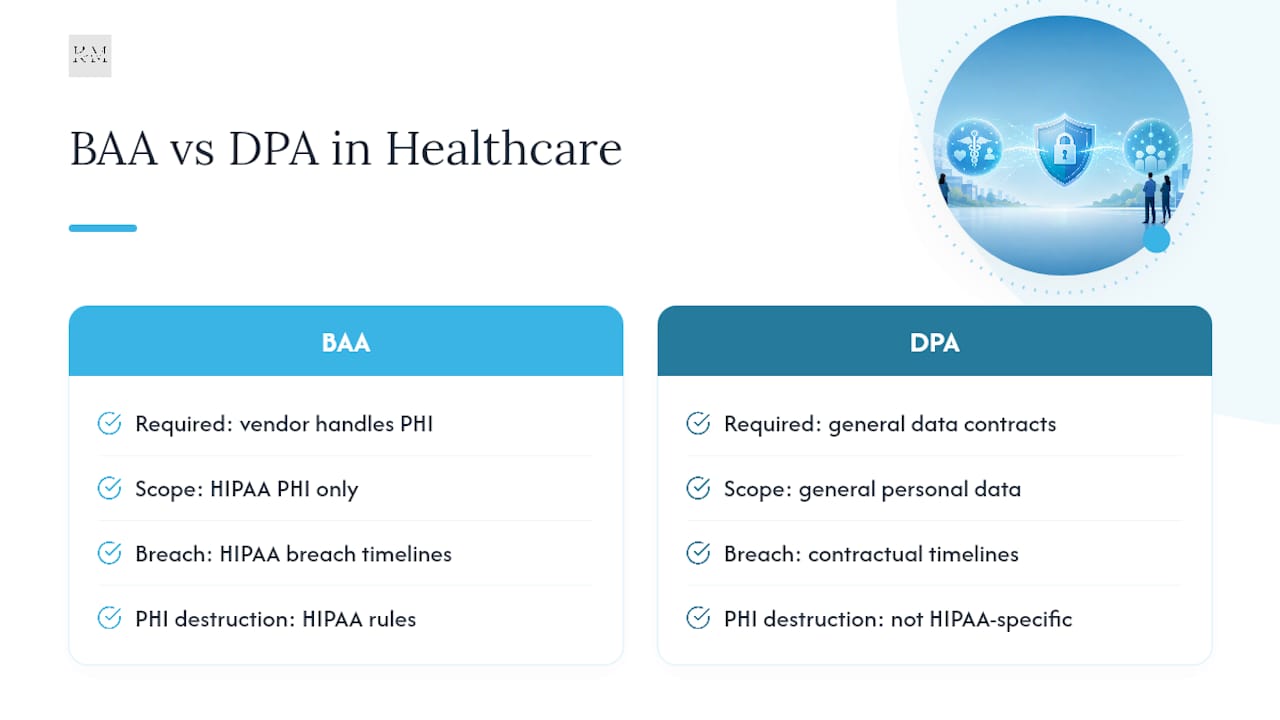
People also confuse BAAs with Data Processing Agreements. A DPA typically governs general data privacy and security terms and shows up constantly in non-healthcare SaaS contracts. A BAA is HIPAA-specific and carries statutory language a DPA doesn’t include, like breach notification timelines and PHI destruction requirements. If a vendor hands you a DPA and tells you it covers HIPAA, that’s a red flag on its own. You may need both documents if the vendor handles PHI alongside other regulated data types, such as payment information.
Which Marketing Vendors Actually Need a BAA?
Most healthcare marketing teams are surprised by how many tools in their stack qualify once you actually trace the data. The rule isn’t about the vendor’s category. It’s about whether identifiable patient data crosses into their systems.
Vendor types that typically require a BAA once PHI enters the picture:
- CRMs holding patient names, contact details, or appointment history for follow-up campaigns.
- Appointment reminder or SMS services that send messages containing a patient’s name paired with a visit date or provider.
- Cloud hosting or storage providers where patient lists, forms, or campaign data live, even temporarily.
- Call centers or answering services that handle inbound patient calls tied to scheduling or care.
- Analytics or behavioral tracking tools that ingest identifiers like email addresses, phone numbers, or device data linked to a patient record.
- Email service providers storing segmented patient lists for newsletters or care reminders.
The edge cases trip up more teams than the obvious ones. A vendor’s admin console access alone can count as “receiving” PHI, even if the vendor claims they never look at the data directly. Subcontractor chains matter too: if your CRM vendor uses a third-party email delivery service, that subcontractor needs its own flow-down agreement. And a dataset you consider “pseudonymized” may still qualify as PHI under HIPAA if it can be re-identified using other information the vendor holds.
A real-world example: uploading a spreadsheet of patient names and visit dates into a marketing automation tool for a “we miss you” campaign triggers the BAA requirement the moment that file leaves your system, regardless of how short the campaign runs.
What Should a Marketing Vendor BAA Actually Include?
The HHS model BAA lays out the standard clauses every agreement should contain, and most vendor-supplied contracts borrow this language directly rather than inventing new terms.
Core provisions to verify are present:
- Permitted uses and disclosures, spelling out exactly what the vendor can do with PHI and for what purpose.
- Required safeguards aligned with the Security Rule, covering encryption, access controls, and technical protections.
- Breach notification obligations with a defined reporting timeline back to your organization.
- Subcontractor flow-down, requiring any subcontractor the vendor uses to accept the same restrictions and safeguards.
- Patient rights support, meaning the vendor must assist with access, amendment, and accounting-of-disclosures requests.
- Return or destruction of PHI once the relationship ends or the data is no longer needed.
- Inspection and monitoring rights, letting you verify compliance rather than take the vendor’s word for it.
Marketing vendors introduce a few negotiation points that a generic BAA template won’t cover. Push for scope limits tied to the specific service tier you’re actually buying, minimum-necessary language that restricts data to what the campaign requires, defined data-retention limits, and logging or audit access so you can confirm the vendor isn’t holding onto records longer than agreed. Ask exactly how the vendor defines “de-identified” for analytics purposes, since some vendors use a looser standard than HIPAA’s Safe Harbor method.
If a vendor wants to exclude certain features or services from the BAA, don’t accept a vague carve-out. Demand a written list of exactly which components are excluded and confirm your team won’t route PHI through any of them.
Pro Tip: Keep a single scope matrix per vendor listing every service you use, which ones touch PHI, and which are explicitly covered by the signed BAA. Marketing teams add new features constantly, and an outdated scope matrix is how PHI ends up in an uncovered tool by accident.
When Do You Actually Need One, and What If the Vendor Says No?
Run every vendor decision through this three-step framework instead of guessing case by case.
- Apply the trigger test first. If the vendor creates, receives, maintains, or transmits PHI for you in any capacity, a BAA is required. This isn’t a judgment call once PHI is confirmed in the data flow.
- If the vendor refuses or can’t sign, you have four paths: strip PHI from what you send them, de-identify the dataset before export, restrict the vendor to non-PHI tasks only, or replace them with a vendor that will sign.
- For genuine “maybe” cases, such as a vendor that only sees aggregate campaign metrics with no identifiers, document your reasoning in writing and flag it for legal review before you rely on it. A written risk assessment protects you if that “maybe” turns out to be a “yes” later.
A defensible workaround when a vendor won’t sign is pseudonymizing data at ingestion, so only de-identified aggregates ever reach their systems, and documenting that decision as part of your vendor risk assessment. That approach only holds up if the pseudonymization is genuinely irreversible on the vendor’s end, not just stripped of an obvious name field.
Red Flags That Signal a Bad-Faith BAA Negotiation
Some vendors treat BAAs as an afterthought, and that shows up in specific, predictable patterns during procurement.
Watch for these warning signs:
- Outright refusal to sign, often disguised as “we don’t handle PHI” without asking how you’ll actually use their product.
- Offering only a Data Processing Agreement and calling it equivalent to a BAA.
- Limited-scope BAAs that quietly exclude the exact feature or integration you plan to use.
- Liability-shifting language that tries to make your organization responsible for the vendor’s own security failures.
- BAA availability locked to the most expensive tier, which many SaaS vendors do without disclosing it upfront.
Negotiation works better when you come prepared. Require explicit scope language naming your actual use case, insist on subcontractor disclosure with full flow-down obligations, and request recent independent audit evidence like SOC 2, AT-C 315, or HITRUST reports rather than accepting a marketing claim of “enterprise-grade security.” Set a specific breach-notification timeline in writing, and clarify retention and destruction terms before you sign, not after a dispute starts.
Build a procurement checklist that flags HIPAA-eligible pricing tiers before your team commits budget, since a vendor’s security policy needs to map cleanly onto BAA safeguard language or you’ll be renegotiating mid-contract.
Pro Tip: “BAA available” and “BAA executed” are not the same thing. A vendor listing HIPAA compliance on their marketing page means nothing until your organization holds a signed, dated agreement covering the specific services you’re using.
Managing BAAs Across a Full Marketing Program
Treating a BAA as a one-time signature is how compliance gaps open up months later. It has to work as a living record.
A thorough HIPAA-compliant vendor management system tracks every marketing vendor against a standard set of fields: the service itself, the PHI types involved, current BAA status, signature date, renewal date, an internal owner, known subcontractors, and the audit evidence on file. That structure turns vendor management into something a compliance officer can audit in minutes rather than chasing down through email threads.
The procurement sequence stays consistent: request the BAA early alongside a written scope matrix, require the signed agreement before any PHI transfer happens, and collect audit reports as part of onboarding rather than after a concern arises. On the configuration side, apply minimum-necessary settings, role-based access limits, and logging on every tool, then review the full vendor list on a set cadence, not only when something breaks.
| Workflow stage | What to track | Owner |
|---|---|---|
| Vendor intake | Service, PHI types involved, subcontractors | Compliance + marketing |
| BAA execution | Signature date, scope matrix, renewal date | Compliance |
| Configuration | Access roles, logging, minimum-necessary settings | IT/marketing ops |
| Ongoing review | Audit evidence, scope changes, renewal status | Compliance |
Model BAA clauses from HHS drop directly into most procurement requests without modification, which is worth knowing before you pay legal to draft language that already exists. There are guides on HIPAA-compliant marketing automation and a full HIPAA-compliant website workflow that walk through where these controls actually live inside a live marketing stack.
Why Working With a Healthcare-Focused Marketing Partner Cuts Real Risk
Generic marketing agencies treat HIPAA as a checkbox they get to after launch. Specialized healthcare marketing partners build the BAA conversation into vendor selection from day one, because they’ve already been burned by a vendor that “forgot” PHI touched their system. That difference shows up in how fast a scope matrix gets built and how quickly a vendor’s audit evidence actually gets reviewed instead of filed and forgotten.
The tradeoff is real, though. An in-house team keeps full control over vendor relationships and can move faster on small decisions, but usually lacks the bandwidth to track renewal dates and subcontractor chains across a dozen tools. An agency partner brings tested processes and prior BAA negotiations, but you’re relying on their operational discipline instead of your own. The right call depends on how many marketing vendors touch PHI and how much internal compliance capacity you actually have on staff.
Neither path removes the core obligation. Whoever manages your vendor list, someone has to own the scope matrix, the signature dates, and the audit evidence, or none of this holds up under scrutiny.
— Opinly
Get HIPAA-Ready Marketing Without the Guesswork
Specialized marketing programs for independent pharmacies, clinics, and practices often include BAA compliance handled from the first vendor conversation, not bolted on after a scare. That means fewer surprises when a vendor’s pricing tier suddenly requires an upgrade to unlock the agreement you needed all along.
Some agencies help healthcare organizations draft accurate BAA scope language, run a full vendor inventory across their marketing stack, and configure minimum-necessary access settings so PHI never lands somewhere it shouldn’t. That includes HIPAA-compliant website design built around the same safeguards your BAAs require, and marketing automation onboarding that treats vendor compliance as part of setup, not an afterthought. If your current stack has vendors you’re not sure about, you can request a vendor audit through a HIPAA-compliant web design service and get a clear answer on what needs a signed agreement before your next campaign goes out.
Where to Go for the Actual Legal Text
Start with the HHS page on business associates for the statutory basis, then pull the model BAA PDF for clause language you can drop into procurement requests. Klyrmedia’s healthcare marketing checklist rounds out the operational side for teams building this into an existing workflow.
This article is general information, not a substitute for advice from a qualified lawyer. Consult a qualified legal professional about your own circumstances before acting on anything here.

