

What Is Digital Reputation Management for Healthcare

Digital reputation management is the ongoing practice of monitoring, influencing, and shaping how your business or healthcare practice is perceived across digital channels. The industry term for this discipline is online reputation management, or ORM, and it covers everything from Google search results to patient reviews to AI-generated summaries. For independent pharmacies, medical clinics, and healthcare practices, ORM is not a marketing luxury. It is a core business function that directly affects patient trust, appointment volume, and long-term survival in a crowded market.
What is digital reputation management and why does it matter?
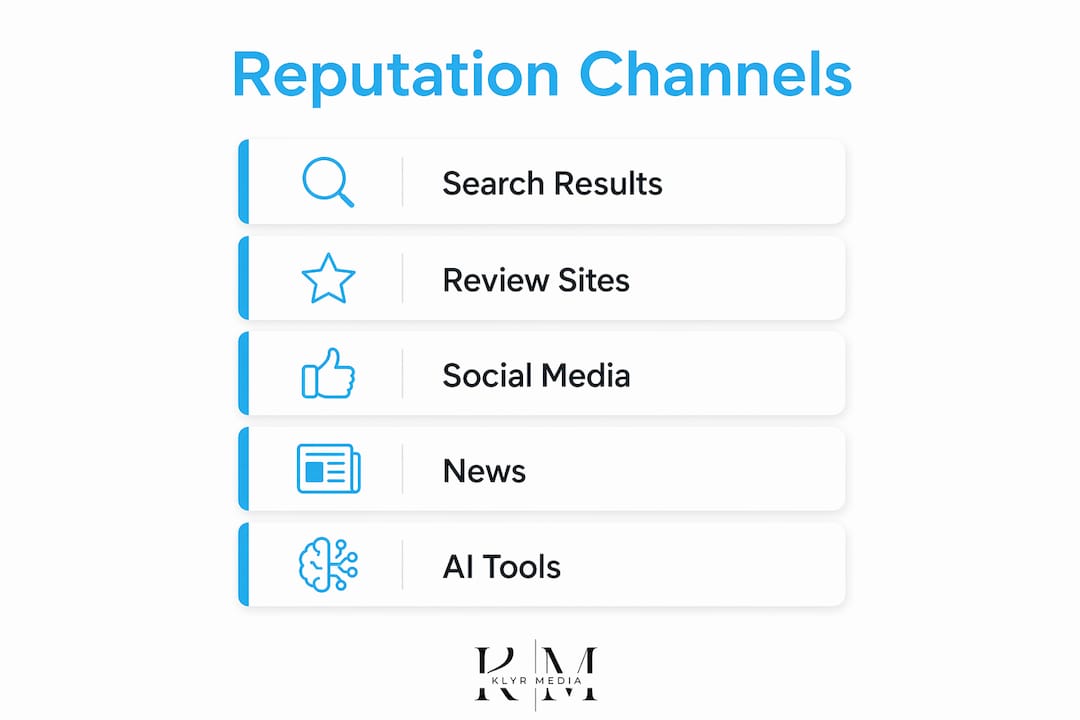
ORM is the ongoing practice of monitoring and shaping brand perception across every digital channel where patients and customers search for you. That includes search engines, review platforms, social media, news outlets, and increasingly, AI-powered tools like Google AI Overviews and ChatGPT. Each of these channels forms part of the picture a potential patient sees before they ever call your office.
The stakes are real. Businesses with strong online reputations experience less friction in sales and patient acquisition, while unaddressed negative content can kill a new patient relationship before it starts. ORM has moved well beyond marketing. It is now a risk management and visibility function that every healthcare administrator needs to take seriously.

Think of your digital reputation as the front door to your practice. If that door looks damaged or neglected, patients walk past it to the next option on the list.
What channels does online reputation management cover?
Effective ORM spans five key channels: search engine results, review sites, social media, news and media publications, and community forums. Each channel requires a different approach, and ignoring any one of them creates a blind spot.
Here is how each channel works in practice:
- Search engine results: Your Google Business Profile, brand SERP, and autocomplete suggestions all shape first impressions. A patient who searches your clinic name and sees a negative news story on page one has already formed an opinion.
- Review platforms: Google Reviews, Yelp, and Healthgrades are the primary decision points for healthcare patients. These platforms carry significant weight in local search rankings as well.
- Social media: Facebook, Instagram, and LinkedIn surface comments, tags, and community discussions that you may not even know exist without active monitoring.
- News and industry publications: A single negative press mention can outrank your own website for months. Proactive PR and content publishing help push those results down.
- AI-generated summaries: AI-powered search summaries from tools like Google AI Overviews now aggregate information from multiple sources and present it as a single answer. If the sources feeding those summaries are negative or outdated, your reputation suffers without you knowing why.
| Channel | Primary Tactic | Healthcare Example |
|---|---|---|
| Search engine results | Local SEO, Google Business Profile | Ranking for “pharmacy near me” |
| Review platforms | Review requests, response management | Responding to a 2-star Google review |
| Social media | Social listening, community engagement | Addressing a patient complaint on Facebook |
| News and media | PR outreach, content publishing | Publishing a health tips article |
| AI-generated summaries | Content authority, citation building | Ensuring accurate info feeds AI tools |
How does ORM affect patient trust and business performance?
The numbers here are hard to ignore. 98% of consumers read online reviews for local businesses before making a decision. That means nearly every patient who finds your practice online will check your reviews before booking. A single star improvement on Yelp correlates with a 5–9% revenue increase. That is not a rounding error. That is real money tied directly to how you manage feedback.
For healthcare providers, the connection between reputation and performance runs even deeper. Patients are not just buying a product. They are trusting you with their health. A pattern of unanswered negative reviews signals to prospective patients that you do not listen or care. A practice that responds thoughtfully to criticism signals the opposite.
Active engagement on review platforms and timely responses elevate Google star ratings and create a measurable competitive advantage. This matters especially for independent pharmacies and clinics competing against large chains with bigger marketing budgets. Your reputation is the one asset a chain cannot replicate at scale.
The business case for managing your online reputation comes down to three outcomes:
- Patient acquisition: Positive reviews and strong search visibility bring new patients through the door.
- Patient retention: Consistent engagement and responsiveness build loyalty over time.
- Competitive differentiation: A well-managed reputation sets you apart when patients have multiple options nearby.
What strategies and best practices drive effective reputation management?
Effective ORM is not a one-time cleanup. Viewing ORM as a continuous process is the only approach that works. Stopping engagement allows outdated or negative information to fill the vacuum and shape public impression on your behalf.
Here are the core practices that produce results:
- Set up continuous monitoring. Use Google Alerts for your practice name, monitor your Google Business Profile weekly, and check review platforms at least twice a month. You cannot respond to what you do not see.
- Respond to every review. Thank patients for positive feedback. Address negative reviews with empathy and a clear path to resolution. Never argue publicly. A calm, professional response to a bad review often impresses prospective patients more than the review itself.
- Create and promote authoritative content. Blog posts, health guides, and FAQ pages on your website push positive, accurate content into search results. This crowds out negative results over time. ORM is fundamentally about search dominance through consistent, quality content that ranks higher than the negatives.
- Request reviews proactively. Ask satisfied patients to leave a review immediately after a positive experience. Most patients who had a good visit simply forget to review unless prompted. A simple follow-up text or email changes that.
- Address inaccurate information directly. If a review contains false claims, flag it with the platform. If a news article is outdated or wrong, contact the publication. Letting inaccuracies sit unchallenged is a choice with consequences.
Pro Tip: Set a recurring calendar reminder every two weeks to audit your Google Business Profile, check your top three review platforms, and scan Google for your practice name. Fifteen minutes of consistent monitoring prevents months of reputation repair.
The most overlooked best practice is this: operational conduct is the foundation of reputation. No amount of digital polishing replaces poor service. ORM surfaces sentiment, but your real-world patient experience supplies the raw material. Fix the operations first, then manage the digital signal.
What tools and technologies support managing your online reputation today?
Modern ORM tools help you track online mentions, analyze sentiment, and coordinate responses without spending hours manually searching every platform. The right tools depend on your practice size and how many channels you need to cover.
The main categories of reputation tools include:
- Review management platforms: These aggregate reviews from Google, Yelp, Healthgrades, and other sites into a single dashboard. You can respond to reviews directly from the platform without logging into each site separately.
- Social listening tools: These monitor mentions of your brand name, your providers, and relevant keywords across social media and forums. They alert you when someone talks about your practice, even if they do not tag you directly.
- Reputation monitoring services: These track your overall reputation score, flag new negative content, and sometimes include automated response suggestions. Entry-level options suit small practices; enterprise platforms serve large health systems with multiple locations.
- AI overview tracking: A newer category that monitors how AI-powered search tools describe your practice. Monitoring AI-driven platforms is now a required part of any complete ORM strategy, not an optional add-on.
For healthcare providers, HIPAA compliance adds a layer of complexity. Any tool that handles patient data or communications must meet HIPAA standards. Generic reputation tools built for retail businesses often do not. This is where working with a healthcare-specialized partner like Klyrmedia makes a practical difference. Klyrmedia builds HIPAA-compliant digital systems that integrate reputation management with your broader online presence.
Key Takeaways
Digital reputation management is the continuous, multi-channel practice of monitoring and shaping online perception, and for healthcare providers, it directly determines patient trust, acquisition, and revenue.
| Point | Details |
|---|---|
| ORM covers five channels | Search results, review sites, social media, news, and AI summaries all require active management. |
| Reviews drive revenue | A one-star improvement on Yelp correlates with a 5–9% revenue increase for local businesses. |
| Continuous monitoring is non-negotiable | Stopping engagement lets negative or outdated content define your reputation by default. |
| Operations come first | Digital tools surface sentiment, but real-world patient experience creates the reputation. |
| Healthcare requires HIPAA-compliant tools | Generic ORM software often fails compliance standards that healthcare providers must meet. |
Why most practices get reputation management wrong
Here is the uncomfortable truth I have seen play out repeatedly: most healthcare practices treat reputation management as damage control. They ignore their reviews for six months, get a bad one, panic, and then scramble to “fix” it. That is not a strategy. That is a fire drill.
The practices that actually win on reputation are the ones that treat it like patient care itself: consistent, proactive, and grounded in genuine service. They respond to every review within 48 hours. They publish useful content regularly. They ask happy patients to share their experience. And when something goes wrong operationally, they fix the root cause rather than just crafting a polished response.
The other mistake I see constantly is chasing the wrong metrics. A practice obsesses over getting five-star reviews while ignoring the fact that their phone goes to voicemail during lunch. The review is the symptom. The voicemail is the disease. No amount of reputation management fixes a patient experience that is broken at the operational level.
The good news is that independent pharmacies and clinics have a real advantage here. You can build genuine relationships with your patients in ways that large chains simply cannot. That relationship is your reputation. Manage it like it matters, because to your patients, it does.
— Opinly
How Klyrmedia supports your healthcare reputation online
Your digital reputation is only as strong as the systems behind it. A slow, insecure, or non-compliant website sends a signal to patients before they even read a single review.
Klyrmedia builds HIPAA-compliant websites designed specifically for healthcare providers, giving your practice a secure and credible online foundation that patients trust. Paired with marketing automation services that handle patient follow-up, review requests, and engagement at scale, Klyrmedia gives independent pharmacies and clinics the tools to compete with larger systems. If you are ready to build a reputation that actually reflects the quality of care you deliver, Klyrmedia is built for exactly that.
FAQ
What is digital reputation management in simple terms?
Digital reputation management is the practice of monitoring and shaping what people find when they search for your business online. It covers reviews, search results, social media, and AI-generated summaries.
Why does reputation management matter for healthcare providers?
98% of consumers read online reviews before choosing a local business, including a healthcare provider. A strong online reputation directly influences patient acquisition and retention.
How often should I monitor my online reputation?
Audit your Google Business Profile and top review platforms at least twice a month. Set up Google Alerts for your practice name to catch mentions in real time.
What is the difference between ORM and SEO?
SEO focuses on improving your search rankings through content and technical factors. ORM uses SEO as one tool among many to shape the overall perception of your brand across all digital channels.
Do reputation management tools need to be HIPAA-compliant for healthcare?
Any tool that touches patient data or communications must meet HIPAA standards. Generic retail-focused tools often do not, which is why healthcare providers need purpose-built or healthcare-specialized solutions.

