

The Real Role of Content Marketing in Clinics

Most clinic marketers assume content marketing means keeping a blog alive. Post something, rank somewhere, get patients. That’s not how it works, and quietly, you probably already know that. The actual role of content marketing in clinics is far more strategic: it reduces friction before a patient ever calls, builds trust before they even know your provider’s name, and positions your clinic as the obvious choice in a local market that’s more crowded than ever. This article cuts through the noise and gives you a practical, research-backed picture of what content can actually do for your clinic.
Table of Contents
- Key takeaways
- The role of content marketing in clinics, defined
- Mapping content to the patient journey
- Evidence-based results you can actually point to
- Why cookie-cutter content fails your clinic
- Practical steps to build and optimize your content strategy
- What I’ve learned after watching clinics get this wrong
- How Klyrmedia helps clinics turn content into patient growth
- FAQ
Key takeaways
| Point | Details |
|---|---|
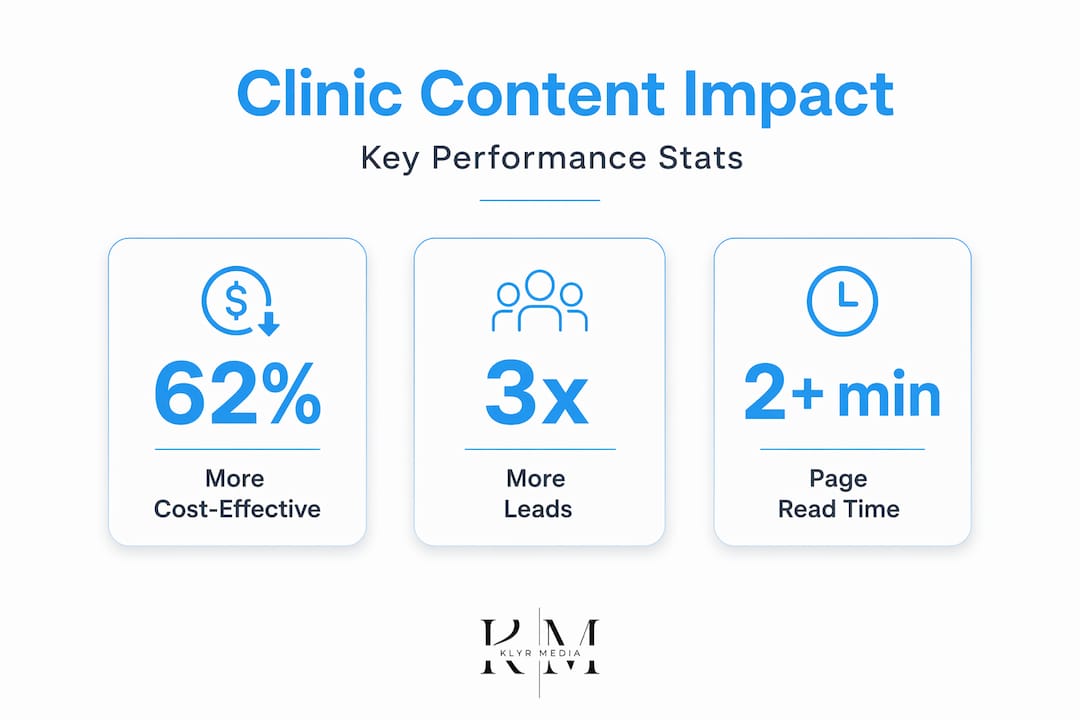
| Content marketing outperforms traditional ads | Healthcare content marketing is 62% more cost-effective than traditional marketing while generating 3x the leads. |
| Map content to the patient journey | Matching content types to awareness, consideration, and decision stages drives better conversions and lowers friction at each step. |
| Metrics must connect to appointments | Blog time-on-page and video click-through rates are only meaningful when tied to downstream scheduling and patient acquisition data. |
| Cookie-cutter strategies leak growth | Generic, templated content ignores local market dynamics and patient psychology, producing weak lead quality regardless of volume. |
| AI speeds up production with oversight | Clinics using AI for content see gains in speed, but human clinical review stays non-negotiable for accuracy and compliance. |
The role of content marketing in clinics, defined
Let’s clear something up. Content marketing for clinics is not a branding exercise and it’s not about hitting a publishing quota. It’s a patient communication system that works before, during, and after the clinical relationship.
At its core, content marketing for healthcare clinics means creating and distributing information that helps prospective and existing patients make decisions. That information might be a blog explaining what to expect during a first visit, a short video answering the most common questions about a chronic condition your clinic treats, or a condition-specific FAQ page that shows up in local search before a competitor does.
The importance of content marketing here comes down to trust at scale. A single provider can only have so many conversations per day. Well-placed content does that work 24 hours a day. And patients are looking. 83% of patients found purpose-led healthcare content meaningful and supportive during their care journey. That number should reshape how you think about every piece you publish.
The content formats that consistently deliver results for clinics include:
- Condition and symptom explainers that rank locally and answer high-intent questions
- Provider bios and philosophy pages that accelerate trust before the first appointment
- Patient education resources tied to your specific service lines
- Video and podcast content that supplements written formats for patients who process information differently
- FAQ pages aligned to the questions your front desk actually fields
One insight worth holding onto: effective patient engagement requires multilevel communication strategies that integrate interpersonal, team, and system perspectives. Content fits the system layer of that model. It standardizes and scales what your best communicators would say, if they had unlimited time.
Mapping content to the patient journey
Here’s where most clinics get tripped up. They produce content, but not the right content for the right moment. A patient who just searched “what is a lipid panel” is not ready to book an appointment. A patient who searched “best cardiologist near me accepting new patients” is. Same topic, completely different intent, and they need completely different content.
Clinics that map content to patient decisions rather than arbitrary publishing schedules report improved trust, reduced friction, and better conversion. Here’s a practical framework:
-
Awareness stage. The patient has a symptom or a concern. They’re searching broadly. Content here should educate without selling. Think condition overviews, myth-busting articles, and guides to understanding test results.
-
Consideration stage. The patient knows they need help and they’re comparing options. This is where provider spotlights, service comparison pages, and testimonials work hard for you. Local SEO and healthcare content strategy matter most here because patients are filtering by proximity and trust signals.
-
Decision stage. The patient is ready to act. They need friction removed. Clear information about what to bring to a first visit, how to schedule, what insurance you accept, and what to expect in the first 15 minutes. This is the content most clinics forget entirely.
-
Retention stage. After the visit, content keeps the relationship active. Appointment reminders, post-visit education, condition management resources. This stage drives the referrals and return visits that most clinics rely on but few deliberately cultivate.
Pro Tip: Build a simple content audit. For each major service line, check whether you have at least one piece of content at each patient journey stage. The gaps you find are your highest-priority content opportunities.
One common pitfall: treating local SEO as separate from content strategy. They’re the same thing. A page about pediatric care that mentions your city, your neighborhood, and local community health concerns performs better in local search and resonates more with the patient reading it. That’s the local patient acquisition principle working in practice.
Evidence-based results you can actually point to
Opinion about content marketing is everywhere. Here’s what the research says about the impact of content marketing in healthcare.
| Metric | Finding | Source |
|---|---|---|
| Cost per lead | Content marketing is 62% more cost-effective than traditional marketing | TrySight.ai / Grand View Research |
| Lead volume | Content generates 3x more leads than outbound tactics | TrySight.ai / Grand View Research |
| Patient satisfaction | Informational podcasts improved satisfaction by 14% | JMIR, 240 patients |
| Shared decision-making | Podcasts improved scores by 15% in outpatient settings | JMIR, 3 specialized clinics |
| Appointment uplift | Content with time-on-page over 2 min and video CTR over 3% shows 25% uplift in appointment metrics | TrySight.ai |
Informational podcasts supplementing written content increased patient satisfaction by 14% and improved shared decision-making scores by 15% in outpatient clinics. That’s not a theoretical benefit. It’s a measurable shift in how patients experience care.
On the AI side, GPT-4-generated discharge letters improved patient medical comprehension significantly, with 66.9% of patients fully stating their medication information correctly compared to 50.8% in the control group. The implication is clear: better-written content, regardless of how it’s drafted, produces measurable patient behavior change.
“The winning content marketing pattern is not to produce more content but to publish what patients actually need, ensure rigorous review, and measure impact through appointment and revenue data.”
Clinics tracking meaningful metrics like blog time-on-page over two minutes and video click-through rates over 3% see a 25% uplift in downstream appointment metrics. That’s the difference between vanity analytics and content performance that your leadership team will actually care about. It’s also the argument you need when defending content marketing budget.
Pair these content insights with a solid patient engagement strategy and the numbers become even stronger. Content doesn’t work in a vacuum. It works when it’s integrated with the rest of how your clinic communicates.
Why cookie-cutter content fails your clinic
Generic content is worse than no content. It is not a neutral choice. When a clinic publishes the same article template that 400 other clinics are using, patients notice the absence of specificity, even if they can’t articulate why. And Google notices too.

Cookie-cutter marketing lacks local relevance and misaligns with patient psychology, which caps clinic growth regardless of how much content gets produced. And standardized campaigns that ignore brand positioning, patient psychology, and clinic stage consistently lead to poor lead quality. This matters more than most marketers admit.
Here’s what content strategy for clinics looks like when it’s done right:
- Use local specificity. Your content should name the community you serve, reference local health trends, and reflect what your specific patient population actually asks about. A rural family medicine clinic and an urban dermatology practice need entirely different content voices and topic libraries.
- Lead with clinical strengths. What does your clinic do better than anyone nearby? That answer should be the organizing principle of your content, not an afterthought.
- Respect the patient’s psychological state. Someone researching a cancer diagnosis is not in the same emotional space as someone looking for a sports physical. Content tone, format, and call to action need to match the condition, not the content calendar.
- Differentiate by depth. Superficial articles on common topics help no one. Detailed, specific content on the nuances of your service lines signals expertise and builds the kind of authority that generic content never will.
Pro Tip: Before writing any new piece, ask this one question: “What specific patient question is this answering that no other content on our site already covers?” If you can’t answer it, the piece isn’t ready to be written.
True growth in healthcare marketing comes from strategic content that reduces friction before scheduling and answers specific patient questions in a locally relevant way. That’s an insight worth posting on your team’s wall.
Practical steps to build and optimize your content strategy
This is where strategy meets execution. Here’s a step-by-step approach that integrates content marketing best practices with the operational realities of running a clinic marketing function.
-
Audit your current content by service line and patient stage. Map every existing piece to a service line and a patient journey stage. The gaps are your editorial calendar for the next quarter.
-
Involve clinical staff in content creation. Not to write it, but to review it. Compliance failures in healthcare content are reputational and legal risks. Clinicians catching medical inaccuracies before publish is non-negotiable. The healthcare marketing compliance considerations are real and worth building into your workflow.
-
Use AI tools to accelerate drafts, not replace clinical review. Clinics using AI for content see meaningful gains in production speed, but the human oversight layer for accuracy and compliance stays essential. AI is your drafting assistant, not your medical editor.
-
Set KPIs that connect content to clinical outcomes. Traffic and rankings are inputs. Appointment conversions, new patient acquisition cost from content channels, and patient retention rates are outputs. Track both, but optimize for the outputs.
-
Integrate content with your local SEO structure. Every high-value page needs a geographic signal, a clear service focus, and a healthcare SEO foundation. Structure your website so content pages pass authority to your core service pages.
-
Respond to digital engagement promptly. Delayed responses in digital communication lead patients to disengage and abandon the platform entirely. Content brings patients to the door; responsiveness lets them in.
What I’ve learned after watching clinics get this wrong
I’ve seen well-resourced clinic marketing teams spend months building editorial calendars full of articles that never moved a single appointment metric. And I’ve seen small clinics with lean teams publish eight focused pieces and double their organic patient inquiries inside six months.
The difference is never volume. It’s intent.
Most clinics treat content like a tax they pay for visibility. Write enough, post enough, and eventually something works. That thinking produces a library full of generic material that patients skim and search engines deprioritize. Content stops being a cost center the moment you treat it as an operating system. Every piece has a job. It either reduces a specific friction point, answers a specific patient question, or builds authority on a specific clinical topic your clinic owns.
The compliance gap is real too. I see clinics err so far toward safe and sanitized content that they strip out anything a patient would actually find useful. That’s not safety. It’s missed opportunity.
Here’s the hard truth about measuring success: most clinics give up on content marketing before the results show up. The feedback loop in healthcare content is longer than in retail or B2B. Patients research slowly. They book when they’re ready, not when you publish. Give a real strategy at least 90 days of consistent execution before drawing conclusions.
The clinics that win are the ones that stop asking “how much content should we produce” and start asking “what does our patient actually need to know before they trust us enough to schedule.”
— Opinly
How Klyrmedia helps clinics turn content into patient growth
If you’ve read this far, you’re not looking for generic marketing advice. You’re looking for a system that actually works for a clinic like yours.
Klyrmedia builds exactly that. From HIPAA-compliant web design that gives your content a trustworthy home, to healthcare SEO services that get your best content in front of the right patients at the right moment, every service is built specifically for independent clinics and medical practices. The team at Klyrmedia understands compliance constraints, local market dynamics, and what it actually takes to connect content to appointment volume. If you’re ready to stop guessing and start building a content strategy that earns its place in your growth plan, Klyrmedia is worth a serious conversation.
FAQ
What is the role of content marketing in clinics?
Content marketing in clinics serves as a patient communication system that builds trust, educates prospective patients, and reduces friction before scheduling. It works across the full patient journey from first symptom search to post-visit retention.
How cost-effective is content marketing for healthcare clinics?
Content marketing is 62% more cost-effective than traditional marketing in healthcare and generates three times more leads, making it one of the highest-ROI channels available to clinic marketing teams.
What content formats work best for patient engagement?
Condition explainers, provider bios, FAQ pages, short videos, and informational podcasts all perform well. Podcasts specifically have been shown to improve patient satisfaction by 14% and shared decision-making scores by 15% in outpatient settings.
How do clinics measure whether their content is working?
Track blog time-on-page, video click-through rates, and most importantly, downstream appointment conversions. Clinics that monitor engagement metrics alongside scheduling data see a clearer picture of which content actually drives patient acquisition.
Why does generic healthcare content underperform?
Standardized content ignores local market context, patient psychology, and clinic-specific strengths. Without that specificity, content fails to differentiate the clinic or meet patients at their actual decision points, resulting in low engagement and poor lead quality.

