

Email Marketing for Clinics: Your 2026 Growth Guide

Most clinic owners pour money into ads and wonder why patients don’t come back. The answer is usually sitting in a spreadsheet collecting dust: your patient contact list. Email marketing for clinics is one of the highest-ROI channels available to healthcare providers today, yet most clinics either ignore it entirely or blast out generic newsletters that get deleted without a second glance. This guide walks you through building a quality list, crafting campaigns that actually resonate with your local patient base, and setting up the automation that keeps patients engaged between visits.
Table of Contents
- Key Takeaways
- Email marketing for clinics: laying the right foundation
- Crafting campaigns that actually connect
- Automating without losing the human touch
- Measuring what actually matters
- Avoiding mistakes that sink clinic campaigns
- My take on why most clinic email programs stall out
- Ready to build a clinic email program that actually works?
- FAQ
Key Takeaways
| Point | Details |
|---|---|
| Start with a clean list | Build your email list through inbound methods; purchased lists hurt deliverability and damage your sender reputation. |
| Segment before you send | Divide patients by condition, visit history, or location so every message feels personally relevant, not mass-produced. |
| Automate the heavy lifting | Welcome sequences, appointment reminders, and follow-ups can all run on autopilot once you configure them correctly. |
| Track what matters | Monitor open rates, click rates, and patient retention impact together. No single metric tells the full story. |
| Compliance is non-negotiable | Every clinic email campaign must satisfy CAN-SPAM requirements and respect HIPAA privacy boundaries for patient data. |
Email marketing for clinics: laying the right foundation
Before you write a single subject line, you need to know where your list comes from and whether it will actually reach anyone. This is the part most clinics skip, and it costs them later.
Building a list worth having
Purchased email lists lack reliability and consistently produce high bounce rates and low engagement. Inbound lead magnets, including downloadable wellness guides, appointment booking incentives, or seasonal health checklists, attract people who genuinely want to hear from you. That matters a lot for deliverability.
If you are starting from scratch or supplementing an existing list, email append services can help. They match your existing patient records against verified contact databases. The catch is that email append services match only 30 to 50% of records, and every appended address needs to be verified on the first send to catch bad data before it damages your sender score.
Pro Tip: Set up a double opt-in process for all new subscribers. Yes, it reduces your list size slightly, but the people who confirm twice are far more likely to open and stay subscribed.
Legal compliance you actually need to understand
There is a common misconception that HIPAA governs all clinic email marketing. It does not. HIPAA does not regulate B2B email marketing to healthcare providers, and CAN-SPAM governs commercial emails sent to patients. CAN-SPAM requires a physical address, a clear subject line, and a working unsubscribe option. No prior consent is required under CAN-SPAM, but HIPAA still applies to any message that contains protected health information. The safest approach is to keep your marketing emails free of specific patient health data and to follow HIPAA-compliant marketing practices for anything that touches individual patient records.
Here is a quick comparison of common list-building sources:
| Source | Quality | Deliverability risk | Best use case |
|---|---|---|---|
| Inbound opt-ins | High | Low | Ongoing patient nurture sequences |
| Email append services | Medium | Medium | Supplementing existing patient records |
| Purchased lists | Low | High | Almost never justified |
| Referral programs | High | Low | Growing word-of-mouth-driven lists |
Crafting campaigns that actually connect
Generic healthcare email templates are everywhere. They are also why most clinic email campaigns get ignored. Standardized healthcare marketing campaigns often fail because they ignore clinic-specific strategy, local market dynamics, and the real psychology of your patients. You are not marketing to “patients in general.” You are talking to people in your zip code who have specific health concerns and specific reasons to choose you over the clinic down the street.
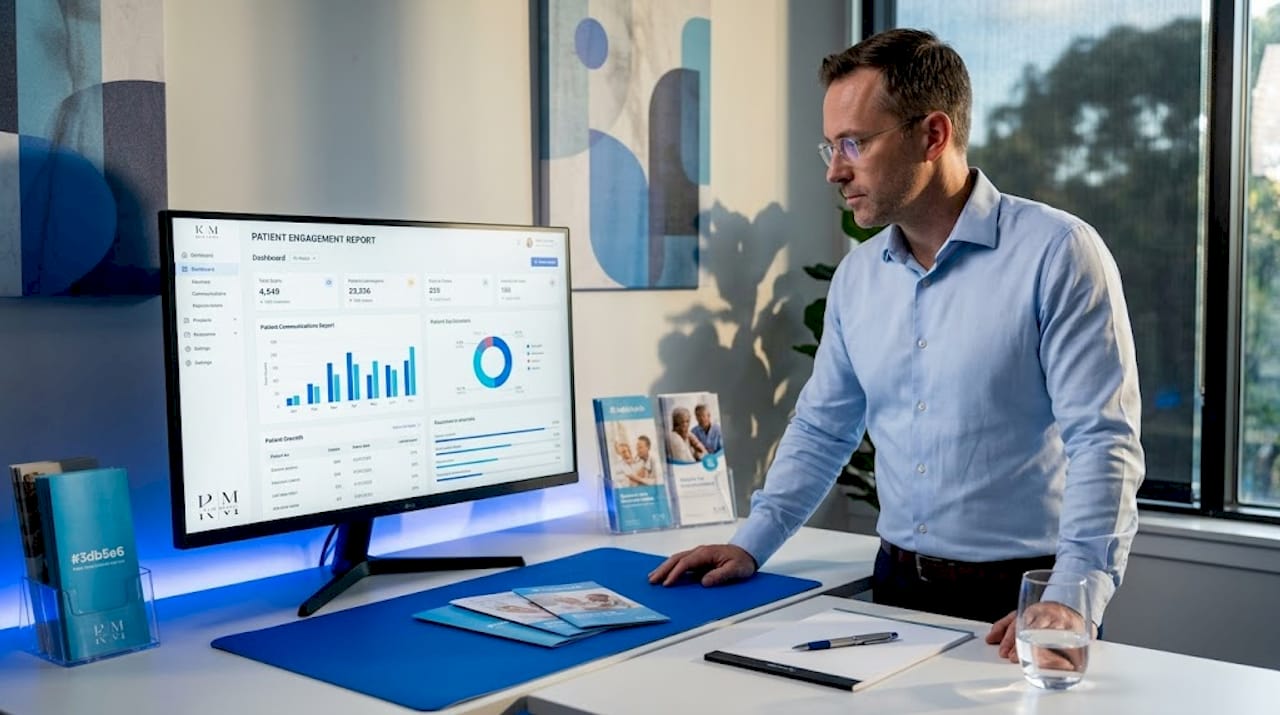
Segmentation is the work that pays off
Segmenting subscribers by geographic and behavioral data consistently improves both open rates and downstream conversions. For clinics, that means breaking your list into groups like chronic condition patients, new patients who have not returned for a follow-up, parents of pediatric patients, or patients who opted into a specific service line like physical therapy or sports medicine.
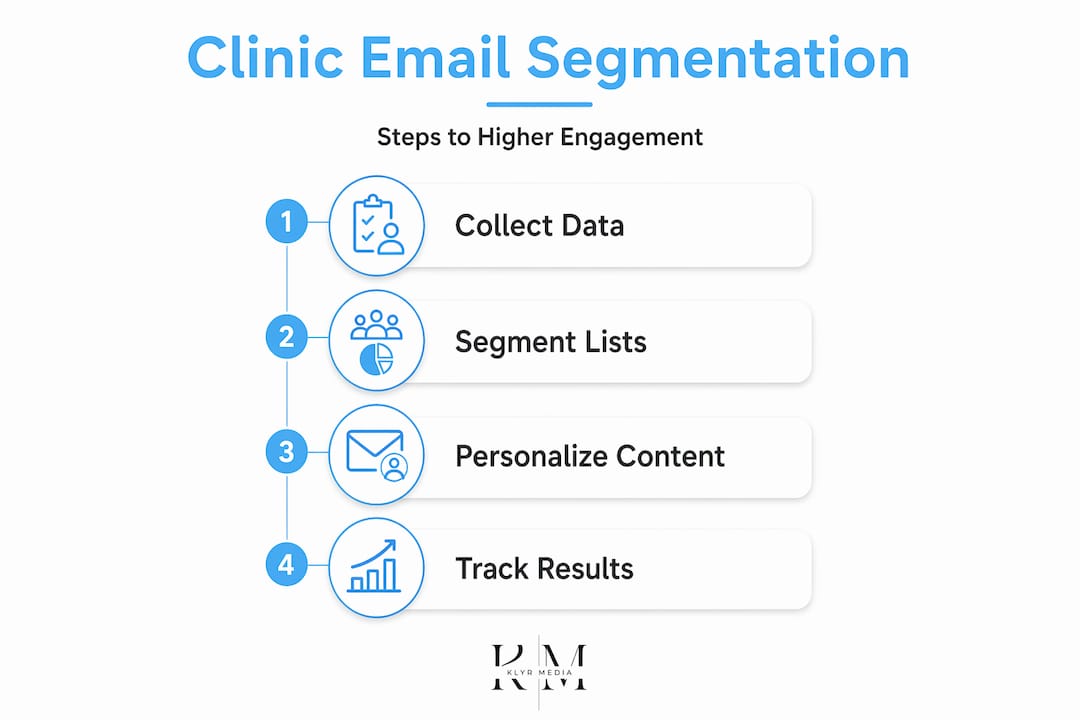
Each segment gets a different message. A patient managing Type 2 diabetes needs education about A1C monitoring and seasonal flu risks. A new patient who came in once and ghosted needs a re-engagement sequence that reminds them why they chose your clinic in the first place.
A few campaign types that consistently perform well in clinic settings:
- Welcome series. A two to three email sequence that introduces your clinic, sets expectations, and invites the patient to book their next appointment.
- Appointment reminders. Sent 48 hours and 24 hours before a scheduled visit, these reduce no-shows noticeably.
- Seasonal health campaigns. Back-to-school physicals in August, flu shots in October, blood pressure awareness in May. Timely and locally relevant.
- Re-engagement campaigns. For patients who have not visited in six or twelve months, a simple “We haven’t seen you in a while” message with a clear call to book can recover a surprising number of lapsed patients.
Pro Tip: Apply the 60-40 rule to your content mix: 60% educational value (health tips, condition awareness, clinic news) and 40% promotional content (appointment offers, new services). Clinics that flip this ratio see unsubscribe rates spike.
Subject lines deserve their own attention. Local specificity outperforms generic healthcare language almost every time. “5 things Riverside patients ask about flu shots” will beat “Stay healthy this season” every single time. Write to your community, not to an imaginary national audience.
Automating without losing the human touch
Automation is where clinic email marketing goes from a time-consuming task to a self-sustaining patient engagement system. The goal is not to remove human judgment. It is to free up your team so they can focus on the conversations that actually need a person.
Here is a practical workflow for setting up your first automated clinic email program:
- Choose your platform. Select an email marketing platform that supports segmentation, automation, and integration with your EHR or practice management system. Many healthcare-friendly options exist that handle HIPAA considerations at the platform level.
- Import and segment your list. Bring in your verified contacts and tag them by patient type, visit history, and condition where appropriate.
- Build your welcome sequence. A welcome sequence of two to three emails sent within the first week reduces unsubscribes significantly by setting expectations early. Draft these first.
- Set up appointment reminder automations. Trigger these based on data from your scheduling system. Patients who get a 48-hour reminder show up more consistently.
- Configure a re-engagement flow. Any patient with no activity in 90 days enters a short sequence designed to pull them back before they lapse permanently.
- Warm your sending domain. Start with small send volumes and increase gradually. Healthcare provider email deliverability depends heavily on domain reputation, which takes weeks to build properly.
- Review and optimize monthly. Automation is not set-and-forget. Check your open rates, click rates, and unsubscribes every 30 days.
Integrating telemedicine into your email strategy adds another layer of retention power. Clinics that connect email communication to telemedicine pathways see up to 40% higher patient retention by reducing the friction between a patient receiving information and actually accessing care. A simple “Book a virtual visit” button in your follow-up sequence can recover patients who would otherwise never return.
Pro Tip: Review your unsubscribe reasons if your platform captures them. “Too many emails” and “not relevant” are two very different problems requiring two very different fixes.
Measuring what actually matters
You can have beautiful emails and still run a failing campaign. Measurement closes the gap between effort and results.
The metrics that matter most for clinic email campaigns:
- Open rate. Industry average for healthcare hovers around 20 to 25%. Below 15% suggests subject line or deliverability problems.
- Click-through rate. A good benchmark is 2 to 4% for healthcare. Low clicks mean your content or calls to action are not resonating.
- Unsubscribe rate. Anything above 0.5% per send is a signal worth investigating immediately.
- Patient retention impact. This requires connecting email activity to appointment booking data, which most platforms support through UTM parameters.
For tracking offline actions, UTM parameters embedded in every email link tell you exactly which campaign drove a website visit or appointment booking. Promo codes work well for services like flu shot discounts or new patient specials. They give you a clean attribution line even when patients call in rather than click through.
| Metric | Healthy benchmark | Warning sign |
|---|---|---|
| Open rate | 20 to 25% | Below 15% |
| Click-through rate | 2 to 4% | Below 1% |
| Unsubscribe rate | Below 0.3% | Above 0.5% |
| Bounce rate | Below 2% | Above 5% |
Smart segmentation and local relevance are what push email marketing ROI toward the $36 return for every $1 invested benchmark. If your numbers are flat, the fix is almost always better targeting, not more volume.
Avoiding mistakes that sink clinic campaigns
Most clinic email programs do not fail because of bad writing. They fail because of avoidable structural problems and ignored security risks.
The biggest content-side mistake is what we touched on earlier: cookie-cutter campaigns that ignore local context. Your emails need to feel like they come from a practice that knows the community. Reference local health trends. Mention seasonal issues specific to your region. Connect your service promotions to what is actually happening in your patients’ lives.
On the security side, clinics face real and growing risks. Effective clinic email marketing must include employee phishing education, robust filtering, and data backup to protect patient confidentiality. Staff who click phishing links that arrive in email marketing workflows can expose patient data and destroy the trust you have built over years.
A single data breach traced back to a phishing email in your marketing system can cost more than your entire annual marketing budget. Train your team before you launch your first campaign.
Pro Tip: Use a dedicated sending domain (like emails.yourclinic.com) separate from your main business domain. If your sending reputation takes a hit from a deliverability issue, your core domain stays clean.
The short list of mistakes to avoid:
- Sending from a free email address (gmail.com, yahoo.com). It kills deliverability.
- Ignoring list hygiene. Remove hard bounces after every send.
- Writing subject lines that read like spam. Avoid all caps, excessive exclamation points, and the word “free.”
- Skipping mobile optimization. Over 60% of emails are opened on a phone.
My take on why most clinic email programs stall out
I’ve worked with enough independent clinics to notice a pattern. They launch an email program with a lot of energy, send three or four newsletters, get mediocre open rates, and then quietly stop. The frustrating part is that the problem is almost never the email itself. It is the strategy underneath it.
What I’ve seen work is matching your email approach to the actual stage of your clinic. A practice that opened 18 months ago has a different patient relationship than one that has been in the community for 12 years. New clinics need emails that build trust and explain what makes them different. Established clinics need emails that deepen relationships and re-activate lapsed patients. Sending the same message to both contexts fails for obvious reasons.
I’ve also learned that automation without personalization signals is a trap. You can automate everything and still have patients feel like they’re getting form letters. The fix is small: use the patient’s first name, reference the service they used, and time your messages around real calendar events in your area. These small touches are what separate clinics that see measurable retention gains from telemedicine integration from clinics that send emails into a void.
Stop chasing quick wins. The clinics that build durable email programs treat every message as a deposit into a long-term relationship. The return on that patience is a patient base that shows up consistently, refers their neighbors, and does not disappear when a larger chain opens nearby.
— Opinly
Ready to build a clinic email program that actually works?
If you have read this far and you’re thinking “this all makes sense but I don’t have the time or team to build it from scratch,” that is exactly the problem Klyrmedia was built to solve.
Klyrmedia specializes in healthcare email marketing and patient retention automation for independent clinics and medical practices across the United States. Every program is built with HIPAA compliance in mind, designed around your specific patient segments, and integrated with your existing scheduling and EHR workflows. You get a localized strategy that speaks to your community, not a recycled template from a generic marketing agency. If you want to see what a purpose-built clinic email program looks like for your practice, start with Klyrmedia.
FAQ
What is email marketing for clinics?
Email marketing for clinics is the practice of sending targeted, compliant email communications to current and prospective patients to improve retention, appointment volume, and ongoing health engagement. Done well, it produces some of the highest ROI of any marketing channel available to healthcare providers.
How do I build an email list for my clinic?
Build your list through inbound opt-ins such as appointment booking flows, wellness downloads, and in-office sign-up prompts. Purchased lists hurt deliverability and should be avoided. Inbound-generated lists consistently produce higher open rates and lower unsubscribe rates.
What email metrics should clinics track?
Focus on open rates (healthy benchmark: 20 to 25%), click-through rates (2 to 4%), unsubscribe rates (below 0.3%), and bounce rates (below 2%). Connecting email activity to appointment booking data through UTM parameters gives you the clearest picture of real business impact.
Is HIPAA a concern for clinic email marketing?
Yes, but not in the way most people assume. HIPAA applies when your emails contain protected health information. CAN-SPAM governs the commercial email requirements. Keep marketing emails free of specific patient health data and follow established healthcare compliance guidelines to stay on the right side of both.
How often should clinics send marketing emails?
Most clinics perform well sending two to four emails per month. Frequency should be determined by your patient segment and content quality, not by a fixed schedule. Sending more often with low-value content accelerates unsubscribes faster than almost any other mistake you can make.

