
7 Operational Steps to Cut Patient No Shows and Recover Revenue
An operations-first, evidence-ranked playbook to reduce patient no shows. Stack automated reminders, shorter lead times, frictionless self-scheduling, and...

7 Operational Steps to Cut Patient No Shows and Recover Revenue

Reminders alone will nudge your no-show rate down a few points, but they won’t fix it. The durable gains come from stacking three things: automated reminders, shorter booking lead times with frictionless rescheduling, and targeted live phone outreach for your highest-risk appointments. A systematic review of 61 studies found reminders are the most tested intervention in the literature, but the combination is what moves the needle in clinics that actually track results.
TL;DR:
- Combining automated reminders, shorter appointment lead times, and targeted live outreach reduces no-show rates more effectively than reminders alone.
- Lengthy booking intervals increase no-shows, but reconfirmation calls closer to the appointment can recover lost commitment, especially for long-lead visits.
- Online self-scheduling with real-time waitlists and easy cancellations lowers no-shows and increases slot fill rates through immediate backfilling.
- Risk stratification with simple criteria and focused phone calls for high-risk patients significantly decreases absenteeism and helps address health disparities.
- Successful implementation requires measuring baseline data, testing interventions incrementally, and ensuring systems include HIPAA compliance, EHR integration, and clear ownership roles.
Table of Contents
- What Actually Works to Reduce Patient No Shows?
- How Do You Implement Each No-Show Reduction Tactic?
- How Do You Measure Whether Your No-Show Fixes Are Working?
- What Technology and Roles Do You Need in Place?
- What KLYR Media Brings to No-Show Reduction
- The Systems View on Fixing No-Shows
- How Klyrmedia Helps You Stop Losing Revenue to No-Shows
- Sources
- FAQ
What Actually Works to Reduce Patient No Shows?
Not every tactic deserves equal investment. Some interventions cost almost nothing to run and pay for themselves in a week. Others take real staff time and only make sense for your riskiest appointment slots. Here’s how the evidence ranks them.
Reminders (SMS, phone, IVR, mail). These are the baseline, not the strategy. A meta-analysis of electronic text notifications found that multiple reminders can lift attendance noticeably over no reminder at all, but effect sizes vary widely by setting, patient population, and channel. Voice calls and multiple touches tend to outperform a single SMS blast. If you’re only sending one text 24 hours out, you’re leaving easy gains on the table.
Shortening lead time and reconfirming long-lead visits. The longer a patient waits between booking and the actual appointment, the more life gets in the way. Operational playbooks consistently flag lead time as one of the strongest predictors of no-shows. When a long lead time is unavoidable, for example a specialist referral booked eight weeks out, a reconfirmation call or message closer to the date recovers much of that lost commitment.
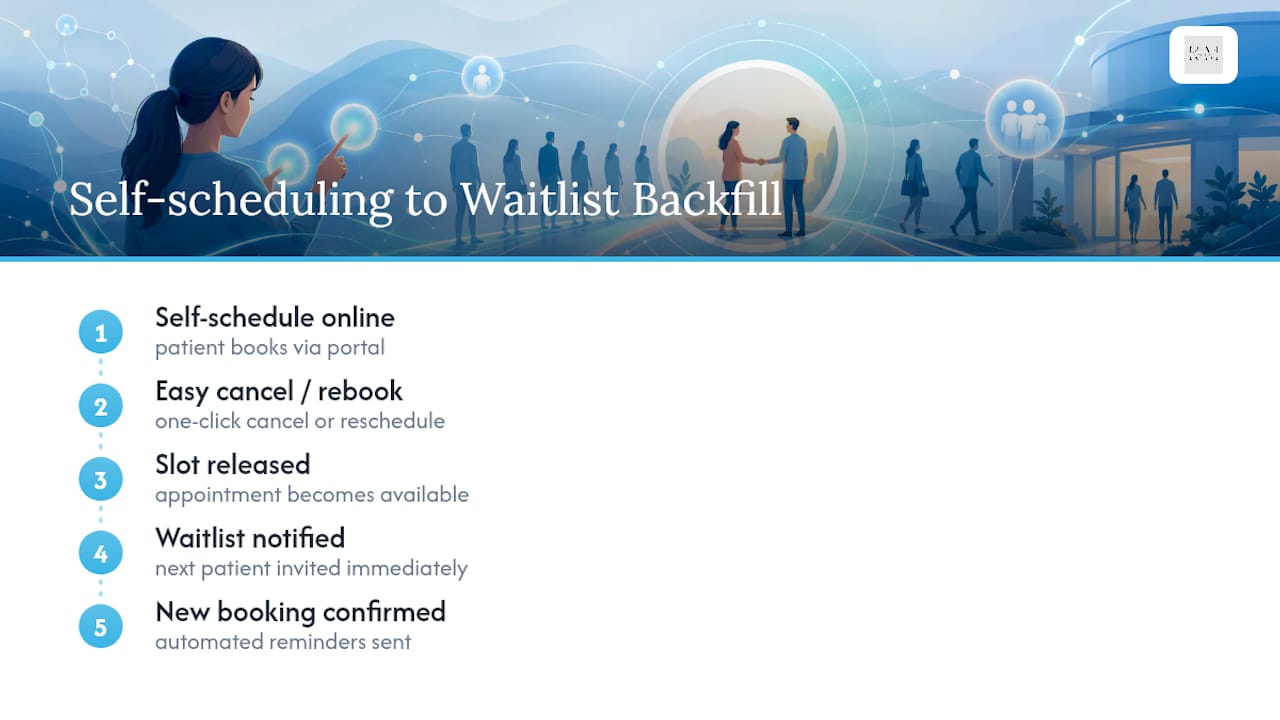
Self-scheduling with frictionless cancellation and backfill. Letting patients book, cancel, and rebook online removes a phone-tag layer that kills follow-through. Research on online appointment scheduling found lower no-show rates in practice settings where patients scheduled online, in part because easy cancellation frees slots that staff can immediately backfill from a waitlist.
Risk stratification with targeted live outreach. Broadcasting more reminders to everyone is less effective than calling the patients most likely to miss. A randomized quality improvement initiative that layered model-driven telephone outreach on top of standard automated reminders cut the composite no-show rate by several percentage points, with larger gains among some historically underserved groups in that sample.
Access interventions. Telehealth, transportation support, and language access matter most when the barrier to attendance isn’t forgetfulness but logistics. These interventions help a real subset of patients, but they don’t substitute for the reminder and scheduling fixes above. They fill a different gap.
Overbooking, deposits, and fees. Use these sparingly. They can offset chronic no-show slots in high-demand specialties, but blanket fees carry real equity risk and can punish patients facing transportation or childcare barriers rather than patients who are simply careless. Behavioral economics research suggests friction-reducing nudges consistently outperform blunt financial penalties for most practices.
How Do You Implement Each No-Show Reduction Tactic?
Knowing the ranked list is one thing. Building it into your week-to-week operations is another. Here’s a workable sequence for rolling out each tactic without overwhelming your front desk.
- Set your reminder cadence. For standard visits, send touches at 72 hours, 48 hours, and 24 hours before the appointment, with a same-day morning nudge for high-risk slots. For visits booked more than four weeks out, add a mid-point reconfirmation call. Use two-way messaging so patients can confirm, cancel, or ask to reschedule directly from the text, rather than making them call in.
- Cap your lead times by visit type. New-patient primary care visits should ideally book within about one to two weeks. Specialist referrals that require several weeks of lead time need a reconfirmation touch at the 2-week mark, not just a reminder the day before.
- Build self-scheduling with real backfill logic. Your online scheduler needs a visible cancellation button, a waitlist that automatically offers freed slots to the next eligible patient, and a staff handoff so a canceled slot doesn’t sit empty for six hours before anyone notices. Clinics running mature self-scheduling systems report far fewer unused slots because backfill happens in minutes, not days.
- Score risk with a simple rule first. Before you buy a predictive model, try a basic point system: prior no-shows in the last 12 months, lead time over 21 days, and new-patient status. Validate it against three months of your own scheduling data before trusting it. Predictive models can roughly halve non-attendance among flagged high-risk patients when paired with targeted phone calls, but a model built on someone else’s population may not transfer cleanly to yours.
- Script the live outreach calls. Staff calling high-risk patients should confirm the appointment, ask directly whether transportation or scheduling conflicts are likely, and offer an earlier or telehealth alternative on the spot, consistent with approaches described in the Ask a Christian Counselor Podcast - Prism Counseling & Coaching | Faith-Based Counseling and Spiritually-Integrated Therapy in Peoria and Phoenix AZ. Escalate to a patient navigator when the barrier is financial or logistical rather than a simple scheduling conflict. After-hours texting closes the loop for patients who don’t answer daytime calls.
- Triage telehealth candidates deliberately. Convert follow-up visits, medication checks, and behavioral health sessions to telehealth when clinically appropriate. Confirm the patient has a working device and has consented to the modality switch. Telehealth reduces access-related no-shows but introduces its own attendance quirks, since a patient who “forgets” an in-person visit may also forget a video link.
- Size overbooking and deposits carefully. Overbook only the specific slots with a documented history above your clinic’s average no-show rate, not the whole day. If you use refundable deposits, apply them only to appointment types with chronic non-attendance, communicate the policy in writing at booking, and refund automatically on 24-hour cancellation notice.
Pro Tip: Run your risk score and your live-outreach list side by side for two weeks before changing anything else. If the two lists mostly overlap, you’ve confirmed your model is worth building on. If they don’t, your front desk staff’s instincts are probably still your best signal.
Automated systems like the ones outlined in medical appointment reminder guidance can carry steps one through three without adding headcount, which frees your team’s calling hours for step five, where a human voice actually changes outcomes.
How Do You Measure Whether Your No-Show Fixes Are Working?
You can’t tell if an intervention is working without a baseline. Pull 90 days of scheduling data before you change anything, and segment it by new versus returning patients, specialty, and lead time. That segmentation matters because a fix that works for a 15-minute follow-up won’t necessarily work for a new-patient intake booked six weeks out.
Track five numbers on a rolling basis:
- No-show rate by appointment type, not just a clinic-wide average that hides which visits are actually the problem.
- Confirmation rate from reminders, meaning the share of patients who actively confirm rather than just receive a message.
- Contact or reach rate for live outreach calls, since a call that goes to voicemail isn’t the same as a completed conversation.
- Cancellation-to-reschedule ratio, which tells you whether canceled slots are actually getting rebooked or just vanishing.
- Backfill fill rate, the percentage of canceled slots refilled from your waitlist within a useful window.
Run interventions as small, controlled tests rather than clinic-wide overhauls. A/B two reminder message framings on a single appointment type for a month. If you have multiple locations, treat one as a rough control while you pilot in another.
For cost-effectiveness, calculate calls per no-show prevented: divide staff hours spent on outreach by the number of no-shows avoided compared to your baseline, then multiply by loaded staff cost per hour. Compare that figure against average revenue per completed visit. If a call costs less than the revenue recovered, scale it.
Watch for equity effects throughout. Track no-show rates by patient demographics before and after each intervention. A fee policy or aggressive overbooking schedule that lowers your average rate while widening the gap for lower-income or transportation-limited patients isn’t a win. The randomized outreach study cited earlier actually narrowed disparities for some patient groups. That’s the outcome to aim for, not just a lower topline number.
What Technology and Roles Do You Need in Place?
Six categories of tools cover most of what a clinic needs: automated reminders, self-scheduling, waitlist and backfill automation, EHR integration, telehealth infrastructure, and a reporting dashboard that ties them together.
When evaluating a vendor, insist on:
- A signed HIPAA Business Associate Agreement, non-negotiable for any tool touching patient contact data.
- Two-way messaging so patients can confirm or reschedule without a phone call.
- Clear opt-in and opt-out handling that respects patient messaging consent.
- Direct EHR sync so reminder and scheduling data doesn’t live in a separate silo your staff has to check manually.
- Audit logs and exportable reporting so you can actually run the measurement plan above.
Assign clear ownership: an operations lead who owns the no-show KPIs, an IT integrator who manages EHR sync, a clinical champion who sanity-checks scripts and risk thresholds, and someone who owns the weekly reporting review. In a small clinic, one administrator can wear the operations and reporting hats together, but someone still needs to own each function explicitly, or none of it gets checked consistently.
What KLYR Media Brings to No-Show Reduction
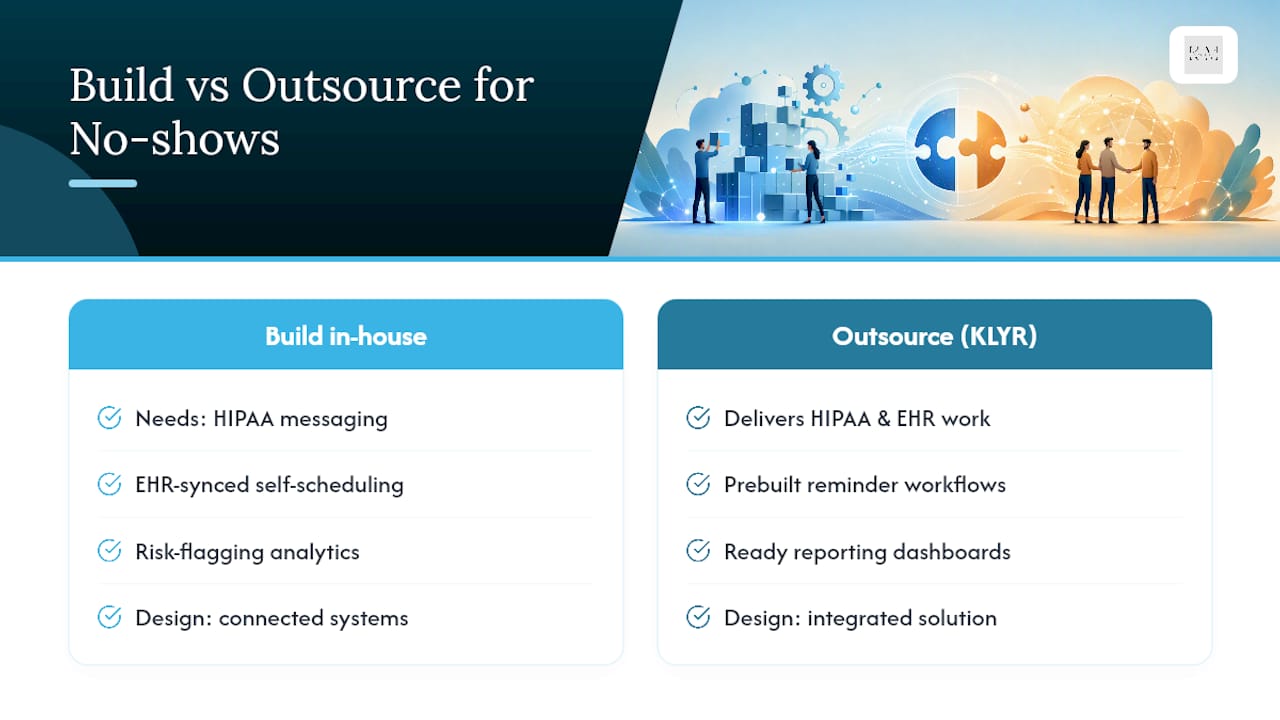
Clinics that build this stack in-house need HIPAA-compliant messaging, EHR-synced self-scheduling, and analytics that actually flag high-risk patients before the appointment date, not after. These solutions are designed as connected systems rather than one-off tools: automated reminder workflows, self-scheduling integrations, and reporting dashboards tailored for healthcare practices. Outsourcing this build makes sense once your clinic is spending more staff hours untangling spreadsheets than talking to patients. Building in-house can work for larger systems with dedicated IT, but most independent practices get there faster with an implementation partner who has already solved the HIPAA and EHR-integration pieces.
The Systems View on Fixing No-Shows
Reminders are the floor, not the ceiling. The clinics that see lasting drops in no-shows treat this as an operations program, not a messaging tweak. That means running small pilots, measuring what actually moves before scaling it clinic-wide, and checking that every fix helps your most vulnerable patients rather than just improving the average. Layer reminders with shorter lead times and targeted calls, then build the roof on top of that floor.
— Opinly
How Klyrmedia Helps You Stop Losing Revenue to No-Shows
Some providers opt for integrated solutions instead of piecing together multiple vendors. These offer HIPAA-compliant reminders, self-scheduling, and analytics built to communicate with each other and EHR systems from day one.
If your front desk is still calling every patient by hand or your reminder system doesn’t sync with your scheduling calendar, that gap is costing you booked revenue every week. Klyrmedia’s marketing automation services build the two-way messaging and targeted outreach workflows described above, while HIPAA-compliant website design handles the self-scheduling and booking flow patients actually use. Request a practice audit to see which of these gaps is costing your clinic the most appointments, and start with the fix that pays for itself fastest.
FAQ
How Can You Reduce Patient No-Show Rates?
Stack automated reminders with shorter booking lead times, frictionless online rescheduling, and targeted phone calls to your highest-risk patients. A randomized quality improvement study found this layered approach cut no-show rates significantly more than reminders alone.
What Is a Good Process for Reducing No-Shows?
Start by baselining your current no-show rate for 90 days, segmented by visit type and lead time, then pilot one intervention at a time, such as adding a reconfirmation call for long-lead appointments, before scaling clinic-wide. Klyrmedia typically recommends starting with automated reminders and self-scheduling before layering in staffed outreach, since that sequence builds on infrastructure you can measure right away.
How Do You Professionally Document a Missed Appointment?
Most practices use neutral, non-judgmental language such as “patient did not attend” or “appointment not kept” in the chart, avoiding blame-laden terms. Some practices follow up with a message noting the missed visit and offering to reschedule, which keeps the tone collaborative rather than punitive.
Can You Charge a Workers’ Compensation Patient a No-Show Fee?
Whether you can charge a no-show fee to a workers’ compensation patient depends on your state’s workers’ comp regulations and your payer contract terms, which vary widely and often restrict billing injured workers directly. Check your specific state’s workers’ compensation board rules and your provider agreement before applying any no-show fee to these visits.

