
Physician Referral Marketing for Practice Admins: Fix Intake Under 24 Hours
Operations first playbook for practice admins: audit referral sources, cut intake under 24 hours, use automation and KPIs to turn referrals into booked...

Physician Referral Marketing for Practice Admins: Fix Intake Under 24 Hours
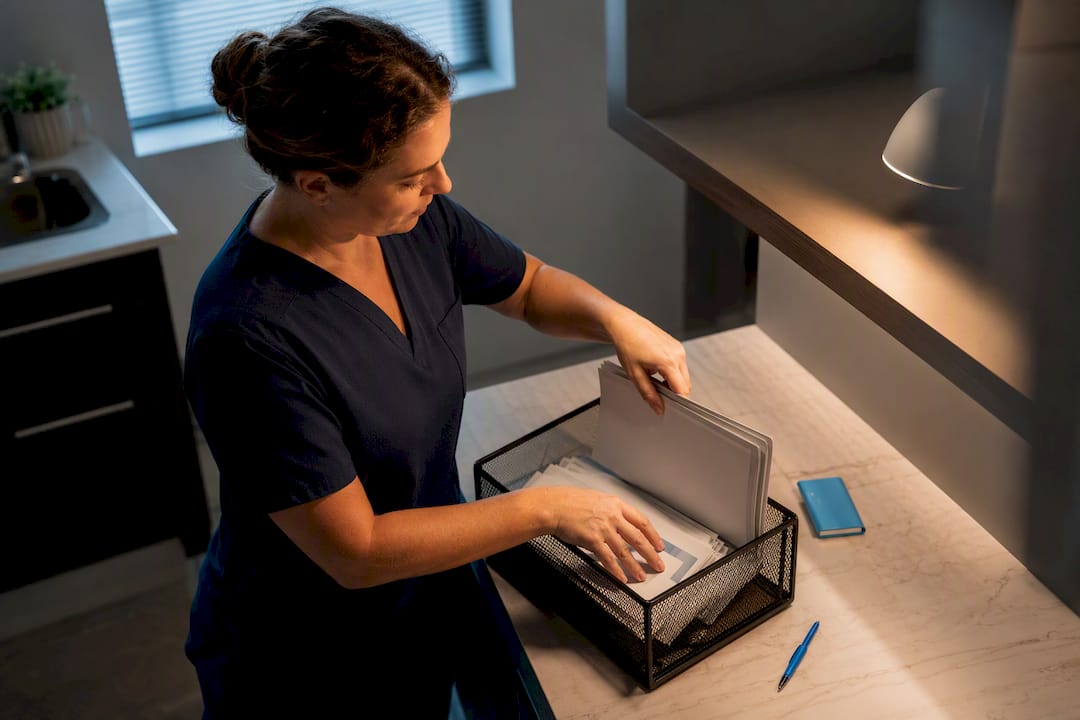
Physician referral marketing is the combination of deliberate relationship management and dependable operational workflows that keep referring clinicians sending patients your way. The single highest-leverage move you can make right now is fixing intake speed and closed-loop communication, because a slow or silent process quietly drains the referrals you already have. Before spending another dollar on outreach, run a 30 to 90 day audit of your referral sources and how long it takes you to make first contact with each new patient.
TL;DR:
- Focusing on fixing intake speed and closed-loop communication can triple referral completion rates by ensuring timely patient contact within 12 to 24 hours.
- Prioritize outreach efforts based on referral volume data, targeting top referrers with personalized visits and digital engagement rather than broad, unfocused campaigns.
- Automating follow-up with SMS, email, and EMR-integrated systems can increase referral completion by 250 to 300 percent compared to paper-based workflows.
- Improving patient experience by reducing appointment wait times and enhancing communication directly influences the likelihood of repeat referrals from physicians.
- Operationalizing referral marketing through targeted audits, automation, and reputation management significantly boosts consistent, reliable referral flow.
Table of Contents
- Build and Map Your Referral Network
- High-Impact Outreach Tactics That Actually Move the Needle
- Fix Your Intake Workflow Before You Fix Anything Else
- The KPIs That Tell You If Your Referral Program Is Working
- Common Mistakes That Quietly Kill Referral Relationships
- Why This Works: The Evidence Behind the Operational Approach
- Training Staff on Referral Management and Physician Communication
- How Patient Experience Determines Whether Referrals Repeat
- Fitting Referral Marketing Into Your Broader Marketing Plan
- Our Take: How Klyrmedia Helps Practices Operationalize Referral Growth
- How Klyrmedia Can Help You Fix the Leaks in Your Referral Program
- Sources
Build and Map Your Referral Network
You can’t run physician referral marketing on instinct. Pull 12 months of referral data from your EMR or scheduling system and look for concentration. Most practices find that a small slice of referrers accounts for most of their volume. That pattern isn’t unusual. Research on referral behavior consistently shows that roughly 20% of referring physicians generate about 80% of referral volume, a Pareto pattern documented in step-by-step referral marketing systems for specialists. That means your outreach budget should not be spread evenly. It should follow the money.
Once you have the data, sort referrers into tiers:
- Champions: Your top 10 to 15% by volume. Monthly personal check-ins, priority scheduling access, and a dedicated relationship owner.
- Growth: Mid-volume referrers with upside. Quarterly visits plus consistent digital touches.
- Potential: Low-volume or new contacts worth testing. Digital-only outreach until they show engagement.
Map each tier by specialty, payer mix, and geography. A cardiology group fifteen minutes from your clinic that shares your payer contracts deserves a different visit cadence than an out-of-network referrer forty miles away. Assign a named relationship owner to every Champion and Growth account, and set a service level agreement: outreach within a set number of days after any gap in referral activity, and a maximum response time for any question a referring office sends you. Without an owner, accountability disappears into “someone on the team will handle it,” which usually means nobody does.
High-Impact Outreach Tactics That Actually Move the Needle
In-person visits still work, but only when they’re targeted. A quick clinical briefing on a new service line, a lunch-and-learn on updated treatment protocols, or a fifteen-minute check-in with a Champion referrer’s office manager builds trust that no email replicates. Save these for Champions and high-potential Growth accounts. Spreading in-person effort thin across every referrer on your list wastes your best relationship-building tool on people who aren’t going to send you volume anyway.
Digital tactics scale the parts that don’t need a handshake:
- Email sequences targeted to referring physicians with case briefs, new provider announcements, and updated wait times.
- LinkedIn engagement with referring physicians and their practice managers, especially for specialty groups that publish clinical content.
- Referral landing pages with a downloadable referral form, clear referral criteria, and a direct line for urgent cases.
Content works best when it answers what a referring clinician actually wants to know: turnaround time, appointment availability, and what languages your staff speaks. Outreach that leads with your brand story instead of clinical usefulness gets ignored, a pattern the AMA’s guide to physician referral strategies backs up directly: referrer-facing marketing performs best when it demonstrates service quality and addresses the referrer’s own clinical needs, not yours.
Pro Tip: Send Champions a one-page “referral criteria card” they can pin near their desk. It sounds low-tech, but a physical or digital quick reference outperforms a polished brochure that gets filed and forgotten.
Fix Your Intake Workflow Before You Fix Anything Else
Every referral needs a minimal packet captured at the moment it arrives: patient contact information, referring provider, reason for referral, and urgency level. If that packet isn’t captured cleanly on day one, everything downstream slows down or falls apart.
Speed is not optional here. Reaching a patient within 12 to 24 hours of referral creation correlates with very high scheduling rates, according to Linear Health’s referral management benchmarks, and that rate drops sharply after day three. Build a persistence sequence that doesn’t rely on a single phone call:
- Automated SMS within hours of intake, with a scheduling link
- Follow-up email if SMS goes unanswered within 24 hours
- Phone call from staff by day two if no response
Referral completion substantially increases, by at least two to three times, when systems are EMR-integrated instead of paper-based, according to research on EMR-integrated referral coordination. If a full EMR integration isn’t in the budget yet, a lightweight version still works: a referral-source field in your practice management system, templated acknowledgment emails, SMS scheduling links, and a weekly team huddle to review anything stuck.
Send a consult summary back to the referring physician within 48 to 72 hours of the visit. This is a small operational habit, but practitioners consistently describe it as one of the highest-return activities for earning repeat referrals, because it tells the referring office their patient was actually seen and their trust was rewarded.
The KPIs That Tell You If Your Referral Program Is Working
You can’t manage what you don’t measure, and physician referral marketing generates plenty of numbers worth tracking weekly, not quarterly.
- Referral completion rate: Referrals scheduled and completed divided by total referrals received. Best-practice targets sit between 85% and 95% when automation and multi-channel persistence are in place.
- Time to first contact: Hours from referral receipt to first outreach attempt. Target under 24 hours.
- Closed-loop rate: Percentage of completed visits where a consult summary was returned to the referring provider.
- Referral leakage: Referrals that went unscheduled or were sent to a competing provider instead.
- Revenue per referrer: Total downstream revenue divided by active referral sources, useful for justifying relationship investment.
To calculate outreach cost per completed referral, divide total outreach spend for a tier by the number of completed visits from that tier. If you spend $2,000 a quarter on Champion-tier visits and it produces 40 completed referrals, that’s $50 per completed patient, a number worth comparing against the average revenue that patient generates. Build a simple weekly dashboard with these five metrics and review it in a standing 20-minute meeting.
Common Mistakes That Quietly Kill Referral Relationships
The most common failure isn’t a bad relationship. It’s a good relationship undermined by a broken back office.
- Relying on lunches and gifts while ignoring how long it takes your staff to actually contact the referred patient
- Failing to capture referral source at intake, which makes leakage impossible to diagnose later
- Treating referral marketing as a one-time campaign instead of an ongoing operational function
- Ignoring compliance: any exchange of value with referring physicians should be reviewed against Stark Law and anti-kickback statute requirements, and this article isn’t legal advice, so loop in counsel before structuring any financial arrangement
Watch for red flags: a Champion’s monthly volume drops by a third, a referring office stops answering calls, or a competitor opens near one of your top referrers. When you see one, the fix is a same-week phone call from the relationship owner, not an email.
Pro Tip: If a top referrer goes quiet, don’t lead the recovery call with an apology about marketing. Lead with a question about their patients. Most relationship damage traces back to a scheduling delay, not a lack of attention.
Why This Works: The Evidence Behind the Operational Approach
The research on this is remarkably consistent: speed and follow-through beat charm every time.
Contacting a patient within 12 hours of referral creation produces dramatically higher booking rates than outreach delayed even a day or two, and EMR-integrated coordination can lift completion rates by 250 to 300% over paper-based processes.
That gap, drawn from findings on EMR-integrated referral systems, explains why practices investing in automation see faster growth in referral volume than practices investing only in physician liaisons. Automation doesn’t replace the relationship. It protects it, by handling the repetitive coordination work so staff can focus on exceptions and the referring physicians who need a real conversation. Closing the loop with a consult summary remains the highest-return, lowest-cost activity in the entire system.
Training Staff on Referral Management and Physician Communication
Your front desk and referral coordinators are the actual face of your referral program, more than any liaison who visits twice a year. If they don’t know the intake protocol cold, every tactic above falls apart on contact.
Train staff on three things specifically. First, the referral packet: what fields are mandatory, where they’re entered, and who owns follow-up if information is missing. Second, the persistence sequence: exactly when SMS goes out, when email follows, and when a phone call is required. Ambiguity here is where referrals quietly die. Third, tone. Staff need scripts for calling a referred patient that sound like a warm invitation, not a collections call, and they need a short protocol for calling a referring office when something is unclear rather than guessing.
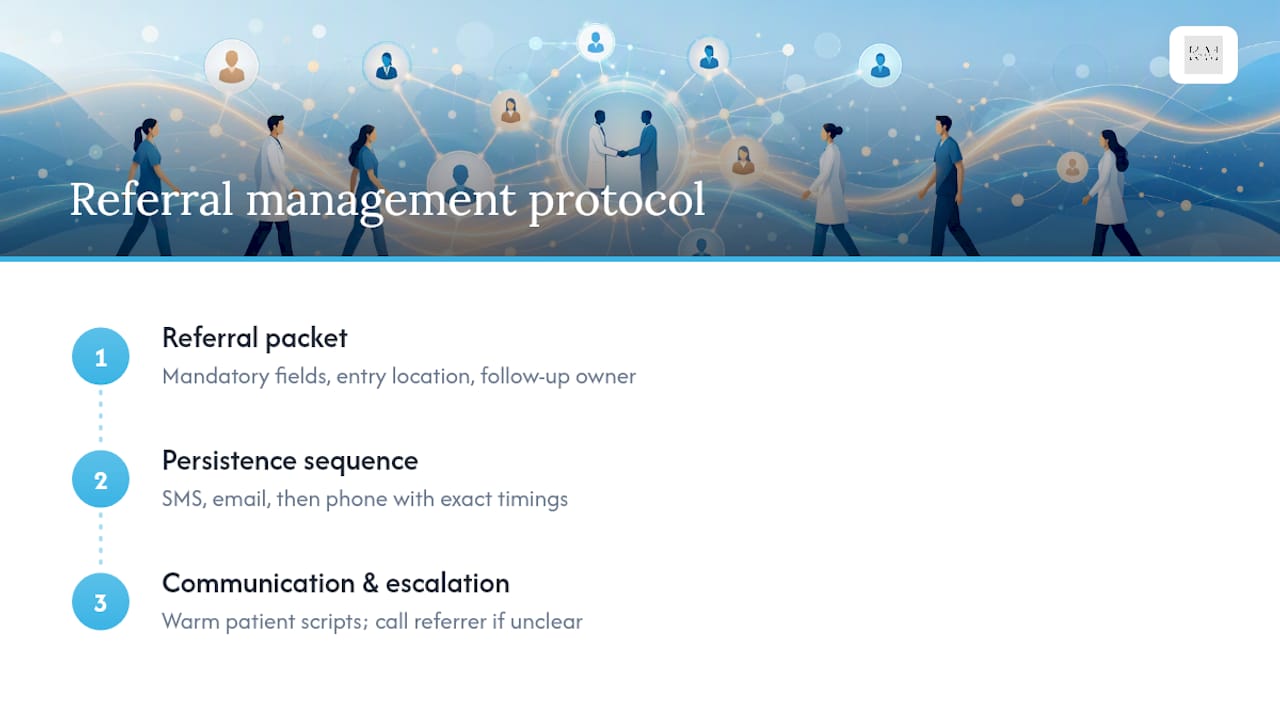
Run a quarterly refresher, not a one-time onboarding session. Referral volume and referrer expectations shift, and staff turnover means your best practices need to live somewhere other than one person’s memory. A shared one-page protocol, reviewed in team meetings, works better than a lengthy manual nobody reopens. Give new hires a shadowing period on live referral calls before they handle them solo. The referring physician on the other end of that first phone call is forming an opinion about your entire practice, not just your intake staff.
How Patient Experience Determines Whether Referrals Repeat
A referring physician doesn’t just judge you on clinical outcomes. They judge you on what their patient tells them afterward, and that feedback loop is faster and more honest than any survey you send.
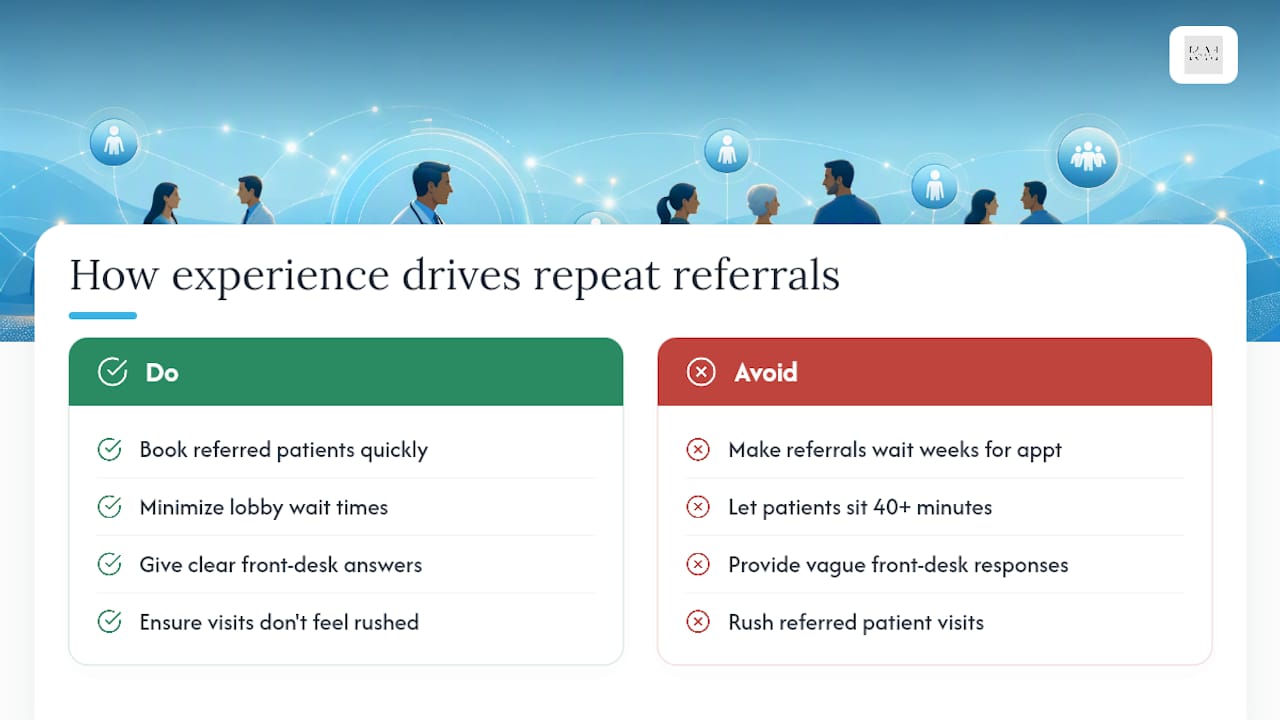
If a referred patient waits three weeks for an appointment, sits in your lobby for forty minutes, or can’t get a straight answer from your front desk, that experience travels back to the referring office, usually in casual conversation. Referring physicians hear this constantly, and it shapes where they send the next patient more than any brochure you handed them last quarter.
Optimize for the moments patients actually notice: how fast they got an appointment, how clearly staff explained next steps, and whether the visit felt rushed. A strong online reputation reinforces this loop, since referring physicians and their staff often check reviews before sending a patient to a new specialist, especially for elective or high-cost procedures. Track patient satisfaction specifically for referred patients, not just your general patient base, since their expectations often differ. A referred patient arrives with a built-in trust in the referring physician’s judgment, and a poor experience doesn’t just cost you that one patient. It costs you the next five the referring office might have sent.
Fitting Referral Marketing Into Your Broader Marketing Plan
Physician referral marketing shouldn’t operate in a silo separate from your website, your local SEO, or your patient follow-up systems. The same infrastructure that helps patients find you online should help referring offices evaluate you, too.
Your website needs referral-specific pages: provider bios detailed enough for a referring physician to judge fit, clear service descriptions and self-scheduling options, and a referral form that doesn’t require a phone call to find. If your digital reputation management strategy focuses only on patient-facing reviews, you’re missing half the audience, since referring clinicians read reviews too before sending a new patient your way.
Marketing automation built for patient follow-up and appointment reminders can usually be extended to referral intake without building a second system from scratch. The channels overlap. The KPIs overlap. Treating physician referral marketing as its own disconnected initiative means duplicating work your marketing team may already be doing for patient acquisition.
Our Take: How Klyrmedia Helps Practices Operationalize Referral Growth
Most practices we talk to already have referral relationships. What they lack is the operational backbone to convert them reliably. Our engagements typically start with a short audit of referral sources and intake speed, move into a prioritized pilot on the biggest leak we find, then measure and scale from there. We build referral landing pages, marketing automation for intake and follow-up, and reputation systems that keep referring offices confident. If you want a clear read on where your own program is leaking, ask us for an audit.
— Opinly
How Klyrmedia Can Help You Fix the Leaks in Your Referral Program
We are the alternative to piecing together referral fixes yourself with a general marketing vendor. We build infrastructure and automation that turn slow, manual referral intake into a same-day, closed-loop system, without you having to become a workflow engineer on top of running your practice.
A starter engagement usually begins with a short audit of your current referral sources and time-to-contact, followed by a prioritized roadmap and a pilot focused on your biggest single leak, whether that’s a slow intake process, a missing consult-summary habit, or a website that doesn’t give referring physicians what they need to decide fast. From there we build out HIPAA-compliant website design for your referral pages and provider profiles, backed by marketing automation that handles same-day outreach and follow-up without adding to your staff’s workload. If you’re ready to see where your own referral program is leaking revenue, reach out to Klyrmedia for a starter audit and roadmap.
Sources
- PMC article (EMR-integrated referral systems)
- Referral Management Best Practices: KPIs & Benchmarks (Linear Health)
- AMA guide to physician referral strategies

