

Multi-Location SEO for Healthcare: 2026 Guide

Multi-location SEO is the practice of optimizing each individual business location’s online presence to rank well in local search results for its specific area. For healthcare organizations running multiple clinics, pharmacies, or practices, this is not a nice-to-have. It is the difference between a patient finding your nearest location or walking into a competitor’s office instead. 46% of all Google searches are local. That number tells you exactly where your patients are looking before they book an appointment.
What is multi-location SEO and how does it differ from standard local SEO?
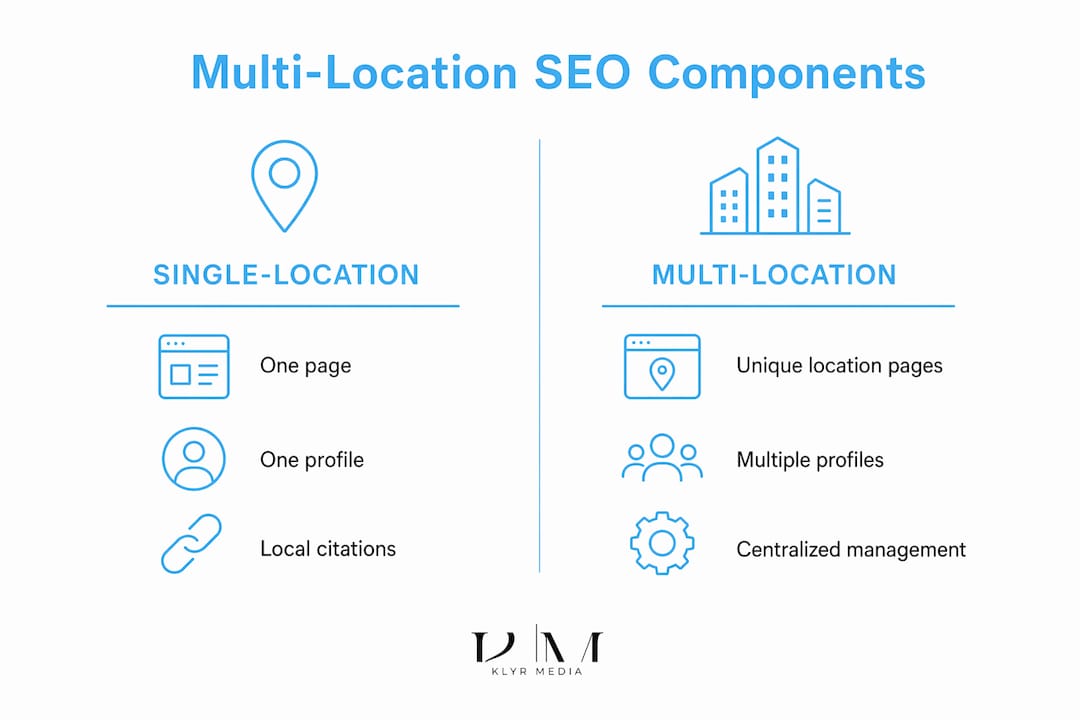
Standard local SEO focuses on one location. You claim one Google Business Profile, build one location page, and manage one set of citations. Multi-location SEO multiplies every one of those tasks across every branch you operate. The complexity is not just additive. It is exponential.

Google ranks local results using three core factors: relevance, distance, and prominence. Those factors have evolved toward entity clustering, meaning Google now evaluates your entire brand footprint as a connected web of entities rather than isolated listings. A strong corporate domain helps your individual locations. A weak or inconsistent one drags them all down.
The specific challenges that separate multi-location SEO from single-location work include:
- Keyword cannibalization. When two of your locations target the same search terms, they compete against each other in Google’s index. Your corporate pages should target broad keywords, while location pages use geo-specific terms like “urgent care clinic in Midtown Atlanta.”
- Duplicate content. Copy-pasting the same page template across 10 locations and swapping only the city name triggers thin content penalties.
- Doorway pages. Google penalizes pages created purely to rank for a location with no genuine local value for the patient.
- Profile management at scale. Each location needs its own Google Business Profile, and each one requires active management.
Pro Tip: Assign a clear content owner for each location page from day one. Ambiguity between corporate marketing and local clinic staff is the fastest way to end up with outdated hours, wrong addresses, and zero accountability.
What are the key components of a successful multi-location SEO strategy?
A working multi-location strategy rests on five pillars. Miss one and the others underperform.
-
Unique location landing pages. Each page needs real local content, not a template with a city name swapped in. The proven approach is 50% brand content and 50% local unique content. That means local staff bios, neighborhood references, specific services offered at that site, and patient-facing hours that are actually accurate.
-
Google Business Profile optimization. Google commands roughly 90% of global search traffic. Google Business Profiles have evolved from static directory listings into entity anchors that verify and unify your brand’s presence across the web. Every location needs a fully completed, actively managed profile. Learn the specifics in Klyrmedia’s guide on optimizing Google Business Profiles for healthcare clinics.
-
NAP consistency. Name, Address, and Phone number must match exactly across every citation, directory, and platform. Even minor variations, like “St.” versus “Street,” create data conflicts that confuse Google and suppress rankings.
-
Local backlink building. Each location benefits from links from local sources: community health organizations, local news outlets, neighborhood business associations, and regional healthcare directories. These links signal genuine local relevance.
-
Per-location tracking. Use UTM parameters and location IDs to measure performance per location. Aggregate reporting hides which locations are thriving and which are invisible.
| Component | Single-location SEO | Multi-location SEO |
|---|---|---|
| Location pages | One page | One unique page per location |
| Google Business Profile | One profile | One profile per location, centrally managed |
| NAP citations | One set | Consistent set across all locations |
| Keyword strategy | Broad local terms | Geo-specific terms per location |
| Reporting | Overall traffic | Per-location attribution |
Pro Tip: Build a modular page template with locked brand sections and editable local sections. This gives corporate control over compliance and messaging while letting local teams add genuine neighborhood content.
How do healthcare organizations optimize multi-location SEO for patient acquisition?
Healthcare SEO carries requirements that most industries never face. HIPAA compliance, accessibility standards, and clinical accuracy are non-negotiable. They also create a real opportunity. Patients searching for a clinic or pharmacy are not just looking for proximity. They are looking for trustworthy providers. Your SEO strategy needs to signal trust at every touchpoint.
Here is what that looks like in practice:
- Service-specific location pages. A clinic with three locations should not have three identical “services” pages. Each page should reflect the actual services available at that site. A location offering pediatric care should rank for pediatric search terms in its zip code, not just the clinic’s general name.
- Patient reviews by location. Google surfaces reviews as a prominence signal. Actively request reviews for each specific location profile, not just the brand overall. A patient who visited your Buckhead clinic should leave a review on the Buckhead profile.
- Localized content. Blog posts, FAQs, and health resources tied to the local community build topical authority for each location. A pharmacy in a neighborhood with a high diabetic population should publish content on diabetes management and local resources.
- HIPAA-compliant digital practices. Contact forms, appointment booking tools, and patient portals must meet HIPAA compliance standards at every location’s digital touchpoint. One non-compliant form across 10 locations is still a liability.
- Healthcare directory listings. Platforms like Healthgrades, Zocdoc, and WebMD are authoritative sources in healthcare search. Claiming and maintaining accurate profiles on these platforms builds both citation consistency and domain authority.
Pro Tip: Treat your healthcare SEO strategy as patient experience design. Every piece of missing or wrong information online is a patient who gave up and called someone else.
What are common pitfalls in multi-location SEO?
Most multi-location SEO failures are not technical mysteries. They are operational breakdowns that compound over time.
- Duplicate content across locations. Copying the same page text for every location is the single most common mistake. Google either ignores the duplicates or penalizes the whole site. Neither outcome helps patients find you.
- Inconsistent NAP data. Even one profile suspension or data error can cascade into ranking drops across all your locations. This is especially damaging for healthcare brands where patients rely on accurate contact information.
- Proximity myths. Ranking power diminishes with physical distance. You cannot compensate for a missing physical location by expanding your service area radius in Google Business Profile. If a patient is searching three miles from a competitor and five miles from your nearest clinic, the competitor wins that result.
- No centralized management. Without a central system for monitoring all profiles, one location’s outdated holiday hours or wrong phone number can sit unnoticed for months.
“Multi-location SEO is best understood as customer service. Every location deserves equal discovery and equal access for its local market.” — Search Engine Land
The fix for most of these pitfalls is governance, not technology. Assign ownership. Set review schedules. Build a process for updating information across all locations simultaneously when anything changes.
Key takeaways
Multi-location SEO requires consistent data, unique location content, and centralized management across every location to drive patient acquisition at scale.
| Point | Details |
|---|---|
| Define ownership early | Assign a content owner per location to prevent outdated or conflicting information. |
| Build unique location pages | Use 50% brand content and 50% local content to avoid duplicate content penalties. |
| Manage every Google Business Profile | Treat each profile as an entity anchor and keep NAP data consistent across all platforms. |
| Track performance per location | Use UTM parameters and location IDs to identify which locations need attention. |
| Prioritize HIPAA compliance | Every digital touchpoint across all locations must meet healthcare compliance standards. |
The part most healthcare marketers skip
I have worked with healthcare organizations that had solid websites, decent content, and zero traction in local search. The problem was almost never the content itself. It was the gap between what the website said and what Google could verify.
Multi-location SEO is not a content project. It is a data integrity project that happens to involve content. The organizations that win local search are the ones that treat their Google Business Profiles, citations, and location pages as a single connected system, not three separate tasks owned by three different people.
The healthcare sector has one advantage here that most industries do not. Patients are not browsing casually. They are searching with intent. They need a pharmacy, a clinic, a specialist. If your location data is accurate, your reviews are current, and your page reflects real services at that address, you are already ahead of most competitors. The bar is lower than it looks. Most healthcare organizations just never clear it consistently.
The 2026 shift toward AI-driven entity clustering in Google’s algorithm makes this even more urgent. Google now uses AI to draw from entity data when ranking multi-location brands. That means every inconsistency in your data is a signal Google uses to rank you lower. Fix the data first. The content strategy follows naturally.
— Opinly
How Klyrmedia supports healthcare multi-location SEO
Healthcare providers managing multiple locations need more than a generic marketing agency. They need a partner who understands HIPAA, local search, and the specific pressure of competing with large hospital systems and pharmacy chains.
Klyrmedia builds HIPAA-compliant websites designed specifically for healthcare providers who need every location to rank, convert, and stay compliant. From location landing pages to Google Business Profile management, Klyrmedia’s systems are built for the multi-location reality of modern healthcare. For practices and facilities looking to manage their full digital presence across sites, Klyrmedia’s medical facilities solutions provide the structure and oversight that scattered in-house efforts rarely achieve.
FAQ
What is multi-location SEO in simple terms?
Multi-location SEO is the process of optimizing each business location’s online presence separately so it ranks well in local search results for its specific area. It involves unique location pages, individual Google Business Profiles, and consistent contact data across all platforms.
How is multi-location SEO different from local SEO?
Local SEO typically focuses on one location with one set of profiles and citations. Multi-location SEO scales those same practices across every location while managing risks like duplicate content, keyword cannibalization, and inconsistent data.
Why do healthcare businesses need multi-location SEO?
46% of Google searches are local, meaning patients actively search for nearby providers before booking. Without location-specific optimization, individual clinic or pharmacy locations remain invisible to the patients closest to them.
What is the biggest mistake in multi-location SEO?
The most damaging mistake is using the same page content across multiple locations. Duplicate location pages either get ignored by Google or trigger penalties, and inconsistent NAP data can suppress rankings across every location in the brand.
How do you track multi-location SEO performance?
Use UTM parameters and unique location IDs in your analytics setup to attribute traffic and conversions to each specific location. Aggregate reporting masks underperforming locations and makes it impossible to allocate resources where they are needed most.

