
Branded Search for Clinics: What It Is and Why It Matters
Discover what is branded search for clinics and why it’s vital for attracting patients ready to act. Learn to maximize your marketing impact!

Branded Search for Clinics: What It Is and Why It Matters

Branded search for clinics is defined as any search query containing a clinic’s name, a doctor’s name, or a specific branded service term tied to that practice. These are not exploratory searches. Patients typing your clinic’s name already know you exist and are ready to act. That intent gap between branded and generic search is where most clinic marketing budgets leak money and miss patients. Understanding what branded search is, and how to protect and grow it, is one of the highest-return moves a healthcare marketer can make in 2026.
What is branded search for clinics, exactly?
A branded query is any search that includes a clinic’s brand name, a close variation, or even a common misspelling, indicating the searcher already knows the practice. Google Search Console’s branded queries filter, fully implemented by march 2026, uses AI classification to separate these queries from generic ones. That distinction matters because branded and generic searches serve completely different patient needs.
Generic searches look like this:
- “urgent care near me”
- “flu shot clinic open Saturday”
- “pediatrician accepting new patients”
Branded searches look like this:
- “Riverside Family Clinic flu shots”
- “Dr. Sarah Chen dermatologist reviews”
- “Northside Pediatrics appointment booking”
- “Westview Medical patient portal login”
The difference is intent. Generic searches come from patients exploring their options. Branded keywords in healthcare carry navigational or transactional intent, meaning the patient has already been exposed to your brand through a referral, a social post, a billboard, or a previous visit. They are not comparing you to competitors. They are trying to reach you specifically.
Common branded keyword types include your clinic name paired with a treatment, a location, a review request, or a login modifier. Each type signals a different stage of the patient relationship. A “reviews” modifier means a patient is validating their choice. A “login” modifier means they are already yours. Knowing which branded queries drive the most traffic tells you exactly where your reputation is working and where it is not.

Why branded search matters for clinic growth
Branded search visibility in healthcare directly reflects the trust a clinic has built through patient experiences and community engagement. That is not a soft metric. It is a measurable signal of how well your offline reputation translates into online demand.
Patients searching a clinic or doctor’s name have shorter decision paths and convert to calls, visits, and appointment bookings at higher rates than generic searchers. Branded search is not just visibility. It is captured demand waiting to be fulfilled.
The practical impact shows up fast. When a patient types your clinic’s name, they expect to find your website, your phone number, your hours, and your reviews at the top of the page. If a competitor’s ad, an aggregator listing, or an outdated directory entry appears instead, you lose that patient even though they were already looking for you. That is a real problem, and it happens more than most clinic administrators realize.
Branded search visibility builds over time as patients repeatedly encounter your clinic’s name across digital assets. Each touchpoint, whether a Google review, a social media mention, or a local news feature, adds to the branded search signal. The compounding effect means clinics that invest consistently in their digital presence see branded search volume grow year over year, even without paid advertising. That growth represents real patient loyalty made visible.
Branded search also gives you control over your reputation on the search results page. When your Google Business Profile is accurate, your website ranks first, and your reviews are current, you own the narrative. When those elements are missing or inconsistent, someone else fills that space, and it is rarely flattering.
How to optimize branded search for your clinic
Getting your branded search presence right requires consistent work across several channels. Here is a practical sequence that works for most clinics:
- Audit your branded queries in Google Search Console. Use the branded filter to see exactly which name-based queries drive traffic. Look for misspellings, doctor name variations, and service-plus-name combinations you may not be tracking.
- Lock down your Google Business Profile. Verify every field: name, address, phone number, hours, services, and photos. AI-generated search descriptions pull from your Business Profile, website data, reviews, and third-party citations. Inconsistency leads AI to generate inaccurate clinic descriptions that confuse patients.
- Build dedicated doctor and service pages. Each physician on your team should have a page with credentials, specialties, patient reviews, and a booking link. Patients searching “Dr. [Name] at [Clinic]” need a direct landing page, not your generic homepage.
- Apply schema markup to your website. Structured data for medical organizations, physicians, and local businesses helps search engines and AI tools pull accurate information about your clinic. This is the technical backbone of strong branded search results.
- Maintain citation consistency across directories. Your name, address, and phone number must match exactly on Healthgrades, Zocdoc, Yelp, and every other directory. Fragmented data confuses AI-powered search descriptions and weakens your local rankings. Klyrmedia’s healthcare SEO services include citation audits as a standard part of clinic onboarding.
- Run branded paid search ads. Ranking first organically for your clinic’s name does not eliminate the need for branded ads. Paid ads appear above organic listings and let you control the message, the call to action, and the landing page. In competitive markets, a competitor may be bidding on your clinic’s name right now.
- Collect and respond to reviews consistently. Reviews are both a trust signal and a branded search asset. Patients searching your name will see your star rating before they see your website. A steady stream of recent, positive reviews reinforces the trust that drove the branded search in the first place.
Pro Tip: Set up a Google Alert for your clinic’s name and each physician’s name. You will catch new mentions, reviews, and directory listings the moment they appear, giving you a chance to respond before they affect your reputation.
Branded search vs. generic search: how to balance both
Branded and generic search serve different functions in patient acquisition, and confusing them leads to wasted budget.
| Factor | Branded search | Generic search |
|---|---|---|
| Patient intent | High. Patient knows the clinic and wants to engage. | Exploratory. Patient is comparing options. |
| Conversion rate | Higher. Shorter decision path to booking. | Lower. Requires more nurturing and trust-building. |
| Primary goal | Capture existing demand and protect brand presence. | Generate new demand from unfamiliar patients. |
| Ad strategy | Defensive bidding to control messaging and block competitors. | Offensive bidding to reach new patient segments. |
| SEO focus | Accurate profiles, reviews, and branded landing pages. | Condition pages, location pages, and symptom content. |
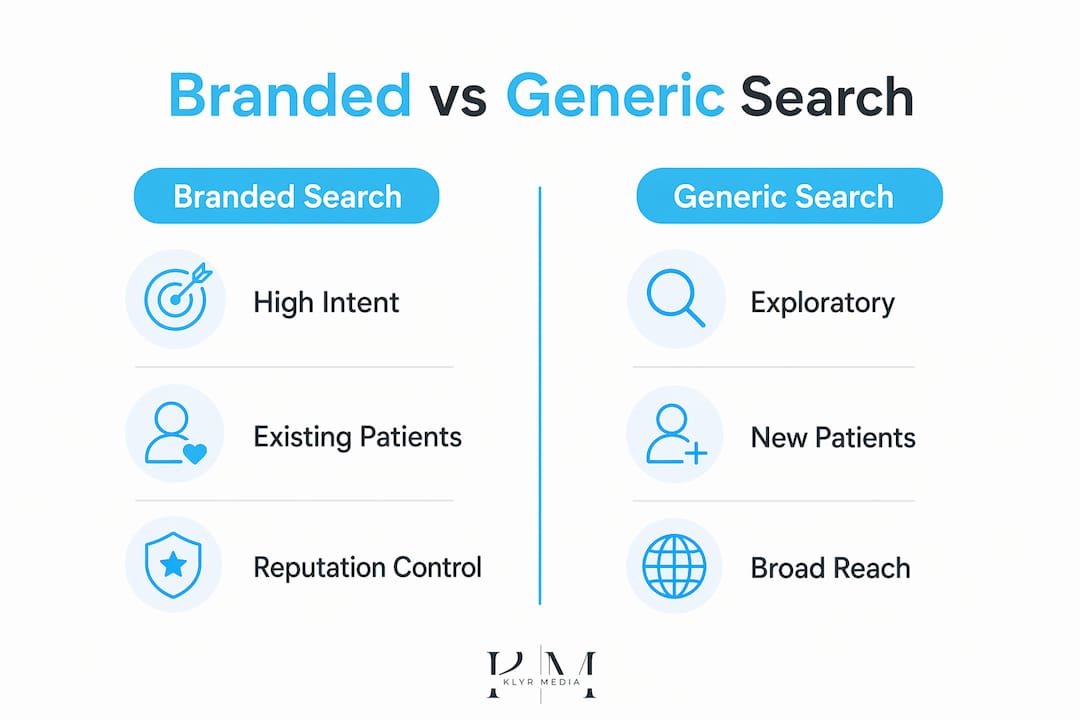
Branded keywords capture existing demand, while non-branded keywords target new demand from patients without a brand preference. Neither is optional. A clinic that ignores generic search never grows its patient base. A clinic that ignores branded search loses patients it already earned.
The right balance depends on your growth stage. A newly opened clinic needs heavy generic search investment to build awareness. An established practice with strong word-of-mouth referrals needs to protect and convert its branded search volume. Most clinics need both, but the ratio shifts as the practice matures. Klyrmedia’s approach to local patient acquisition accounts for this balance explicitly, rather than treating all search traffic as interchangeable.
Bidding on branded keywords also serves as a defense against competitors targeting your clinic’s name. This is especially critical for newly rebranded clinics or practices in dense urban markets where aggregator sites and competing practices actively bid on branded terms.
Key Takeaways
Branded search is the highest-intent traffic a clinic can capture, and protecting it requires consistent data hygiene, paid ad coverage, and a strong review profile across every patient touchpoint.
| Point | Details |
|---|---|
| Define your branded queries | Use Google Search Console’s branded filter to identify all name-based searches driving traffic to your clinic. |
| Protect your brand with paid ads | Bidding on your own clinic name controls messaging and blocks competitors from stealing high-intent patients. |
| Data hygiene drives AI accuracy | Consistent Business Profile, schema markup, and citations prevent AI tools from generating inaccurate clinic descriptions. |
| Branded search reflects reputation | Visibility grows as patients encounter your name repeatedly across digital channels, building long-term trust. |
| Balance branded and generic efforts | Branded search captures existing demand; generic search builds new demand. Both are required for sustained growth. |
The part most clinic marketers get wrong
Here is what I have seen repeatedly working with healthcare practices: clinic administrators assume that ranking first organically for their own name means the job is done. It is not. Organic ranking is one layer of a multi-layer problem.
The search results page for your clinic’s name can include paid ads from competitors, aggregator listings with outdated information, review sites with unresponded complaints, and AI-generated summaries pulling from inconsistent data. Owning the first organic result while ignoring everything else on that page is like locking your front door and leaving every window open.
The other misconception I see constantly is treating branded search as a vanity metric. “We already know our patients find us.” That confidence is misplaced. Branded search visibility is a measurable indicator of how well your clinic’s reputation translates into digital demand. When that number drops, something changed, whether it is a reputation issue, a competitor’s ad campaign, or a data inconsistency that AI tools are now amplifying.
The clinics that win long-term treat branded search as a living system, not a one-time setup. They monitor their branded query volume monthly, audit their Business Profile quarterly, and run branded ads as a permanent defensive layer. That discipline is what separates practices that grow steadily from those that wonder why referrals are not converting.
— Opinly
Klyrmedia’s approach to clinic branded search
Building a strong branded search presence starts with a website that search engines and AI tools can actually read and trust.
Klyrmedia builds HIPAA-compliant websites for medical clinics that are structured for branded search from the ground up. That means proper schema markup, accurate citation management, Google Business Profile optimization, and paid branded search strategy, all built around your clinic’s specific patient acquisition goals. If your clinic’s name is not the first and most accurate result when patients search for you, that is revenue walking out before it ever walked in. Klyrmedia’s healthcare digital solutions are built to close that gap for independent practices competing in crowded local markets.
FAQ
What is branded search in healthcare?
Branded search in healthcare refers to any query containing a clinic’s name, a physician’s name, or a branded service term. These searches signal high patient intent and familiarity with the practice.
Why do clinics need branded search ads if they rank organically?
Organic rankings do not guarantee full control of the search results page. Paid branded ads appear above organic listings and prevent competitors or aggregators from capturing patients already searching for your clinic.
How does Google Search Console help with branded search?
Google Search Console’s branded queries filter, implemented fully by march 2026, uses AI to separate branded from generic queries. This lets clinic marketers measure name-based traffic and identify optimization gaps.
What causes inaccurate AI descriptions of my clinic?
Inconsistent data across your Google Business Profile, website, and third-party citations causes AI tools to generate inaccurate clinic descriptions. Consistent schema markup and citation hygiene correct this problem.
How is branded search different from generic search for clinics?
Branded search captures patients who already know your clinic and are ready to book. Generic search reaches patients still exploring their options, requiring more content and trust-building before conversion.

