

What Is Local Listing Management for Healthcare?

Local listing management is the ongoing process of maintaining accurate business data, including your Name, Address, and Phone Number (NAP), across every major online platform where patients search for care. In the healthcare industry, this practice goes by a more formal name: local presence management or local citation management. Both terms describe the same discipline. The platforms that matter most include Google Business Profile, Apple Maps, Bing Places, Healthgrades, and Zocdoc. 46% of Google searches carry local intent, meaning nearly half of all searches are people looking for something nearby. For a medical clinic or independent pharmacy, that is not a statistic to file away. It is the size of the opportunity sitting in front of you right now.
What does local listing management involve for healthcare providers?
Local listing management is not a one-time setup. It is a repeating cycle of auditing, correcting, expanding, and monitoring your business profiles across dozens of platforms. Healthcare providers face a specific version of this challenge because patient trust is built on accuracy. A wrong phone number or outdated office hours does not just cost you a click. It costs you a patient who called a dead number and booked with someone else.
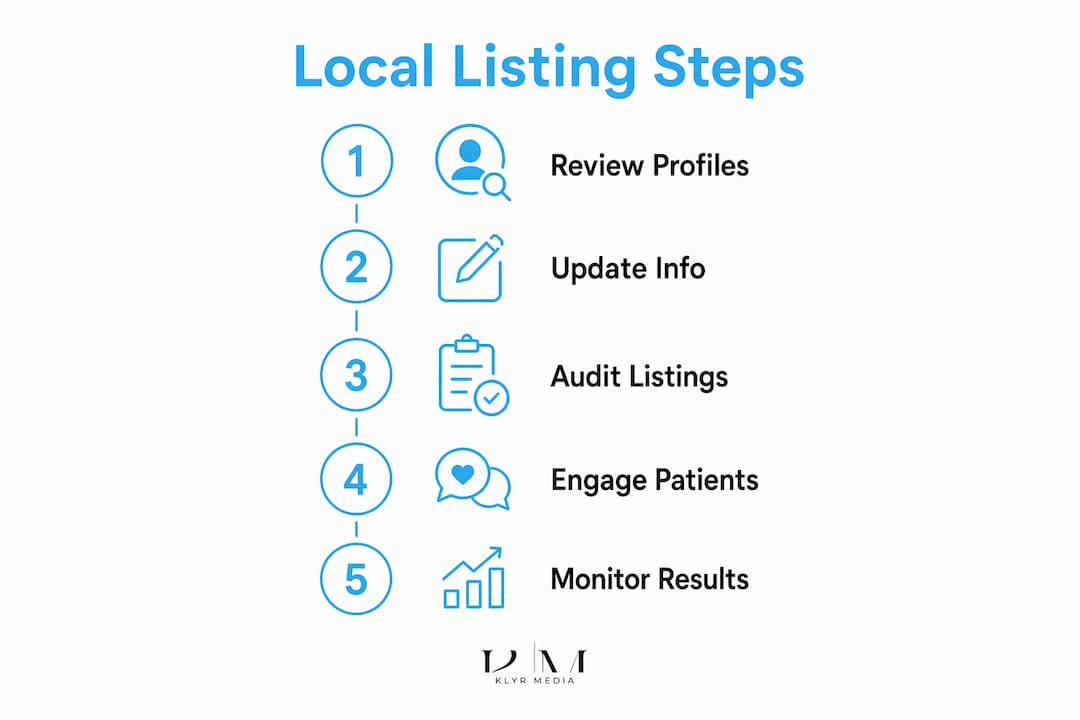
Here is what the process looks like in practice:
- Audit your existing listings. Search your practice name across Google Business Profile, Bing Places, Apple Maps, Yelp, Healthgrades, and major data aggregators like Data Axle and Neustar Localeze. Identify duplicates, outdated addresses, and missing profiles.
- Correct your NAP data. Update your name, address, phone number, website URL, and business hours everywhere they appear. Every platform must match exactly, including punctuation and abbreviations.
- Expand to relevant directories. Healthcare-specific directories like Zocdoc, WebMD, and Vitals carry real weight with patients and search engines. Claim and complete those profiles.
- Add photos, services, and categories. Healthcare listings require monthly updates of photos, service descriptions, and categories to maintain visibility in competitive local markets.
- Monitor for unauthorized changes. Google allows anyone to suggest edits to your listing. Those edits can go live without your approval. Set up alerts and check your profiles at least once a month.
Pro Tip: Set a recurring calendar reminder on the first Monday of every month to review your Google Business Profile. Check your hours, photos, and any pending suggested edits before they cause damage.
A monthly review cadence is not optional in healthcare. It is the minimum standard for staying visible and trustworthy.

How does local listing management improve local SEO and patient engagement?
Accurate listings are the foundation of local SEO for healthcare providers. Search engines use your listing data to decide whether your practice deserves to appear in the Map Pack, the three-business block that dominates local search results. Ranking there is not a vanity metric. Businesses in the Map Pack capture the majority of clicks for local searches. Missing from it means missing patients who are actively looking for what you offer.
The connection between listing accuracy and patient engagement is direct:
- Phone calls. Patients who find your Google Business Profile call directly from the listing. A wrong number means a lost call.
- Appointment bookings. Profiles with complete information, including booking links and service descriptions, convert at higher rates than incomplete ones.
- Directions and visits. An incorrect address sends patients to the wrong location. That is not just a lost visit. It is a patient who will not return.
- AI-powered recommendations. AI systems like Google’s AI Overview and ChatGPT extract and verify business information from local listings as trust signals. If your data is inconsistent, AI tools are less likely to recommend your practice in voice search or AI-generated answers.
That last point is worth pausing on. In 2026, patients increasingly ask AI assistants to find a nearby pharmacy or recommend a clinic. Those AI systems pull from your listing data to decide whether you are credible. Consistent, accurate listings improve your AI-powered local search citations directly.
Measurable ranking improvements appear within 30–60 days of consistent listing management. That is a faster return than most SEO tactics deliver. For an independent pharmacy or clinic competing against large chains, that timeline matters.
Pro Tip: Link your Google Business Profile to a dedicated appointment booking page on your website. Patients who can book directly from search results convert at significantly higher rates than those who have to navigate your site first.
What are common healthcare-specific challenges in listing management?
Healthcare providers run into pitfalls that general businesses do not face. The stakes are higher because patient trust is on the line, and platform penalties in healthcare can be severe.
Here are the most common traps and how to avoid them:
- Keyword stuffing in your business name. Adding terms like “best pharmacy” or “urgent care near me” to your Google Business Profile name is a direct violation of Google’s guidelines. Use your official trade name only. Violations can result in profile suspension, which wipes out your local visibility overnight.
- Inflated service areas. Setting a service area that covers three counties when you realistically serve one is a red flag for Google. A precise, realistic service area is a trust signal. Inflated radii trigger penalization and reduce your ranking effectiveness.
- Losing listing ownership. Many healthcare providers hand over profile access to a marketing vendor and never get it back. Some listing management software locks ownership behind subscription fees. If you stop paying, your listings can disappear or revert to unmanaged status. Always retain direct administrative access to every platform.
- Inconsistent data spreading across directories. Outdated business data spreads negative signals to Google and undermines your legitimacy. In healthcare, where trust is the currency of patient acquisition, bad data acts like an infection. It impairs every other marketing effort you run.
- Ignoring patient reviews. Reviews are part of your listing. Not responding to them, positive or negative, signals to both patients and search engines that you are not engaged. Respond to every review within 48 hours.
Pro Tip: Before signing any contract with a listing management vendor, ask one question: “Will I retain direct admin access to my Google Business Profile and all other platforms?” If the answer is no or vague, walk away.
What tools and services help healthcare managers manage local listings?
You have two real options: manage listings yourself or hire a service. Both work. The right choice depends on how many locations you manage and how much time your team has.
Self-managing vs. hiring a service
| Factor | Self-Managing | Professional Service |
|---|---|---|
| Cost | Low (time investment) | Monthly fee, varies by scope |
| Control | Full, direct ownership | Depends on vendor contract |
| Time required | 2–4 hours per month | Minimal after onboarding |
| Expertise needed | Moderate SEO knowledge | Handled by specialists |
| Best for | Single-location practices | Multi-location or time-strapped teams |
If you manage a single clinic or pharmacy and have someone on staff who understands local SEO, self-managing is viable. For multi-location healthcare groups, a professional service pays for itself quickly.
What to look for in listing management software or services
- Permanent ownership guarantee. You must retain direct admin access to Google Business Profile, Apple Maps, and Bing Places regardless of your subscription status.
- Multi-platform updates. The service should push updates to major data aggregators, not just Google. Platforms like Data Axle and Neustar Localeze feed dozens of downstream directories.
- Periodic audits. Monthly or quarterly audits catch unauthorized edits and data drift before they damage your rankings.
- Healthcare-specific knowledge. A vendor who does not understand HIPAA considerations or healthcare directory nuances will create compliance risks, not solve them.
Integrating listing management with your broader healthcare SEO strategy multiplies the impact. Listings drive local visibility. Your website converts that visibility into appointments. The two systems need to work together, not in isolation.
For healthcare providers exploring how local patient acquisition connects to listing management, the short answer is this: your listing is often the first touchpoint a patient has with your practice. It needs to be accurate, complete, and actively managed.
Key takeaways
Local listing management is the single most cost-effective local SEO investment a healthcare provider can make, delivering measurable ranking gains within 30–60 days when done consistently.
| Point | Details |
|---|---|
| Core definition | Local listing management means keeping your NAP and profile data accurate across all major platforms and directories. |
| Monthly cadence required | Healthcare listings need monthly audits to catch unauthorized edits, outdated hours, and data drift. |
| AI trust signal | Consistent listing data directly improves your visibility in AI-powered recommendations from Google and ChatGPT. |
| Ownership is non-negotiable | Always retain direct admin access to your listings. Never let a vendor lock you out. |
| Healthcare compliance matters | Avoid keyword stuffing in business names and inflated service areas to prevent profile suspension and ranking penalties. |
Why listing management is the infrastructure, not the marketing
Here is something most marketing conversations skip: local listing management is not a campaign. It is infrastructure. You do not run it once and move on. You maintain it the way you maintain your EMR system or your HVAC. When it breaks, everything downstream breaks with it.
I have worked with healthcare providers who spent thousands on paid ads and wondered why their cost per new patient kept climbing. In almost every case, the listings were a mess. Wrong phone numbers, duplicate profiles, inconsistent addresses across directories. The ads were driving traffic to a digital front door that was either locked or labeled with the wrong address.
The AI dimension makes this more urgent than it was two years ago. When a patient asks ChatGPT or Google’s AI Overview to recommend a pharmacy near them, those systems are not just running a search. They are verifying. They cross-reference your listing data against multiple sources to decide if you are credible enough to recommend. Inconsistent data lowers your chance of being surfaced in those AI-generated answers. That is a new patient acquisition channel that most independent practices are not even aware they are losing.
My honest recommendation: treat your Google Business Profile like a patient-facing asset, not a set-it-and-forget-it directory entry. Update your photos quarterly. Post service updates. Respond to reviews. Keep your hours current, especially around holidays. These are not big lifts. But they compound over time into a listing that search engines and AI systems trust, and that patients actually use.
The practices I see winning local search in 2026 are not the ones with the biggest ad budgets. They are the ones whose listings are clean, consistent, and actively managed. That is a winnable game for independent providers who are willing to treat it seriously.
— Opinly
How Klyrmedia helps healthcare providers get local listings right
If managing listings, auditing directories, and keeping up with Google’s ever-changing guidelines sounds like one more thing on an already full plate, you are not alone. Most independent pharmacies and clinics do not have a dedicated marketing team for this.
Klyrmedia specializes in exactly this problem. The team builds HIPAA-compliant healthcare websites and pairs them with local SEO strategies designed to put your practice in front of patients who are actively searching for care in your area. That includes local listing optimization, Google Business Profile management, and the kind of consistent data hygiene that search engines and AI systems reward. If you want to stop losing patients to competitors with cleaner digital footprints, Klyrmedia is worth a conversation.
FAQ
What is local listing management in simple terms?
Local listing management is the ongoing process of keeping your healthcare practice’s name, address, phone number, and profile details accurate across platforms like Google Business Profile, Apple Maps, and health directories. It requires regular audits and updates to maintain search visibility.
How often should healthcare providers update their local listings?
Healthcare listings need monthly reviews at minimum. Monthly audits catch unauthorized edits, outdated hours, and data inconsistencies before they damage your local search rankings.
Why does listing accuracy matter for AI search recommendations?
AI systems like ChatGPT and Google’s AI Overview use your listing data as a trust signal. Inconsistent or inaccurate information reduces the likelihood that AI tools will recommend your practice in voice search or AI-generated local results.
Can i lose control of my google business profile?
Yes. Some third-party listing management platforms retain administrative ownership of your profiles. If you cancel the service, you may lose access. Always maintain direct admin ownership of every platform independently of any vendor relationship.
What is the difference between local listing management and local SEO?
Local SEO is the broader strategy of improving your practice’s visibility in local search results. Local listing management, also called local citation management, is one specific component of that strategy. It focuses on the accuracy and consistency of your business data across directories and platforms.

