

What is healthcare paid advertising? A guide

If you’ve ever paused a Google Ads campaign and watched your appointment requests fall off a cliff the next week, you already understand the core tension in healthcare paid advertising. What is healthcare paid advertising, exactly? It’s any form of paid media you buy to place your practice in front of patients or clinicians — search ads, social media ads, display banners, video pre-rolls. It sounds simple. But healthcare isn’t a simple market, and most providers lose real money figuring that out the hard way. This guide cuts through the confusion so you don’t have to.
Table of Contents
- Understanding healthcare paid advertising: scope and essentials
- Healthcare professional marketing: targeting clinicians vs. patients
- Cost and performance benchmarks for healthcare paid advertising
- Aligning paid advertising with healthcare patient journeys and strategic goals
- Beyond paid ads: brand authority, patient trust, and long-term growth
- Rethinking healthcare paid advertising: balancing brand and performance marketing
- How KLYR Media helps healthcare providers grow with compliant paid advertising
- Frequently asked questions
Key Takeaways
| Point | Details |
|---|---|
| Healthcare paid advertising scope | It includes digital channels targeting both patients and clinical decision-makers under strict compliance. |
| Costs vary widely | Patient acquisition costs range from $40 to over $2,500 depending on specialty and targeting precision. |
| Patient journeys are complex | Successful paid ads align with strategic goals and multiple touchpoints over the patient decision cycle. |
| Paid ads offer short-term impact | Stopping ad spend causes fast drops in patient inquiries, unlike brand authority which sustains flow. |
| Balance brand and paid strategies | Combining brand-building with paid ads drives both immediate and lasting patient growth effectively. |
Understanding healthcare paid advertising: scope and essentials
Paid advertising in healthcare covers every channel where you pay to appear in front of an audience. That includes Google Search ads triggered by patient queries like “urgent care near me,” Facebook and Instagram ads targeting local demographics, YouTube pre-roll video for elective procedures, and programmatic display ads that follow users across the web.
Paid digital advertising is the largest marketing budget channel for U.S. healthcare companies at 12.5% of total spend. That number alone tells you how seriously the industry has shifted toward digital.
What makes healthcare different from, say, a retail brand running ads? Three things:
- Regulatory complexity. HIPAA restricts how you collect and use patient data for targeting. FDA rules govern what pharmaceutical and device companies can claim in ads. Even a small clinic running Google Ads has to be careful about retargeting pixels and data handling.
- Audience specificity. You might be targeting patients searching for symptoms, or you might be targeting physicians who prescribe medications. Each group requires completely different messaging, platforms, and creative.
- Emotional weight. A patient clicking on a healthcare ad is often scared, in pain, or confused. That changes how you write copy and what you promise.
Before you spend a dollar on targeted healthcare advertising, you need to understand what you’re buying, who you’re reaching, and what rules apply to your specific practice type. Skipping this step is where most providers burn their first budget.
Healthcare professional marketing: targeting clinicians vs. patients
Here’s a distinction that a lot of practice managers miss: there are actually two completely different paid advertising universes in healthcare. One targets patients. The other targets healthcare professionals (HCPs) — physicians, nurse practitioners, pharmacists, and others who make clinical decisions.
HCP marketing looks nothing like consumer patient advertising. The platforms are different, the compliance requirements are stricter, and the creative has to be grounded in clinical evidence rather than emotional appeals. Platforms like Doximity verify over 80% of U.S. doctors and enable targeted campaigns to clinical decision-makers, reducing wasted impressions. That kind of verified reach matters enormously when you’re promoting a new drug, a specialty referral service, or a medical device.
If your practice depends on physician referrals, you likely need both tracks running simultaneously. Here’s how to think about each:
- Patient advertising: Focus on awareness and conversion. Channels like Google Search, Facebook, and YouTube work well. Messaging centers on symptoms, outcomes, convenience, and trust.
- HCP advertising: Focus on credibility and clinical differentiation. Channels like Doximity, JAMA Network, and specialty medical publications dominate. Messaging requires clinical data and often needs legal/regulatory review before it runs.
- Compliance calibration by channel: Patient ads must comply with HIPAA data handling requirements. HCP promotions of prescription products fall under FDA oversight. Knowing which rules apply to which campaign prevents costly errors.
- Budget allocation by referral model: If referrals drive 60% of your new patients, underfunding HCP campaigns to boost consumer ads is a real strategic mistake.
Understanding compliance in healthcare marketing isn’t optional. It’s what determines whether your campaigns are sustainable or a liability waiting to happen.
Cost and performance benchmarks for healthcare paid advertising
Let’s talk numbers, because this is where expectations often collide with reality.
The average cost-per-click in healthcare paid search runs around $3.17. That sounds manageable until you factor in how many clicks it takes to generate a booked appointment. Patient acquisition costs range from about $40 up to $2,500 depending on specialty, with most practices paying $150 to $600 per new patient.

| Specialty | Avg. cost per lead | Avg. conversion rate |
|---|---|---|
| General practice | $162 | 8-11% |
| Dental | $190 | 6-9% |
| Orthopedics | $280 | 3-5% |
| Plastic surgery | $320 | 2-4% |
| Cardiology | $260 | 4-6% |
A few things worth knowing about these numbers:
- High-value specialties justify high CPL. A plastic surgery patient generating $8,000 in lifetime revenue can absorb a $300 acquisition cost with ease. A general practice patient on a capitation plan cannot.
- Optimized campaigns beat averages. Top-performing healthcare advertisers achieve cost per lead as low as $30 through tight geographic targeting, strong landing pages, and continuous testing.
- Conversion rate is everything. Getting a 2% conversion rate versus an 11% conversion rate on the same ad spend means five times more patients for the same budget. That gap is almost entirely a function of how well your Google Ads setup and landing page perform.
Pro Tip: Stop optimizing for cost per click. Optimize for cost per booked appointment. A click that never books is just overhead.
Aligning paid advertising with healthcare patient journeys and strategic goals
Here’s where paid media in healthcare gets genuinely interesting. Patient journeys are not linear. Someone searching “knee pain relief” today might not book an orthopedic consultation for another three weeks, after watching two YouTube videos, reading one review site, and asking their primary care doctor.
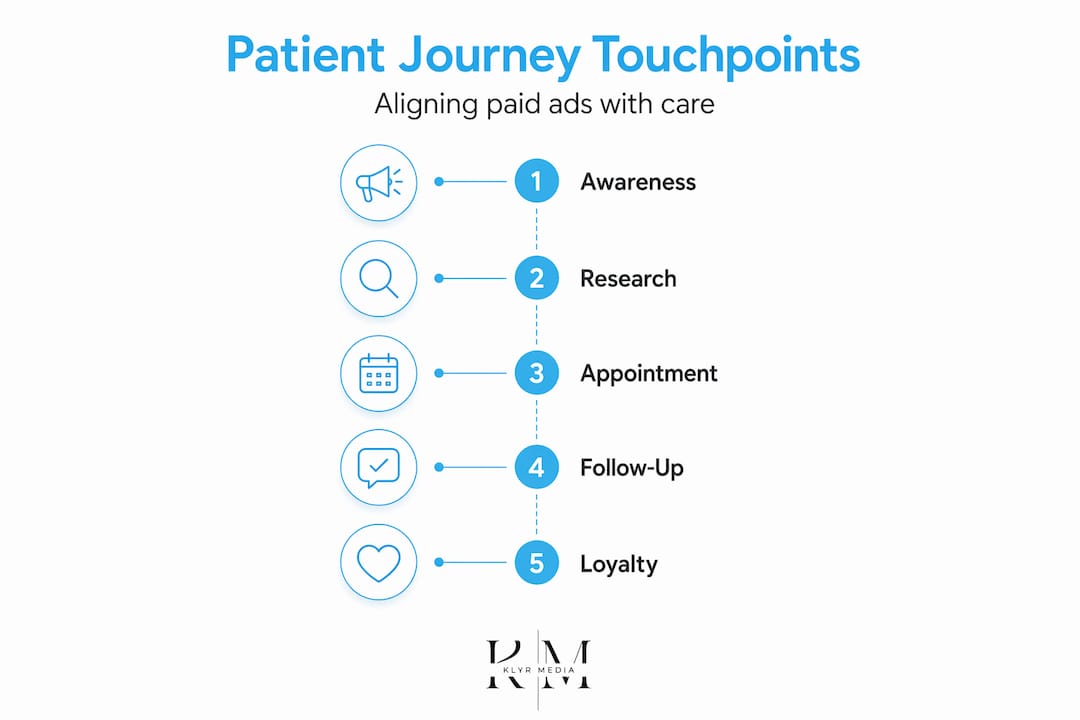
Patient journeys typically involve 6 to 12 touchpoints, and successful paid strategies align channel selection with strategic goals rather than just buying clicks wherever they’re cheapest.
There are two useful frameworks to think about:
| Strategic goal | Primary channels | Ad formats that work |
|---|---|---|
| Market penetration | Connected TV, programmatic display, social awareness | Video ads, branded content, geo-targeted display |
| Service-line dominance | Paid search, YouTube procedure videos, retargeting | High-intent keywords, procedure-specific landing pages |
If you’re opening a new clinic location, you need awareness first. Running only Google Search ads to people who’ve never heard of you means you’re competing purely on price and proximity against every other result on the page.
Key considerations for aligning paid strategy with patient journey:
- Map touchpoints before choosing channels. Know where patients first hear about you versus where they convert.
- Use multi-touch attribution. Not just last-click. A programmatic display ad that ran three weeks before someone searched your brand name contributed to that conversion.
- Match message to stage. Awareness ads should educate. Consideration ads should differentiate. Conversion ads should remove friction.
Understanding the full range of patient journey channels is what separates practices running smart campaigns from those just buying clicks and hoping for appointments.
Beyond paid ads: brand authority, patient trust, and long-term growth
Paid ads are a faucet. Turn them on, water flows. Turn them off, it stops. That’s a real vulnerability that most practices only discover after they’ve built their entire patient acquisition strategy around ad spend.
“Clinics relying solely on paid ads experience an immediate drop in patient inquiries when ad spend stops, while those building authority maintain consistent flow and higher patient trust.”
Brand authority is the opposite of a faucet. It builds slowly, usually over 12 to 18 months of consistent content, reviews, and third-party recognition. But once it’s there, it generates patient inquiries even when you’re not actively paying for them. Patients who find you through organic search or word of mouth also tend to show up more reliably and cancel less often. That’s not a coincidence. Trust reduces friction.
There’s also a cost math argument here. A practice that splits its marketing budget between paid ads and brand building efforts typically sees higher patient lifetime value and lower churn than one that pours everything into ads. The paid ads bring patients in. The brand keeps them.
Pro Tip: Start brand authority efforts the same month you launch paid ads, not after. The two compound each other. Patients who see your ads and then find you organically convert at significantly higher rates.
Rethinking healthcare paid advertising: balancing brand and performance marketing
Here’s an uncomfortable truth the industry doesn’t talk about enough. A lot of healthcare organizations defund brand investment to pour more into paid search when budgets get tight. The logic sounds reasonable: paid search produces measurable, immediate results. Brand building feels slower and fuzzier. So why not just double down on what you can measure?
Because you’re cutting the demand generation that makes your paid search work in the first place. Patients who’ve never heard of your practice and have no positive associations with your brand are the most expensive patients to acquire through paid search. When you hollow out brand investment, you raise your own cost per acquisition over time without realizing why.
The second mistake I see constantly: treating compliance as a ceiling. “We can’t say this, we can’t claim that, we can’t target these people.” That’s a passive posture. The best healthcare marketers treat compliance as a creative discipline. Constraints force creativity. You can build an emotionally resonant, compelling ad campaign that fully respects HIPAA and FDA rules. It just takes more thought than a standard “call now, limited availability” retail ad.
The media planning model is also changing. The old approach was to write a static media plan in January and execute it all year. Dynamic media planning in healthcare responds to real-time clinical intent signals. If flu cases spike in your market, your clinic should be shifting ad spend toward urgent care messaging within days, not waiting for next quarter’s plan review.
The practices winning right now are the ones that treat paid advertising as one part of a balanced system, not the whole system. Paid ads for immediate patient flow. Brand authority for durability. Conversation-based social media and retargeting to stay top of mind between visits. All three together. None of them alone.
How KLYR Media helps healthcare providers grow with compliant paid advertising
You’ve just covered a lot of ground: what paid advertising in healthcare actually involves, how to think about costs, why patient journeys matter, and why brand authority is not optional. Now the practical question is how to execute all of this without it becoming a second full-time job on top of running a practice.
That’s where we come in. KLYR Media builds end-to-end digital marketing systems specifically for healthcare providers. We start with HIPAA compliant web design so your site handles patient data correctly before any ad drives traffic to it. We pair that with healthcare SEO services that build organic visibility alongside your paid campaigns, so you’re not 100% dependent on ad spend for patient flow. And our marketing automation services keep leads engaged and appointments booked without your front desk manually chasing every inquiry. The goal is a system that grows with you.
Frequently asked questions
What types of paid advertising are common in healthcare?
Common types include paid search ads (PPC), display and banner ads, social media advertising, and video ads targeted to patients or healthcare professionals. Paid digital advertising is the primary channel for U.S. healthcare companies by budget share.
How does healthcare advertising differ when targeting clinicians versus patients?
Advertising targeting clinicians uses verified physician platforms and focuses on clinical evidence under strict regulatory compliance, while patient ads focus on symptom relief or wellness benefits across broader consumer channels. HCP marketing targets clinical decision-makers using physician-only platforms with strict regulatory compliance.
Why do healthcare providers see an immediate drop in patient inquiries when paid ad spend stops?
Paid ads generate visibility only while active. Once you stop spending, your ads disappear from patient feeds and search results immediately, unlike brand authority which continues generating inquiries organically. Clinics dependent on paid ads experience sharp declines in inquiries when budgets pause.
What is a key strategy to optimize healthcare PPC campaigns?
Focus your optimization on cost per booked appointment, not cost per click, and continuously test targeting, ad copy, and landing pages together. Top performers achieve lower cost per lead through optimized campaigns that prioritize actual conversions over raw traffic volume.
How can healthcare providers balance paid advertising and brand building?
Use paid ads for immediate patient acquisition and market testing while simultaneously investing in content, reviews, and authority to sustain patient flow when ad spend fluctuates. Smart practices sequence paid advertising with brand authority building for growth that compounds over time.

