
A Practical Online Reputation Management Workflow for 2026
Implement an effective online reputation management workflow to safeguard your brand and enhance recovery. Discover actionable steps.

A Practical Online Reputation Management Workflow for 2026

A repeatable online reputation management workflow has four living stages: monitor, triage, respond/remediate, and build. You can stand up a working version in 7 to 30 days, businesses that treat it as a daily operating rhythm, not a fire drill, see fewer escalations and faster recovery when something does go sideways.
Here’s the checklist to move on today:
- Set up monitoring alerts across search, review sites, and social mentions
- Name one owner for reputation monitoring and one for responses
- Write a response playbook with tone rules and escalation triggers
- Launch a simple review-request process for happy patients or customers
- Publish one piece of owned content that controls a branded search result
One-line ownership map: monitoring runs daily, response runs on a 24-hour SLA, remediation runs weekly, and promotion runs monthly. Miss any one of those cadences and the whole online reputation management workflow starts to lag behind what’s actually being said about you.
Key Takeaways
An effective online reputation management workflow succeeds by combining continuous monitoring, clear response ownership, and root-cause remediation rather than one-off crisis reactions.
| Point | Details |
|---|---|
| Four-stage workflow | Monitor, triage, respond/remediate, and build owned assets on a repeating cycle. |
| Severity matrix drives SLAs | Minor issues get 24-hour SLA; crisis-level issues need immediate leadership notification. |
| Layer your monitoring tools | Combine free options like Google Alerts with paid listening platforms as mention volume grows. |
| Fix root causes, not just replies | Recurring complaints signal an operational problem that a good response alone won’t solve. |
| Klyrmedia builds compliance-ready workflows | Klyrmedia designs HIPAA-aware ORM systems specifically for healthcare providers, from audit through ongoing measurement. |
Table of Contents
- What Is an Online Reputation Management Workflow?
- Why Does Proactive Reputation Monitoring Matter?
- What Are the Steps in an ORM Workflow?
- Which Tools Fit Each Stage of the Workflow?
- What KPIs Should You Track for Reputation Health?
- Who Owns Each Part of the Reputation Workflow?
- How Do You Handle a Reputation Crisis?
- How Long Does It Take to See ORM Results, and What Does It Cost?
- How Does HIPAA Affect Reputation Management for Healthcare Providers?
- Get a Compliance-Ready Reputation Workflow Built for Healthcare
- Frequently Asked Questions
- Sources
What Is an Online Reputation Management Workflow?
Online reputation management, or ORM, is the ongoing process of monitoring what’s said about a business online, responding to it, and actively shaping what shows up when someone searches your name. It’s distinct from broader brand reputation management, which covers internal culture, employer branding, and offline public relations. ORM lives specifically at the intersection of search results, review platforms, and social mentions.
The core activities break down into four buckets:
- Monitoring — tracking mentions across the web, reviews, and social channels
- Building owned assets — publishing content you control that ranks for your name
- Responding — replying to reviews, comments, and mentions in a consistent voice
- Suppression and remediation — fixing the root causes behind negative patterns and pushing outdated or inaccurate content down
Later sections walk through where tools like Google Alerts, Mention, Brandwatch, Sprout Social, Talkwalker, Meltwater, Trustpilot, and Yelp fit into this process. Each one solves a different piece of the puzzle, and none of them solve the whole thing alone.
Why Does Proactive Reputation Monitoring Matter?
Reputation shapes outcomes long before a crisis ever happens. Gartner frames this as an organizationwide discipline: reputation management works best when leadership buys in early and treats it as a cross-functional priority, not a task that lives solely with marketing or PR.
That matters because reputation touches revenue directly. Patients and customers check reviews before booking, partners check search results before signing contracts, and job candidates check Glassdoor before accepting offers. A business that only reacts to problems after they’ve already spread loses the window where a quick, calm response could have contained the damage.
The businesses running continuous monitoring instead of reactive-only checks catch issues while they’re still small. That shows up in four places:
- Higher lead conversion from search and review pages
- Reduced churn when service issues get caught before they compound
- Faster hiring because candidates see a business that responds to feedback
- Lower crisis risk because nothing sits unnoticed for weeks
Pro Tip: Run a 15-minute weekly reputation review even when nothing looks urgent. The businesses that get blindsided are almost always the ones that stopped checking because things had been quiet.
What Are the Steps in an ORM Workflow?
The workflow runs in six ordered steps, and skipping any one of them tends to create blind spots that surface later as a bigger problem.
1. Baseline audit. Before you build anything, find out where you stand. Search your business name in incognito mode, check every review platform, scan social mentions, and now, critically, ask AI assistants what they say about you. LucidRank’s 2026 playbook recommends scoring every mention you find as positive, neutral, negative, outdated, or inaccurate, so you know what actually needs fixing versus what’s just noise.
2. Monitoring setup. Layer your tools instead of relying on one. Google Alerts catches broad web mentions for free; a social listening tool catches conversations that never hit a search engine.
3. Triage rules. RepErase’s step-by-step playbook sorts incoming mentions into four buckets: positive, neutral, legitimate negative, and malicious or policy-violating. Each bucket gets a different first move, positive mentions get amplified, legitimate complaints get a response and a root-cause ticket, and malicious content gets flagged through the platform’s own removal process rather than argued with publicly.
4. Response and remediation. This is where a severity matrix earns its keep:
| Severity | Trigger example | SLA |
|---|---|---|
| Minor | Neutral or three-star review, no factual error | 24-hour SLA |
| Moderate | One-star review with a specific complaint | 24 hours |
| Severe | Viral social post or press mention | 4 hours |
| Crisis | Coordinated attack, legal exposure, or safety claim | Immediate, leadership notified |
A basic response template: “Thank you for sharing this. We take feedback like this seriously and would like to make it right. Could you reach out to [contact] so we can look into what happened?” Keep it short, keep it off-argument, and always move specifics to a private channel.
5. Publish and promote. Positive content pushes negative content down the search results page. That means fresh blog posts, updated Google Business Profile posts, and a steady flow of new reviews.
6. Measurement and iteration. Close the loop weekly by checking whether your severity matrix caught what it was supposed to catch.
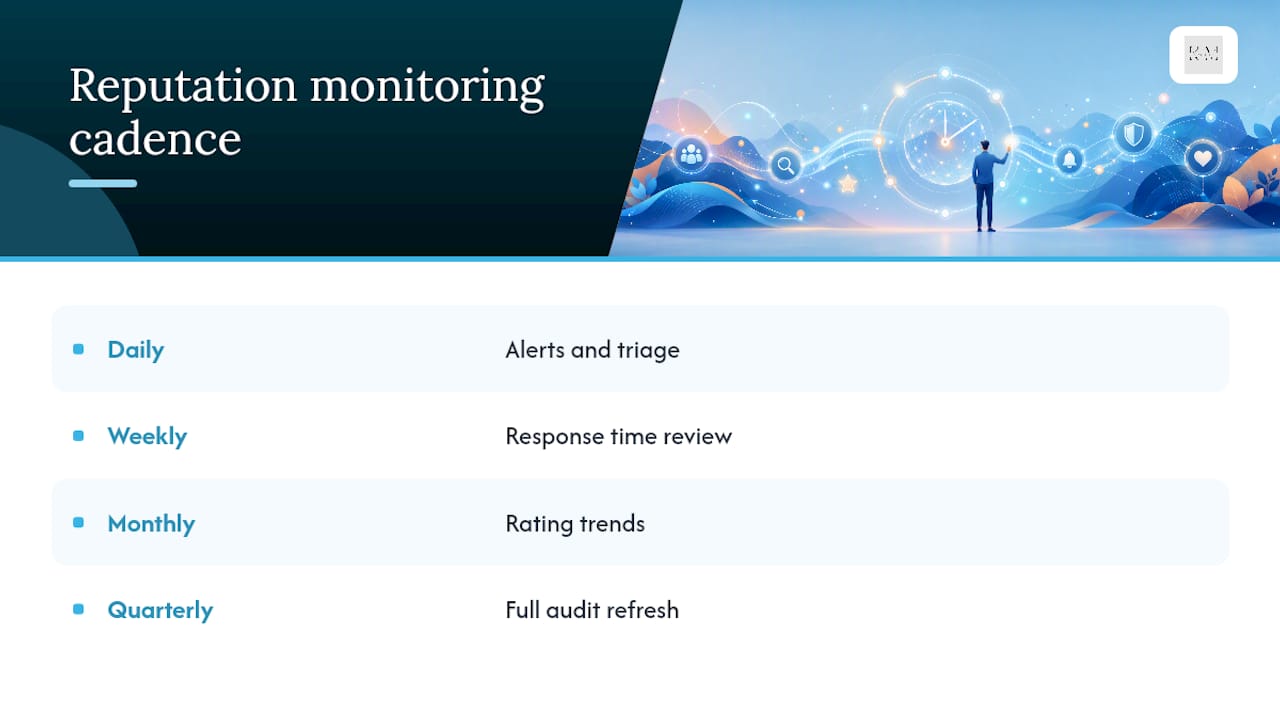
For cadence, run monitoring daily, triage daily, full response review weekly, remediation planning monthly, and a full audit refresh quarterly. Delegate the daily monitoring scan to a junior team member; keep escalation decisions with a named owner.
Which Tools Fit Each Stage of the Workflow?
Tool selection depends on scale, not preference. A single-location practice needs different coverage than a ten-location group.
| Workflow stage | Tool examples | Best fit |
|---|---|---|
| Broad web monitoring | Google Alerts | Free, basic coverage for any business |
| Social and blog monitoring | Mention | Small to mid-size teams tracking conversations |
| Enterprise listening | Brandwatch, Talkwalker, Meltwater | Multi-location or high-volume brands |
| Social management and response | Sprout Social | Teams handling frequent public replies |
| Review management | Trustpilot, Yelp, Google Business Profile | Any business collecting customer reviews |
Google Business Profile, Yelp, and Trustpilot each play a distinct role. Google Business Profile drives local search visibility, Yelp carries weight in service industries and hospitality, and Trustpilot is often the default for e-commerce and SaaS. Trustpilot also runs a formal flagging process for reviews that violate its guidelines, which matters when you’re dealing with fake or malicious content rather than genuine criticism.
Free versus paid comes down to volume. If you’re checking a handful of mentions a week, Google Alerts plus manual review checks cover it. Once mention volume climbs past what one person can track by hand, or you’re managing multiple locations, a paid listening platform earns its cost back in time saved. Check for source coverage, alert customization, CRM integrations, and reporting exports before committing to any platform, and read our guide on enhancing online presence for healthcare providers for more on building the owned assets that these tools help you protect.
What KPIs Should You Track for Reputation Health?
Reputation metrics split into leading indicators, which predict trouble before it shows up in revenue, and lagging indicators, which confirm what already happened. Response time and sentiment trend are leading. Average rating and churn are lagging.
Track these core metrics:
- Average rating by platform (Google, Yelp, Trustpilot)
- New review volume per week or month
- Response rate and average response time
- Sentiment trend across mentions
- Share of page-one search results you control
- AI answer accuracy when assistants are asked about your business
| Cadence | What to review |
|---|---|
| Daily | New mentions, urgent flags, response queue |
| Weekly | Response time average, sentiment shifts |
| Monthly | Rating trends by platform, review volume |
| Quarterly | Full audit refresh, page-one ownership |
Our piece on why online reviews matter in healthcare breaks down how these metrics tie directly to patient acquisition, worth a look if you want the conversion numbers behind the KPIs.
Who Owns Each Part of the Reputation Workflow?
Clear ownership stops the workflow from stalling when a decision needs to be made fast.
- Monitor owner checks alerts daily and routes items into the triage buckets.
- Responder drafts and posts public replies within the SLA for that severity level.
- Escalation lead approves anything above “moderate” severity and decides when legal or leadership needs to weigh in.
- Legal or HR touchpoint reviews any response involving a threat, defamation claim, or employment dispute before it goes public.
Approval rules should be simple: minor and moderate responses go out without sign-off if they follow the template; severe and crisis-level responses need escalation-lead approval first. Response tone rules should ban defensiveness and require every reply to acknowledge, apologize where warranted, and move specifics offline. New responders should shadow five real replies before posting solo, and every team member handling public responses needs a written copy of the escalation matrix on day one.
Pro Tip: Write your response templates before you need them. Trying to draft calm, on-brand language while a one-star review is actively going viral is how good businesses send bad replies.
How Do You Handle a Reputation Crisis?
A crisis, coordinated negative campaigns, safety allegations, or viral misinformation, needs a different playbook than a normal bad review.
- Detect and confirm. Verify the claim is real and understand its scope before responding to anything.
- Stand up a single source-of-truth page. PRSA’s guidance on crisis recovery recommends this as the anchor for verified facts, something you can point journalists and customers toward instead of chasing every comment thread.
- Assign a single spokesperson so messaging stays consistent across every channel.
- Preserve evidence of the original posts, screenshots, and timestamps in case legal involvement becomes necessary.
- Escalate to leadership or legal whenever the claim touches safety, defamation, or regulatory exposure. If it doesn’t, the escalation lead can usually manage it alone.
Businesses that skip the source-of-truth page tend to spend the first 72 hours reacting to rumors instead of controlling the narrative.
How Long Does It Take to See ORM Results, and What Does It Cost?
| Timeframe | What to expect |
|---|---|
| 7 days | Basic monitoring and alerts running |
| 30 days | Full operational cadence in place |
| 3 to 6 months | Meaningful page-one search changes |
| quarterly | Suppression of persistent negative content |
Cost ranges vary by approach. A DIY setup runs mostly on internal time plus a handful of tool subscriptions. A managed service retainer covers ongoing monitoring, response drafting, and reporting without hiring in-house staff. Enterprise tooling plus dedicated staff makes sense once you’re managing multiple locations or a high mention volume. Review volume, number of locations, and regulatory requirements all shift these numbers, a single clinic timeline looks nothing like a ten-location group’s.
How Does HIPAA Affect Reputation Management for Healthcare Providers?
Healthcare adds a layer most ORM guides skip entirely: patient privacy. A public reply that confirms someone was a patient, even in a defensive comment, can cross HIPAA lines fast.
Rules that keep responses compliant:
- Never confirm or deny a patient relationship in a public reply
- Never reference symptoms, treatment, or visit details online
- Move every specific complaint to a secure, offline channel
- Document every exchange in case of a later dispute
A safe template: “We take all patient feedback seriously and would appreciate the chance to discuss this privately. Please contact our office directly.” Nothing more specific belongs in public.
When vetting reputation vendors for a healthcare practice, confirm they understand HIPAA-safe response language, that they won’t publish patient details in case studies without consent, and that their reporting tools don’t store protected information insecurely. Our guide to digital reputation management for healthcare covers this in more depth, and Boss Healthcare’s piece on back-end systems is worth reading if your reputation workflow needs to connect with broader operational infrastructure.

Pro Tip: Train every front-desk and support staffer on the “never confirm patient status publicly” rule. Most HIPAA slip-ups in reputation management happen from a well-meaning employee trying to be helpful, not a malicious leak.
What I’ve Learned Running ORM Engagements
Speed beats perfection on responses; a fast, imperfect reply outperforms a polished one that arrives three days late. Leading indicators matter more than owners think, response time predicts trouble before ratings ever drop. And the biggest mistake I see is teams fixing the reply instead of the root cause behind it, which just guarantees the same complaint returns next month.
Get a Compliance-Ready Reputation Workflow Built for Healthcare
Klyrmedia is the alternative to piecing together generic listening tools and hoping they’re HIPAA-safe, we build reputation workflows specifically for healthcare providers, where every response template, review request, and vendor integration is designed around patient privacy from the start.
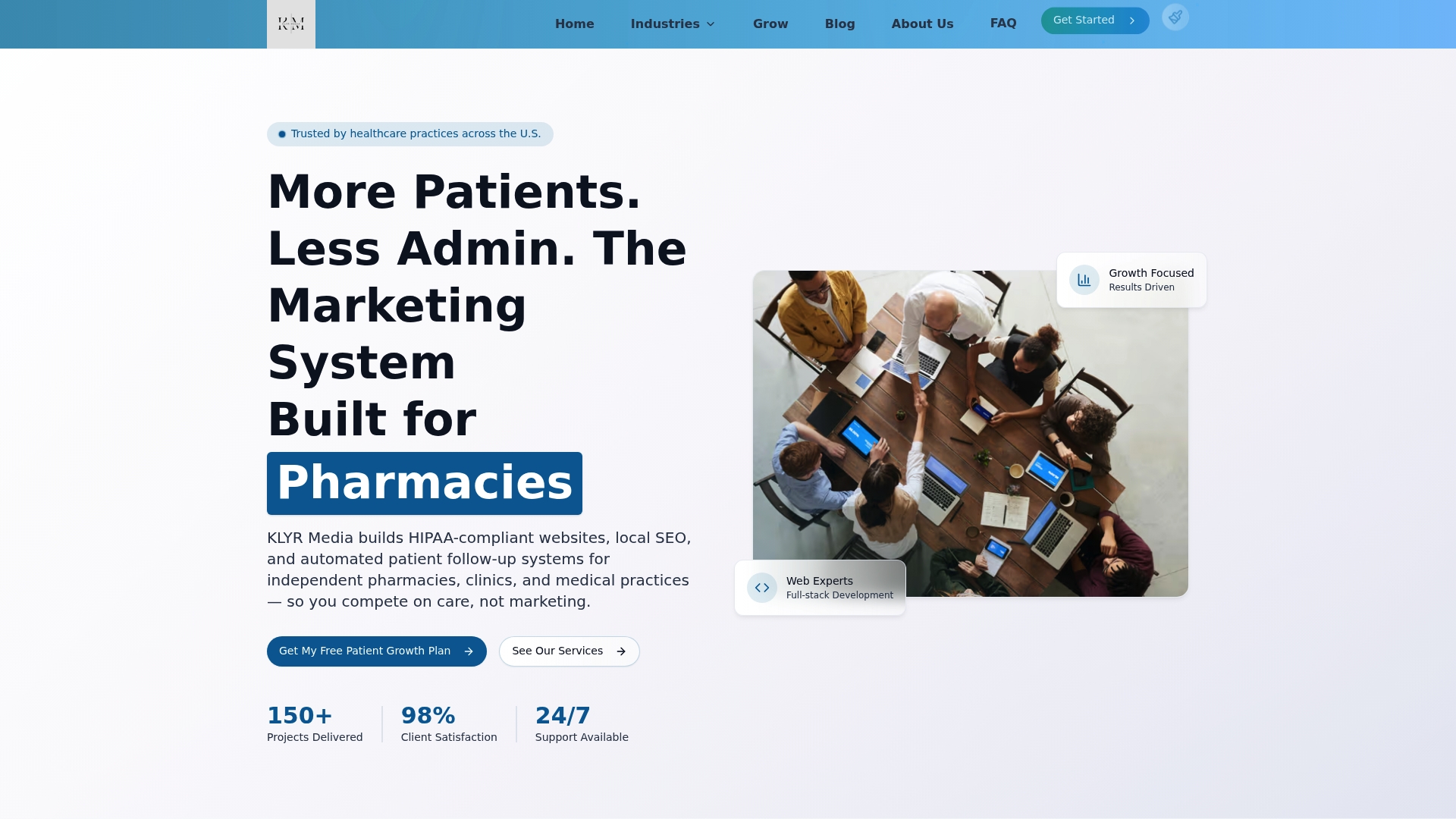
The onboarding path is straightforward: an audit of your current search, review, and social presence, a plan mapped to your specific risk areas, implementation of monitoring and response systems, and ongoing measurement against the KPIs that matter for patient acquisition. For clinics and independent pharmacies, this often pairs with a medical clinic solution built to connect reputation data with patient communication systems already in place. If you’re managing more than one location, the same framework scales through our medical facilities solutions.
Start with a HIPAA-compliant website audit to see exactly where your current setup exposes risk, and where it’s already working in your favor.
Frequently Asked Questions
What’s the fastest way to start an online reputation management workflow? Set up Google Alerts and one social listening tool within a day, assign a single owner to check them daily, and write a basic response template before you need one. That covers the first week.
How often should a business monitor its online reputation? Daily for alerts and triage, weekly for response time review, monthly for rating trends, and quarterly for a full audit refresh. Skipping the daily check is where most reputation problems start compounding unnoticed.
Can you remove a fake or malicious review? Platforms like Trustpilot have a formal process for flagging reviews that violate their guidelines, and it’s worth using instead of arguing publicly. Legitimate negative reviews, even harsh ones, generally can’t be removed and should be addressed with a response instead.
How much does professional reputation management cost? It depends heavily on scale. A DIY approach costs mainly staff time plus tool subscriptions, while a managed retainer or enterprise setup with dedicated staff costs more but frees up internal capacity, particularly useful for multi-location healthcare operations.
Is it a HIPAA violation to respond to a negative Google review? Not if you respond generically without confirming the patient relationship or referencing treatment details. The violation risk comes from specifics, not from responding at all.
Sources
- Reputation management
- Guide to reputation management
- Online Reputation Management Strategy: A 2026 Playbook - LucidRank
- How to Monitor Online Reputation: A Step-by-Step Playbook | RepErase
- Reputation recovery after a crisis: long-term strategies

