
How to Create Engaging Content: Hooks, Workflow & Platform Playbook
Unlock the secrets of creating engaging content with this 8-step checklist, designed to boost interaction and captivate your audience.

How to Create Engaging Content: Hooks, Workflow & Platform Playbook

Use this 8-step checklist to create content that stops the scroll and sparks real interaction — right now, on any platform.
- Hook first: Write your opening line before anything else (Later’s research confirms the first second decides everything)
- Match your audience: Know exactly who you’re writing for and what they actually want
- Pick the right format: Short video, carousel, long-form, or email — each serves a different behavior
- Build a story: Situation → complication → turnaround, even in 15 seconds
- Add visuals: Lighting, framing, and thumbnails move the needle on watch time
- Work a system: Shot lists, batch filming, and an editorial calendar replace creative sprints
- End with a CTA: Every piece needs a clear next action
- Measure and iterate: Track KPIs with tools like Hootsuite and YouTube Studio, then adjust
That’s the whole game. Everything below is how you execute each step.
Key Takeaways
Creating engaging content comes down to one discipline: write the hook first, build a repeatable workflow around it, and measure what actually moves your KPIs.
| Point | Details |
|---|---|
| Hook before everything | Write three hook variations before scripting or filming; the first second decides watch time. |
| Map content to goals | Every piece needs an audience segment, a content goal, and a primary KPI before production starts. |
| Four-pillar calendar | Plan content across educate, entertain, inspire, and promote pillars for variety and predictable outcomes. |
| Compliance is a production step | For healthcare, build HIPAA guardrails into the workflow: no PHI, documented consent, legal review for patient stories. |
| Klyrmedia for healthcare systems | Klyrmedia provides HIPAA-compliant content, patient follow-up automation, and performance reporting for U.S. healthcare practices. |
Table of Contents
- What “engaging content” really means — and why it pays
- How to research your audience and map every idea to a goal
- How to craft scroll-stopping hooks and headlines that earn attention
- How to choose the right format for each platform and audience
- How storytelling and a clear brand voice build loyalty, not just views
- Production fundamentals that improve watch time and shareability
- A repeatable workflow: write the hook first, then build everything else
- How to write CTAs that drive action and repurpose content across platforms
- How to measure engagement and run experiments that actually improve results
- Engaging content in regulated industries: compliance, trust, and HIPAA guardrails
- Interactive content formats that pull audiences in deeper
- Emotional triggers and psychological principles that make content stick
- Using data and analytics to adjust content in real time
- How to build a community around your content, not just an audience
- The part most healthcare marketers get wrong about engagement
- Klyrmedia builds content systems that work for healthcare practices
- Sources
What “engaging content” really means — and why it pays
Engagement is not a vanity metric. It’s a set of measurable behaviors: a viewer watches past the 3-second mark, a reader scrolls to the bottom, someone shares a post to their story, saves a carousel for later, clicks a link, or books an appointment. Each behavior signals a different level of intent, and each one feeds a different part of your growth engine.
Watch time and scroll depth tell you whether your hook and format are working. Shares and saves signal that the content is genuinely useful or emotionally resonant. Comments open a conversation. Conversions close one. NYT Licensing’s foundational tactics treat audience focus, authenticity, and storytelling as table stakes for any publication that wants readers to return.
Why this matters for reach: Most platforms use engagement signals to decide who sees your content next. A post with strong early saves and shares gets pushed to a wider audience. One that gets scrolled past gets buried. Engagement is the mechanism that turns one piece of content into compounding organic reach.
The business case is straightforward. Higher engagement rates mean lower paid-distribution costs, stronger organic reach, better email open rates, and more patient or customer appointments booked without spending more on ads. Copyblogger’s playbook puts it plainly: strong headlines, concise copy, and explicit asks for engagement translate directly into higher interaction rates.
How to research your audience and map every idea to a goal
Most content misses because the creator skipped this step. They had a good idea, made the thing, and hoped the right people would find it. That’s not a strategy. That’s a lottery ticket.
Audience research techniques that actually work:
- Social listening: Search your topic on Reddit, Facebook Groups, and the comments section of top-performing posts in your niche. The exact phrases people use are your hook vocabulary.
- Keyword intent mapping: Use Google Search Console or a tool like Semrush to find what questions your audience is already asking. Group them by intent: informational, navigational, commercial.
- Comment mining: Pull the top 20 comments on competitor posts or YouTube videos in your space. Recurring complaints and questions are content briefs hiding in plain sight.
- Micro-segmentation: Don’t write for “healthcare professionals.” Write for the independent pharmacy owner who’s losing patients to a chain down the street. Specificity converts.
An audience-first approach — listening to community language and search intent — lets you craft curiosity-provoking questions that open the attention loop before the reader even clicks.
Mini-template: map every idea before you produce it
| Audience segment | Content goal | Primary KPI |
|---|---|---|
| Independent pharmacy owner | Build trust, drive foot traffic | Return visits, appointment clicks |
| Healthcare practice manager | Educate on compliance | Time on page, email sign-ups |
| General patient | Inform, reduce anxiety | Shares, saves, comments |
Prioritize ideas by two axes: impact (how much it moves your KPI) and effort (how long it takes to produce). Quick wins are high-impact, low-effort. Strategic pillars take longer but compound over time. Build both into your calendar.
How to craft scroll-stopping hooks and headlines that earn attention
The hook is not the intro. It’s the reason someone stays. Later documents that scroll-stopping content earns attention in the first second, and the teams that win consistently write the hook before the script or caption, not after.
The five hook types that perform in 2026:
- Curiosity gap: “The one thing most pharmacies get wrong about patient retention.”
- Contrarian: “Stop asking patients to leave reviews. Here’s what works instead.”
- Story mid-action: “I was three days from closing the clinic when this happened.”
- How-to with a specific outcome: “How to fill 12 more appointments a month without running a single ad.”
- Social proof: “This is the exact system three independent pharmacies used to cut patient churn by a third.”
Platform notes:
- TikTok and Reels: Lead with the contrarian or mid-action hook. Text overlay in the first frame. No slow build.
- YouTube Shorts: How-to with a specific outcome works best. State the result in the first 2 seconds.
- LinkedIn: Curiosity gap and social proof outperform. Open with a single short sentence, then a line break.
- Static carousels: The cover slide is the hook. Treat it like a headline, not a title.
Fill-in-the-blank hook templates:
- “Why [common belief] is costing you [specific loss].”
- “Here’s what happened when [subject] tried [action] for [time period].”
- “Nobody talks about [overlooked topic] — but it’s the reason [outcome].”
- “If you’re a [audience], you’ve probably been told [wrong advice]. Here’s the truth.”
- “The [number]-step system that [specific result] without [common objection].”
The Dopamine Ladder framework maps six attention stages: stimulation, captivation, anticipation, validation, affection, and revelation. Your hook handles stimulation. Every subsequent beat should move the viewer one rung up, not reset the clock.
Pro Tip: Use an AI tool like ChatGPT or Claude to generate 10 hook variations from a single brief, then filter for the one that sounds most like your voice. The goal is speed of ideation, not outsourcing your tone.
How to choose the right format for each platform and audience
Format is not a creative preference. It’s a strategic decision based on where your audience is, what behavior you want, and how much production time you can afford.
Format decision guide:
- Short video (under 60 seconds): Best for awareness, emotional resonance, and algorithm reach. Works on TikTok, Reels, and Shorts. Low barrier to entry; high volume needed.
- Long-form video (5–20 minutes): Best for trust-building, education, and SEO on YouTube. Requires more production but compounds over time through search.
- Carousels: Best for saves and shares on Instagram and LinkedIn. Teach a process, list a framework, or tell a before/after story across slides.
- Blog posts: Best for organic search, long-tail keywords, and converting warm traffic. Pair with internal links and a clear CTA.
- Email: Best for retention and direct conversion. Works hardest when it feels personal, not broadcast.
Platform-specific adaptation notes:
- TikTok: Hook in frame one. Captions on screen. 15–60 seconds for most content. Trending audio helps early distribution.
- Instagram Reels: Instagram’s creators guidance emphasizes accessibility features — captions, timed text, and image descriptions — to improve reach. Use them every time.
- YouTube Shorts: State the payoff in the first 2 seconds. Vertical format. No intro music.
- LinkedIn: One-sentence opener, line break, then the meat. Long captions work here when they’re personal and specific.
- Blog posts: Lead with the answer. Use H2s and bullets for scannability. Internal links keep readers on-site.
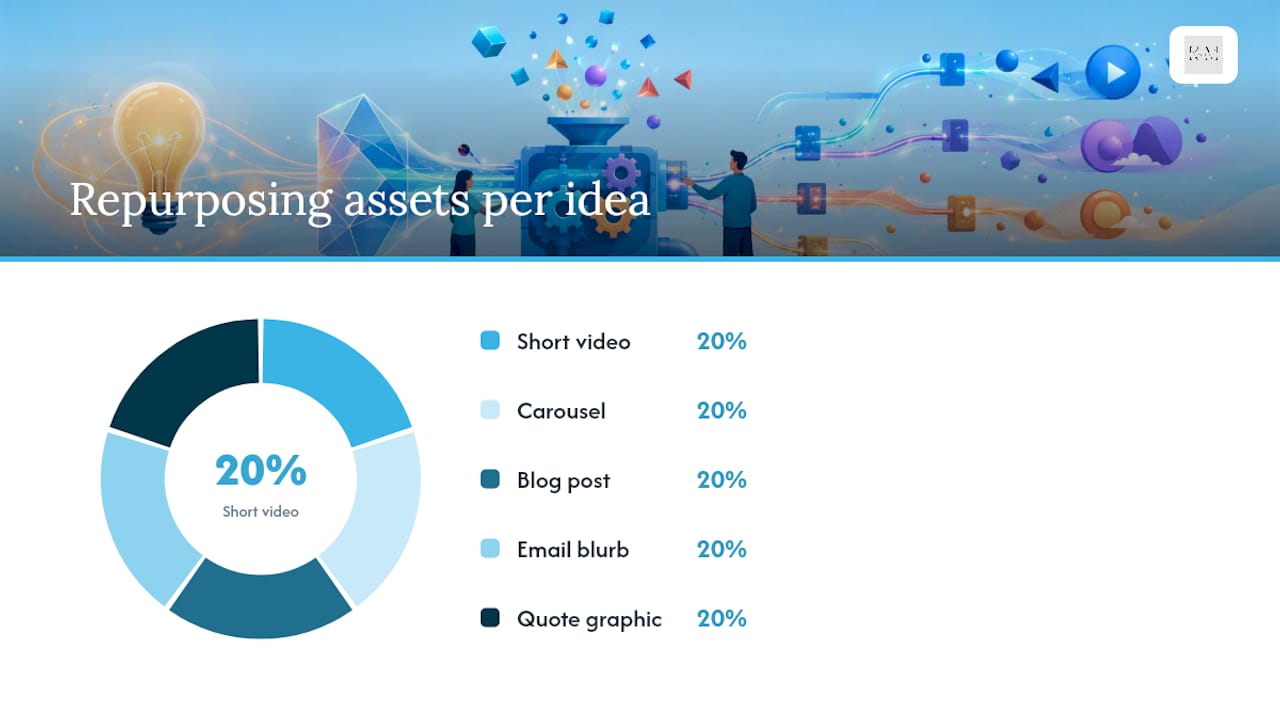
Repurposing checklist — one idea, five assets:
- Core short video (TikTok/Reels/Shorts)
- Carousel version of the same framework (Instagram/LinkedIn)
- Blog post expanding the concept with data and examples
- Email blurb linking to the blog or video
- Quote graphic or static post pulling one line from the video
How storytelling and a clear brand voice build loyalty, not just views
Information alone doesn’t make people come back. Story does. The simplest structure for short-form content is three beats: situation, complication, turnaround. “A patient hadn’t refilled their prescription in six months. The pharmacy had no system to follow up. One automated text brought them back.” That’s a story. It takes four seconds to tell and it sticks.
Authenticity doesn’t mean oversharing. It means being specific where others are vague. Instead of “we care about our patients,” say “we call every patient by name and we remember their kids’ names too.” Specificity is the mechanism that makes a brand voice feel human rather than corporate.
Voice guardrails that keep you consistent:
- Pick three words that describe your brand’s personality and check every post against them.
- Write the way you talk. Read it aloud before you publish.
- Avoid hedging language (“we think,” “maybe,” “sort of”) — it signals uncertainty and erodes trust.
- Don’t chase every trend. Participate in the ones that fit your voice, skip the ones that don’t.
NYT Licensing’s approach treats authenticity and storytelling as non-negotiable for publishers who want readers to return. The same principle applies to a healthcare practice posting on Instagram as it does to a major newsroom.
Mini story templates you can build out:
- The mistake post: “We got this wrong for two years. Here’s what we learned.”
- The behind-the-scenes post: “Here’s what actually happens when you call our pharmacy.”
- The patient win post (anonymized): “A patient came in frustrated. Here’s how we fixed it.”
Production fundamentals that improve watch time and shareability
You don’t need a studio. You need three things: clean audio, decent light, and a stable frame. Everything else is a bonus.
- Audio first. Bad audio kills watch time faster than bad video. A $30 lapel mic beats a $500 camera with no mic every time.
- Natural light or a ring light. Face a window or use a ring light at eye level. Avoid overhead lighting — it creates shadows that read as low-quality.
- Stable framing. A tripod or phone mount costs less than $20 and removes the amateur feel of shaky footage.
- Thumbnails for video. Copyblogger recommends thumbnails as a direct driver of click-through rate. Use a clear face, high contrast, and minimal text (under five words).
- Captions on every video. Instagram’s guidance is explicit: captions and timed text improve both accessibility and algorithmic reach. Most viewers watch without sound.
- Shot framing. For talking-head content, eyes at the upper third of the frame. For product or process content, shoot from slightly above to show context.
Pro Tip: Film near a window in the morning or late afternoon for the most flattering natural light. Overcast days are ideal — no harsh shadows, no squinting.
A repeatable workflow: write the hook first, then build everything else
The biggest reason content output stalls is that creators start in the middle. They open a blank document, stare at it, and try to write the whole thing at once. The fix is a production system, not more motivation.
- Ideation: Pull from your comment mining, keyword research, and content pillars. Aim for 10–15 ideas per session.
- Hook first: Write three hook variations before you write anything else. Later’s workflow guidance is clear on this: the hook comes before the script, before the caption, before the shot list.
- Script or outline: For video, write a tight script (or bullet outline) under the hook. For blog posts, write the H2 structure before the body copy.
- Shot list: For every video, fill in these fields: frame description, spoken line, visual cue, deliverable (TikTok, Reel, Short), platform. This turns a vague idea into a filmable brief.
- Batch filming: Group all talking-head content into one session. Group all B-roll into another. Batching cuts setup time by more than half.
- Edit variants: From one filming session, cut a 15-second version, a 60-second version, and a 3-minute version. Three assets, one shoot.
- Schedule: Use a tool like Hootsuite to schedule posts across platforms. Hootsuite’s four-pillar approach — educate, entertain, inspire, promote — gives your calendar variety and predictable business outcomes. Aim for a roughly 40/30/20/10 split across those pillars.
How to write CTAs that drive action and repurpose content across platforms
A piece of content without a CTA is a conversation that ends with no next step. You’ve earned the attention. Use it.
CTA formulas by goal:
- Comment prompt: “What’s the one thing your pharmacy does that patients always mention? Drop it below.”
- Save/share prompt: “Save this if you’re planning your content calendar this week.”
- Click-to-learn: “Full breakdown linked in bio.”
- Newsletter sign-up: “We send one practical tip every Tuesday. Link in bio to subscribe.”
- Appointment booking: “Ready to talk about your pharmacy’s digital presence? Book a free call at the link below.”
Match the CTA to the intent of the content. An educational post earns a save or a follow. A case study earns a booking. A behind-the-scenes post earns a comment. Mismatching CTA to intent is one of the most common reasons engagement drops at the conversion step.
Repurposing framework — one core idea into four assets:
- Short video (TikTok/Reels/Shorts): the hook + the core point + a comment CTA
- Carousel (Instagram/LinkedIn): the same framework broken into 5–7 slides with a save CTA
- Blog excerpt (website): 300–500 words expanding the concept with data and internal links
- Email blurb (newsletter): 100–150 words linking to the blog or video with a click-to-learn CTA
How to measure engagement and run experiments that actually improve results
Measurement without a framework is just data collection. You need to know which KPI maps to which goal before you look at a single number.
| KPI | What it measures | Goal it maps to |
|---|---|---|
| Watch time / scroll depth | Hook and format quality | Awareness, reach |
| CTR | Headline and CTA strength | Traffic, conversions |
| Shares and saves | Perceived value and utility | Organic reach, loyalty |
| Comments | Community resonance | Engagement depth |
| Return visitors | Content loyalty | Retention |
| Appointment clicks | Direct conversion | Revenue |
Experiment checklist:
- Change one variable at a time: hook type, caption length, thumbnail, or posting time.
- Run each test for at least 7–10 posts before drawing conclusions. Single-post results are noise.
- Track the specific KPI that maps to your goal, not every metric at once.
- When a variation wins, document it in your content brief template and make it the new default.
- Apply learnings to your editorial calendar in the next planning cycle.
Simple A/B tests to start with: test a curiosity-gap hook against a how-to hook on the same topic. Test a caption with a question CTA against one with a save prompt. Small experiments compound into a content system that gets measurably better every month.
Engaging content in regulated industries: compliance, trust, and HIPAA guardrails
Healthcare content has one constraint that most niches don’t: a compliance floor. HIPAA doesn’t prevent you from creating engaging content. It just means you build guardrails into the production process from the start.
Core compliance guidelines for healthcare content creators:
- Never include protected health information (PHI) in public-facing content — no patient names, photos, or identifiable details without documented written consent.
- Use consented testimonials only. Document the consent form, the date, and the specific use case before publishing.
- Consult your legal or compliance team before publishing any patient story, even an anonymized one.
- Avoid specific medical claims that could be read as clinical advice unless reviewed by a licensed clinician.
How to translate platform-native hooks into compliance-safe formats:
- Replace real patient stories with hypothetical scenarios: “Imagine a patient who hasn’t refilled in 90 days…”
- Use anonymized case studies: “A pharmacy in the Midwest reduced patient churn by changing one follow-up message.”
- Frame educational content around general health information, not individual diagnoses or treatment plans.
For deeper guidance on building content that converts without crossing compliance lines, Klyrmedia’s compliance-first content guide covers the specific production and review steps healthcare practices need.
Pro Tip: Before publishing any video featuring staff or patients, run it through a private test audience (a closed Facebook Group or an unlisted YouTube link) to catch any inadvertent PHI before it goes public. Build an audit trail: screenshot the review, log the date, and note who approved it.
Interactive content formats that pull audiences in deeper
Polls, quizzes, and live streams do something passive content can’t: they make the audience a participant. That shift in role changes the psychological relationship between creator and viewer.

Polls are the lowest-friction interactive format. A two-option Instagram Story poll (“Which would help your pharmacy more: more foot traffic or better patient retention?”) takes 30 seconds to create and generates both engagement data and audience insight you can use in future content. LinkedIn polls work similarly for B2B audiences.
Quizzes work best as lead-generation tools. A short quiz (“Is your pharmacy’s digital presence costing you patients?”) with a results page linked to a booking form converts curious visitors into warm leads. Tools like Typeform and Interact make this buildable in under an hour.
Live streams on Instagram, TikTok, or YouTube create real-time urgency that recorded content can’t replicate. The comment section during a live is one of the richest sources of audience research you’ll find. Ask a question in the first two minutes and let the comments answer it. That’s both engagement and a content brief for next week.
TNGlobal’s research recommends interactive formats like quizzes and polls specifically for increasing dwell time and driving return visits. The mechanism is simple: participation creates investment, and investment creates loyalty.
Emotional triggers and psychological principles that make content stick
People share content for emotional reasons, not informational ones. Understanding which emotions drive which behaviors lets you engineer content that spreads.
The emotions that drive sharing: awe, amusement, anxiety, and anger consistently produce the highest share rates. Awe and amusement are the most sustainable for brand content because they build positive associations. Anxiety and urgency work for conversion-focused content but erode trust if overused.
Psychological principles worth applying:
- Social proof: People follow what others in their situation have done. A specific number (“over 200 independent pharmacies”) outperforms a vague claim (“many pharmacies”) every time.
- Loss aversion: Framing a benefit as something you’ll lose by not acting tends to outperform framing it as a gain. “Don’t lose another patient to the chain down the street” lands differently than “Gain more patients.”
- Curiosity gap: The brain dislikes unresolved questions. Open a loop in your hook and close it at the end. The Dopamine Ladder framework maps this as the progression from stimulation through to revelation — each stage keeps the viewer one rung higher on the attention ladder.
- Reciprocity: Give something genuinely useful before you ask for anything. A free checklist, a practical tip, or a real answer to a hard question builds the goodwill that makes a CTA feel natural rather than pushy.
Using data and analytics to adjust content in real time
Most creators check analytics once a month, if at all. The ones who improve fastest check weekly and act on what they find within the same content cycle.
Real-time data doesn’t mean reacting to every post. It means watching for patterns. If three consecutive posts with curiosity-gap hooks outperform your average, that’s a signal. If carousel saves are climbing while video views are flat, your audience is telling you something about format preference.
Practical real-time adjustments:
- Within 24 hours of posting: Check early engagement rate (likes + comments + saves divided by reach). If it’s significantly below your average, boost the post with a comment to restart the algorithm signal.
- Weekly: Review which content pillar (educate, entertain, inspire, promote) is driving the most saves and shares. Shift next week’s calendar toward the winning pillar.
- Monthly: Pull watch time and scroll depth data. If drop-off happens at the same point in multiple videos, your hook is working but your mid-content is losing them. Fix the structure, not the hook.
Tools like Hootsuite’s analytics dashboard, YouTube Studio, and Instagram Insights give you this data without needing a separate analytics platform. The goal is a feedback loop: post, measure, adjust, repeat. Klyrmedia’s healthcare SEO and performance reporting applies this same loop to patient-facing content, tracking appointment clicks and return visits alongside standard engagement metrics.
How to build a community around your content, not just an audience
An audience watches. A community participates. The difference is whether people feel like they belong to something or just consume it.
Comment management as a growth lever: Responding to every comment in the first hour after posting signals to the algorithm that the post is generating conversation. More practically, it signals to the commenter that a real person is on the other side. That feeling of being heard is what turns a one-time viewer into a regular.
Forum and group strategies: For healthcare practices, a private Facebook Group for patients or a LinkedIn Group for local healthcare professionals creates a space where your content lives beyond the feed. Post your best educational content there first, then repurpose it publicly. Members feel like insiders.
Community-building tactics that compound:
- Ask a genuine question at the end of every post. Not “what do you think?” but “What’s the one thing your pharmacy does that patients always mention to their friends?”
- Feature community members. A comment that adds real value deserves a reply that quotes it and expands on it. That person becomes an advocate.
- Create a recurring content series. A weekly “pharmacy tip Tuesday” or “patient story Friday” gives your audience a reason to come back on a schedule.
The audience-first research approach that drives better content also drives better community. When you use the language your audience uses, they recognize themselves in your content and feel like it was made for them specifically.
The part most healthcare marketers get wrong about engagement
Here’s what we’ve seen working with independent pharmacies and healthcare practices: the engagement problem is rarely a creativity problem. It’s a system problem. Practices that struggle with content output are usually trying to create from scratch every week, with no hook library, no shot list, no pillar framework, and no measurement loop.
The tactics in this guide work. But they only compound when they’re built into a repeatable workflow. A pharmacy that batches one filming session a month, writes hooks before scripts, and checks analytics weekly will outperform a larger competitor that posts inconsistently and never tests anything.
The compliance layer adds friction, but it doesn’t have to kill creativity. Hypothetical scenarios, anonymized case studies, and educational content framed around general health information can be just as engaging as a raw patient story. Sometimes more, because the audience can see themselves in the scenario rather than someone else’s specific situation.
The gap between knowing these tactics and executing them consistently is where most healthcare content stalls. That gap is a workflow problem, and workflow problems have solutions.
Klyrmedia builds content systems that work for healthcare practices
Healthcare content has higher stakes than most niches. A post that violates HIPAA isn’t just an engagement miss — it’s a liability. Klyrmedia works specifically with independent pharmacies, medical clinics, and healthcare practices across the United States to build content and digital marketing systems that are both patient-facing and compliance-ready.
The services map directly to what this guide covers: HIPAA-compliant website design that supports your content strategy without exposing PHI, patient follow-up automation that turns your CTAs into booked appointments, and content strategy built around the educate/entertain/inspire/promote pillars with measurable KPIs tied to patient volume. If you’re ready to stop creating content ad hoc and start running a system that compounds, reach out to Klyrmedia for a free strategy call.
Sources
- Create engaging & effective social media content
- Scroll-stopping content earns attention in the first second (Later Hooks Guide)
- Create Engaging Content - Instagram for Creators
- How To Create Engaging Content In 2024 - Copyblogger
- The Dopamine Ladder: Why Nobody Watches & Reads Your Content (How to Fix It)
- How to Create Engaging Content that Ranks: 6 Expert Steps - Engaging Content; Websites, Content, SEO

